
Why Does Shotcrete Bounce Off the Wall? Rebound Causes, Fixes, and Full-Face vs Bench Cut Tunnelling
- Full-face excavation removes the top heading and bench at once and suits small sections in self-supporting ground.
- Bench cuts advance an upper heading and lower bench together: 50 m or more is a long bench, 20 to 30 m a short bench.
- Shotcrete rebound falls when you control spray angle and distance, nozzleman skill, aggregate, cement content and accelerator.
Contents
Shotcrete rebound is the share of sprayed concrete that bounces off a tunnel wall instead of sticking to it, and it is one of the most expensive invisible losses on any underground job. Every clump that lands on the invert has already been batched, pumped and dosed with accelerator, and then it has to be mucked out and hauled away. This guide walks through how a tunnel construction plan fits together, when engineers choose full-face excavation or a bench cut, and the practical levers that cut rebound, with examples from US and UK practice, ACI and EFNARC guidance, and projects such as Crossrail and the Gotthard Base Tunnel.
What goes into a tunnel construction plan?
A tunnel plan is usually broken into a chain of work packages: preparatory works, portal construction, excavation, muck handling, monitoring, installation of ground support, waterproofing and drainage, and finally the permanent concrete lining. At planning stage the team also tries to protect the surrounding environment, minimise cut-and-fill earthworks, and set up emergency and disaster-response facilities before the first round is fired.
Student money tip from CampusDown Law UpA Window in My Apartment Cracked. Is the Bill Coming to Me? — Apartment window cracked or broken and you're scared of the bill?
In the UK, that planning sits inside the Construction (Design and Management) Regulations, and on US federal projects inside OSHA's underground construction standard. Both push the same idea: hazards are cheapest to remove on paper, long before a crew is standing under unsupported rock.
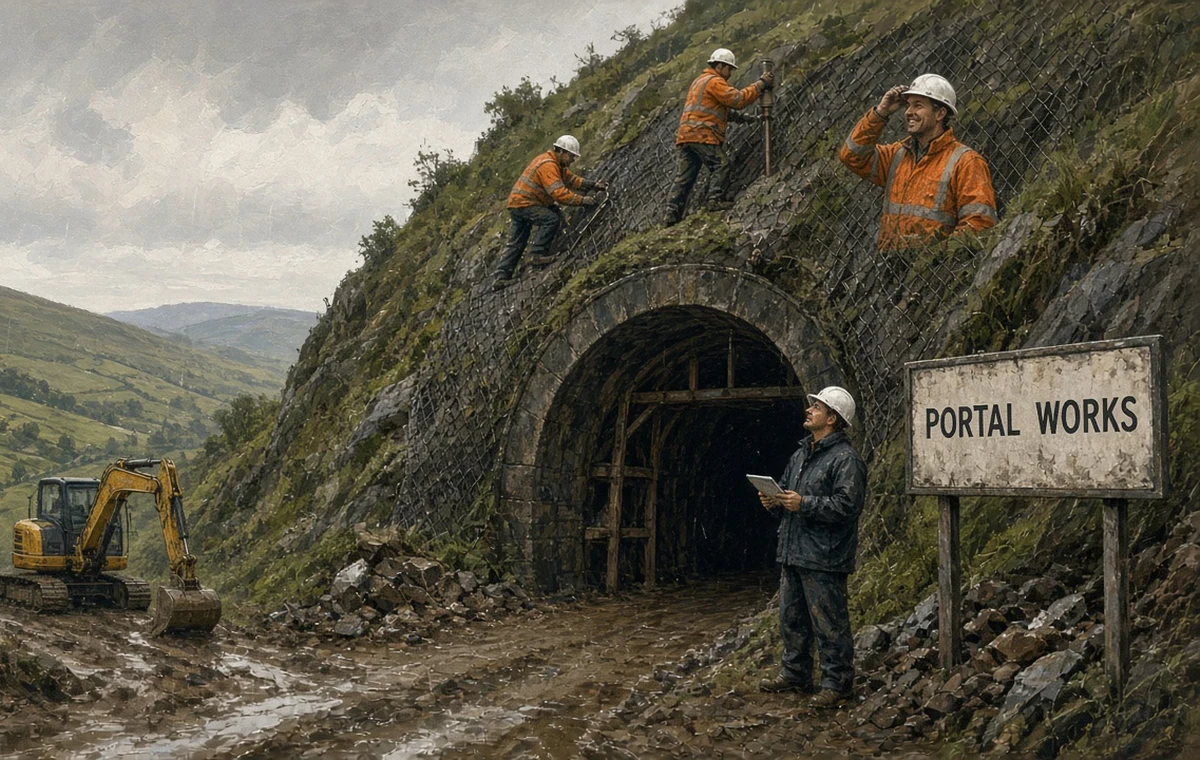
The portal deserves special attention. Before excavation begins, engineers check that the slope above the entrance will not slip, and they assess how rainwater could flood the opening or trigger a landslide. Mesh, rock bolts and a first coat of shotcrete on the portal face are often the very first permanent works on site.

When is full-face excavation the right choice?
The excavation method depends on the size of the cross-section, the tunnel length, the ground and site conditions, and the programme. Full-face excavation removes the top heading and the bench in a single operation. It suits smaller cross-sections, or ground that can stand on its own long enough to install support.
The advantages are big equipment and a single working face that is simple to manage. The weakness is flexibility: if the geology suddenly worsens, a large open face is hard to stabilise quickly. That is why weak or mixed ground is usually excavated in stages.
This logic is at the heart of the New Austrian Tunnelling Method, developed in the 1960s, which treats the surrounding rock as part of the support system and uses quick, flexible shotcrete linings plus monitoring rather than heavy rigid supports. Drill-and-blast with NATM-style sprayed support remains common in hard rock, while tunnel boring machines dominate long, uniform drives.
The choice is rarely all-or-nothing. On Switzerland's 57-kilometre Gotthard Base Tunnel, opened in 2016, most of the length was bored by machine, but several sections and the multifunction stations relied on drill-and-blast with sprayed concrete support.
Skimming the section headings first makes a long guide much easier to map out. Try writing down one question of your own as you read.
How do long bench and short bench cuts differ?
A bench cut splits the face into an upper heading and a lower bench, separated by a step, and advances both together. The worse the ground, the sooner the ring has to be closed, so the shorter the bench.
| Method | Bench length | When it is used |
|---|---|---|
| Long bench cut | 50 m or more | The face cannot stand unsupported, but the ground is relatively stable |
| Short bench cut | 20 to 30 m | Geology varies and the support ring must be closed early |
| Full face | No bench | Small sections or self-supporting rock |
London's Crossrail project used sprayed concrete linings extensively for station caverns, platform tunnels and cross-passages, where staged headings and early ring closure kept settlement of the buildings above under tight control. It is a good reminder that bench length is as much about protecting neighbours as protecting the crew.
Why does shotcrete rebound happen?
Shotcrete is concrete pneumatically projected onto a surface. In a tunnel it seals freshly exposed rock, stops loosening and small falls, and keeps the cycle moving to the next round. Material that fails to stick and bounces back is called rebound. The more rebound, the higher the cost, and because rebound is richer in coarse aggregate, it also changes the mix that does stay on the wall.
Rebound is never down to the accelerator alone. Spray angle and distance, the nozzleman's skill, aggregate size, cement content, sand ratio and layer thickness all interact.
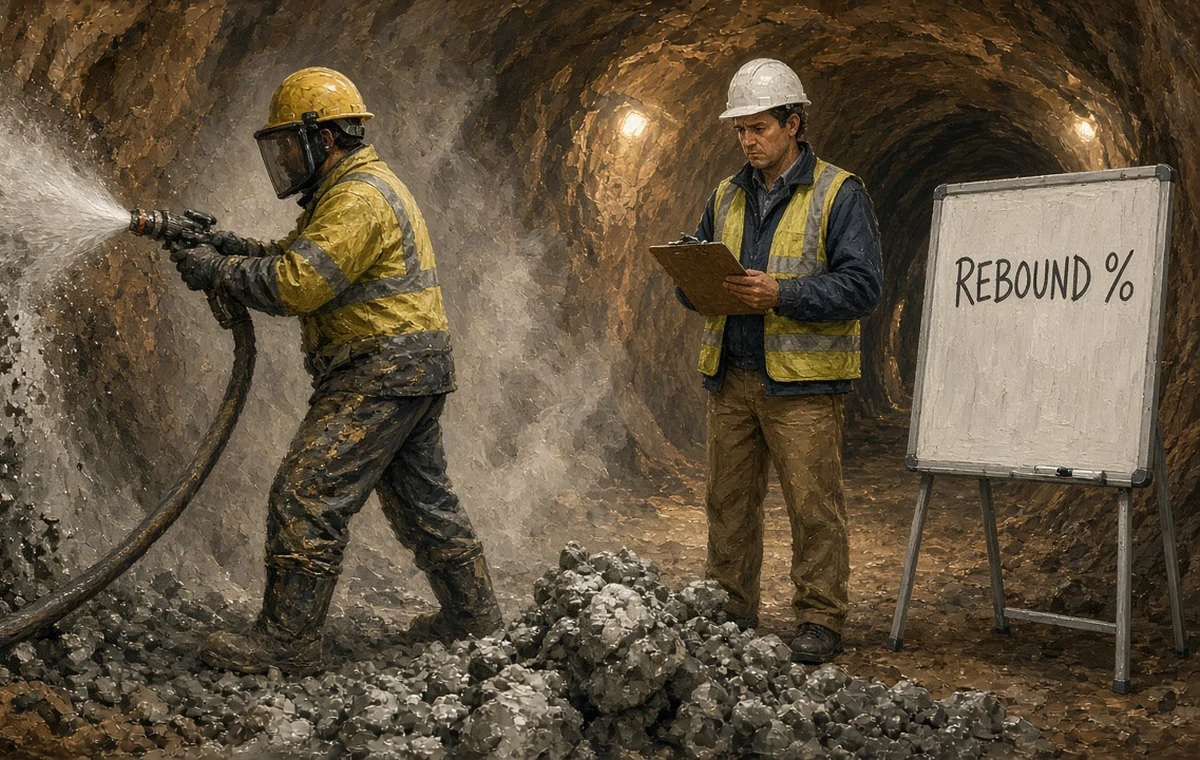
The choice between dry-mix and wet-mix spraying matters too. The comparison below reflects general industry experience reported in ACI 506 guidance and the European EFNARC specification for sprayed concrete.
| Factor | Dry-mix | Wet-mix |
|---|---|---|
| Where water is added | At the nozzle | At the batching plant |
| Typical rebound | Higher, especially overhead | Noticeably lower |
| Dust | More dust at the face | Less dust |
| Output | Lower, flexible for small jobs and repairs | High, suited to robotic spraying arms |
| Quality control | Depends heavily on the nozzleman | Water-cement ratio fixed in the plant |
That is why most large modern tunnels in the US and UK spray wet-mix with a manipulator arm, and why certification schemes such as the ACI shotcrete nozzleman program exist: the skill of the person at the nozzle still decides how much concrete ends up on the floor.
How can rebound be reduced on site?
- Spray at right angles to the surface and keep air pressure steady.
- Hold the nozzle about 1 m from the receiving surface.
- Cement content: 350 to 400 kg/m³ for concrete, 400 to 600 kg/m³ for mortar.
- Maximum coarse aggregate 15 mm or less, fine aggregate fineness modulus 2.8 to 3.2.
- Accelerator 2 to 5%, rising to 7 to 8% where groundwater is flowing.
- Water-cement ratio 40 to 60%, sand ratio 50 to 70%.
Student money tip on CampusDown Law Up: A Window in My Apartment Cracked. Is the Bill Coming to Me?.
Too little cement increases rebound; too much raises cost and dust. Spraying as soon as possible after excavation and keeping the pumping distance short also help. Dust is not a side issue: respirable crystalline silica is regulated by OSHA's 2016 silica standard in the US and by HSE guidance in the UK, so wet-mix methods and good ventilation protect both budgets and lungs.
For students, rebound is also a neat physics problem. Each particle arrives with momentum, and whether it sticks depends on how much energy the soft paste layer can absorb, which is why the first pass on bare rock always rebounds more than later passes; the laws of motion explain the basic mechanics.
Reference: Kolymbas, D. (2005). Tunnelling and Tunnel Mechanics: A Rational Approach to Tunnelling. Springer. Covers excavation methods and ground behaviour around tunnels.
FAQ
What is full-face excavation?
It is a tunnelling method that excavates the top heading and the bench of the tunnel in one operation, used for small sections or ground that can stand unsupported.
What is the difference between a long bench and a short bench cut?
A long bench is 50 m or more and suits relatively stable ground; a short bench is 20 to 30 m and is used when the support ring must close early.
What is shotcrete rebound?
It is the portion of sprayed concrete that bounces off the receiving surface instead of sticking, increasing cost and changing the in-place mix.
Does wet-mix shotcrete have less rebound than dry-mix?
Generally yes. Wet-mix is batched with water in the plant, produces less dust and usually rebounds less, which is why large tunnels favour it.
How far should the nozzle be from the wall?
About 1 m is the usual recommendation, with the nozzle held at right angles to the surface.