
Insulation That Grows on Trees? Expanded Cork Board: Raw Material, Production and Performance
- Cork comes from the outer bark of the cork oak, harvested about every nine years without felling the tree.
- Bark granules are heated with superheated steam and pressed, so cork's own resin binds the board without added glue.
- Its thermal conductivity is typically about 0.036 to 0.040 W/mK, but it is combustible and must meet local fire rules.
Contents
Expanded cork insulation board, sometimes called black or "carbonised" corkboard, is made from the bark of the cork oak, which is stripped by hand without felling the tree, then heated with superheated steam so the granules swell and bind with their own natural resin, with no added glue. It sounds almost too good: an insulation board that grows back on the tree, needs no binder and can be ground up and reused. That is why cork keeps turning up in green building courses and in architecture schools from London to Lisbon.
This guide is based on a Korean study note on eco-friendly building materials. We have rewritten it for UK and US readers, correcting a few numbers along the way and adding how cork fits Part L, US energy codes and some well-known cork buildings.
Why is cork considered a renewable raw material?
Student money tip from CampusDown Law UpMy Security Deposit Wasn't Returned. Here's the Calm, Step-by-Step Plan — Security deposit not returned after move-out?
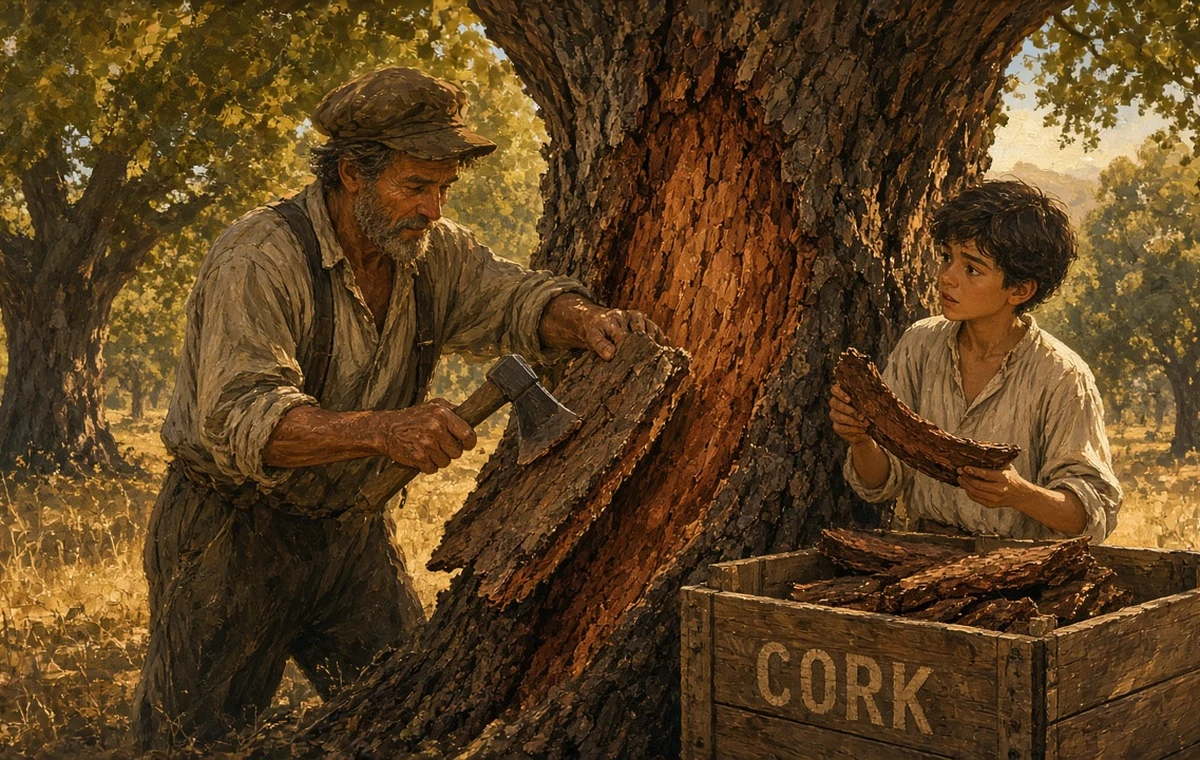
Cork comes from the outer bark of the cork oak, Quercus suber, which grows mainly around the western Mediterranean. Portugal is by far the largest producer, followed by Spain and North African countries such as Morocco, Algeria and Tunisia. A tree is usually first stripped at around 25 years old, once the trunk reaches about 70 cm in circumference at chest height.
The Korean source says the bark can be harvested again roughly every 10 years. In practice the cycle is around nine years: Portuguese law requires a minimum of nine years between harvests, so the bark can regrow to a usable thickness. A cork oak can live for 150 to 200 years, which allows roughly 15 to 16 harvests in a lifetime without cutting the tree down.
Why the forest matters as much as the board
Cork oak woodlands, the montado in Portugal and dehesa in Spain, are managed landscapes that support grazing, wildlife and rural jobs. Because harvesting gives these forests an economic value, buying cork products is often described as helping keep the trees in the ground.

How is expanded cork board actually made?
The Korean source calls the process "carbonisation". That is a little misleading. Bark that is too rough for wine stoppers, including virgin cork from the first harvest and branch trimmings, is granulated and packed into an autoclave. Superheated steam at roughly 300°C or more heats the granules, which expand and darken as their natural resin, suberin, is released. Under pressure, that resin glues the granules into a solid block. Nothing is burned to charcoal, and no synthetic binder is added.
- Collect bark offcuts and low-grade cork
- Granulate and load into a mould
- Heat with superheated steam under pressure so the granules expand and self-bind
- Cool, cut into boards, pack and ship
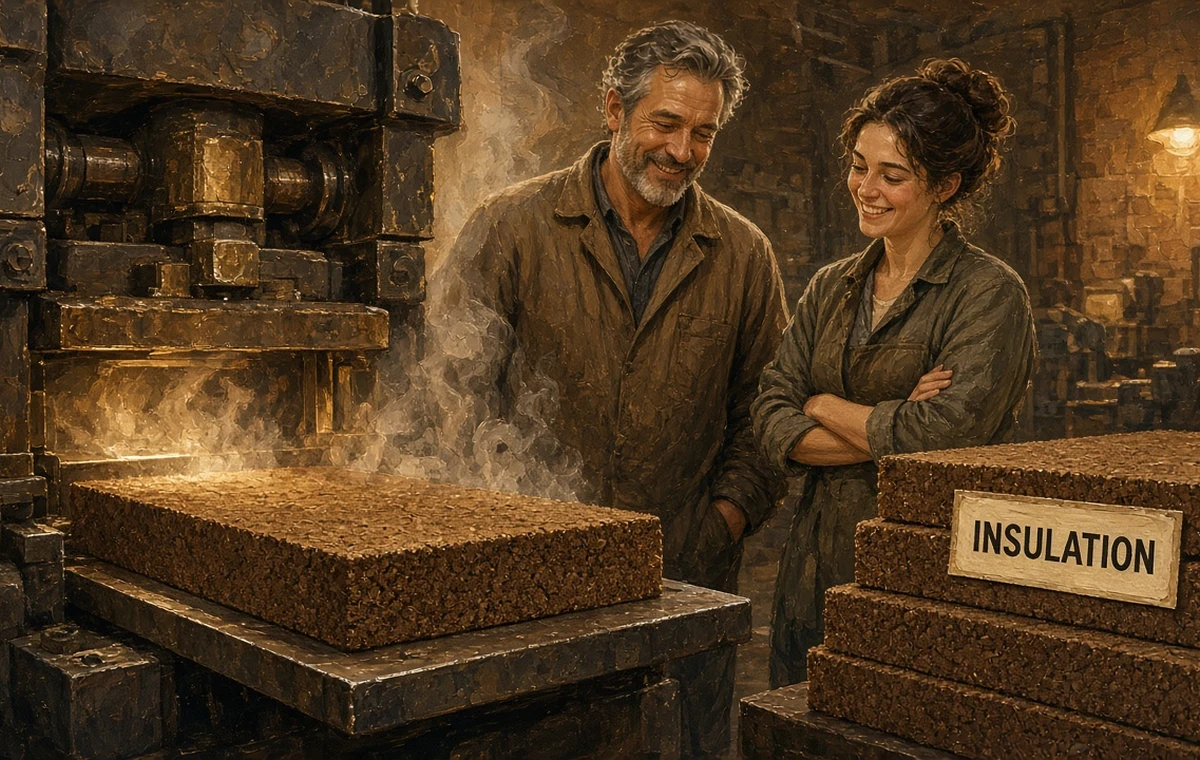
The source also stresses that offcuts and dust from production are reused, and that the finished boards can be ground into granules for new products at the end of their life.
Skimming the section headings first makes a long guide much easier to map out. Try writing down one question of your own as you read.
What does the performance look like in numbers?
A few figures in the original needed correcting. Cork's structure is often described as around 40 million tiny honeycomb cells per cubic centimetre, not per square centimetre. Expanded cork board typically has a thermal conductivity of about 0.036 to 0.040 W/mK, similar to many mineral wools. Manufacturers state that it tolerates a very wide temperature range, but the exact limits depend on the product and its datasheet.
| Property | Typical description | What to check on site |
|---|---|---|
| Thermal insulation | About 0.036 to 0.040 W/mK | Declared value on the product's datasheet or DoP |
| Acoustic | Cellular structure absorbs sound and dampens impact noise | Tested sound reduction for the full wall or floor build-up |
| Indoor air | No added binder, so no added formaldehyde | VOC test certificate if specifying for schools or homes |
| Fire | Combustible, typically Euroclass E unprotected | Required fire class for the location, need for render or boards |
| End of life | Can be ground and reused as granules | Take-back or recycling route |
A note on fire safety
The Korean source says cork releases no toxic gas in a fire. That is too strong. Like wood, cork is combustible and produces carbon monoxide and carbon dioxide when it burns, though it contains no halogens and chars slowly rather than melting or dripping. In the UK, combustible insulation is restricted in the external walls of many taller residential buildings after the Grenfell Tower fire, so always check the building regulations and fire strategy before specifying it on a façade.
How well any insulator works comes down to how heat moves through it. Our page on heat transfer by conduction, convection and radiation explains why millions of trapped air cells make cork a good insulator.
In other words, cork insulates well because of its structure, not because of any added chemistry, which is also why its performance stays fairly stable over decades of use.
How does cork fit UK and US energy rules?
In England, Part L of the Building Regulations sets limits on how much heat can escape through walls, roofs and floors, and the government has been moving towards a tougher Future Homes Standard for new dwellings. Cork board can help meet target U-values, especially in renovation of older solid-wall houses, where its breathability and moisture tolerance appeal to conservation specialists.
In the US, the International Energy Conservation Code sets minimum R-values by climate zone. At 0.040 W/mK, expanded cork works out at roughly R-3.6 per inch, a little below rigid foam boards but comparable to many fibrous products. Its appeal is less about record numbers and more about low embodied carbon, which matters as more projects count whole-life emissions. For the bigger picture of why that is now a design brief, see carbon neutrality.
Cork buildings worth knowing
The Portuguese Pavilion at Expo 2000 in Hanover, by Álvaro Siza and Eduardo Souto de Moura, used cork cladding, and the 2012 Serpentine Gallery Pavilion in London, designed by Herzog & de Meuron with Ai Weiwei, was lined with cork. Both are often cited in student projects as proof that cork can be both a technical and an expressive material.
What other eco-materials does the source cover?
The original also lists activated clay, recycled PET fibre, bottom ash, illite, recycled PVC building products and future materials. The useful lesson is that each sits at a different stage: some are mainstream, others are still mostly in research. When you compare them, look at durability, price and buildability as well as green credentials.
Student money tip on CampusDown Law Up: My Security Deposit Wasn't Returned. Here's the Calm, Step-by-Step Plan.
For coursework, a clean structure is: start with why indoor environments and climate matter, compare each material using the same headings for raw material, process and performance, then end with a case study and an honest note on limits such as cost, fire class and supply. A balanced report scores better than a list of advantages.
Compiled by the CampusDown editorial team from a Korean study note on eco-friendly building materials, corrected and adapted with public information on cork oak harvesting rules in Portugal, expanded cork production, typical thermal conductivity and Euroclass ratings, Approved Document L, the Future Homes Standard and the IECC. Reference: Gil, L. (2009). Cork composites: A review. Materials, 2(3), 776–789. Reviewed November 2026.
FAQ
Is expanded cork board really carbonised?
Not in the charcoal sense. Granules are heated with superheated steam so they expand and bind with their own resin; the dark colour comes from that heating.
How often can cork be harvested?
About every nine years. Portuguese law requires at least nine years between harvests, and a tree can be stripped around 15 to 16 times in its life.
What is the R-value of cork insulation?
At a typical 0.040 W/mK it is roughly R-3.6 per inch, though you should use the value declared for the specific product.
Is cork insulation fireproof?
No. It is combustible, typically Euroclass E when unprotected, and gives off CO and CO2 when burning, so check fire rules for the location.
Does cork board contain formaldehyde?
Pure expanded cork board uses no added binder, so no formaldehyde is added; ask for a VOC certificate if it matters for your project.