
Patient Safety Act and Nurse Medication Errors: Why Drug Mistakes Happen and How Korea, the US and UK Prevent Them
- Korea's Patient Safety Act, enacted in 2015 and in force from 2016, followed a child's death from a wrong-route cancer drug.
- Medication incidents now make up about half of Korea's voluntary patient-safety reports, with nurses as the last barrier.
- Drug knowledge, double checks and blame-free sharing, like US reporting systems and UK never events, are the key defences.
Contents
Korea's Patient Safety Act, passed in January 2015 and in force since July 2016, was born from a child's death caused by a wrongly administered cancer drug, and medication errors remain the most frequently reported type of patient-safety incident in Korea today. This guide explains what the law does, what the numbers suggest, why nurses are at the sharp end of drug errors, and how the United States and the United Kingdom have built their own safety nets.
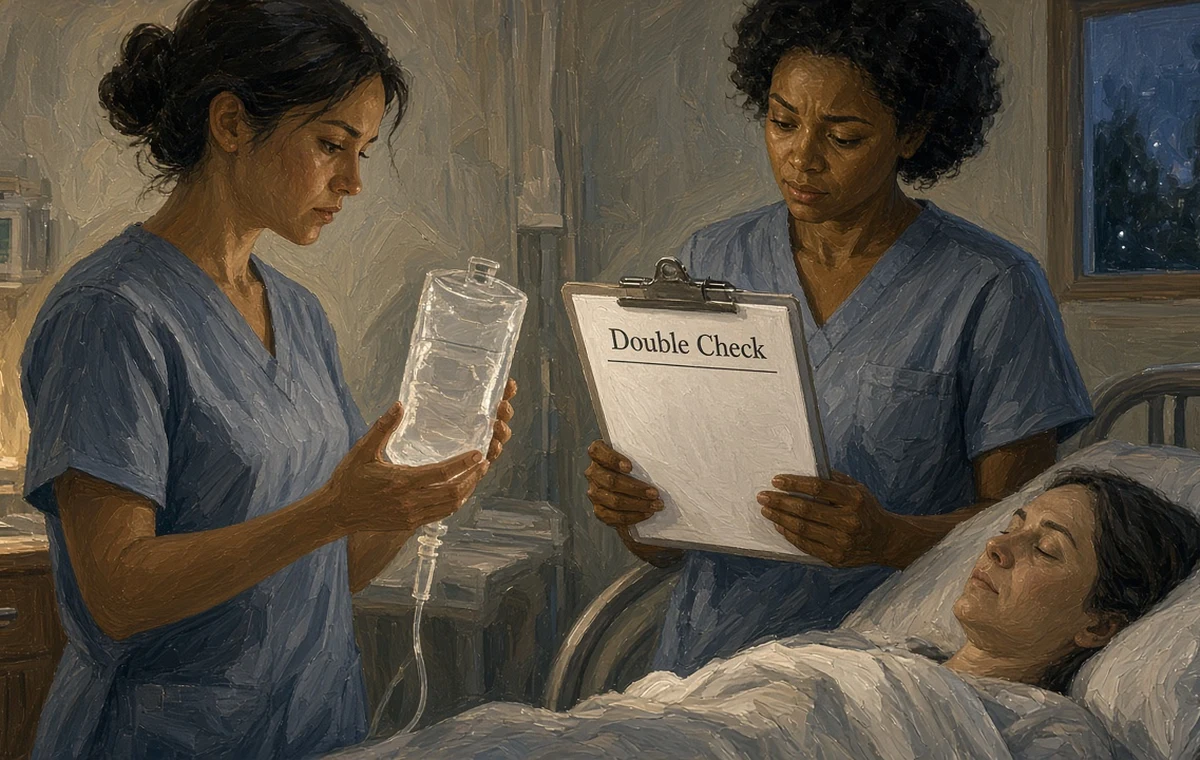
A medication error rarely comes from one careless person. It usually slips through a chain of small weaknesses: similar packaging, a rushed handover, a missing check. The law and the tools discussed here are attempts to break that chain.
Why was the Patient Safety Act created?
In 2010, a young leukaemia patient in Korea died after an anticancer drug meant for a vein was injected into his spinal canal. His family campaigned for change, and the resulting law, often nicknamed after the boy, was enacted in January 2015 and took effect in July 2016. It was Korea's first law dedicated specifically to patient safety rather than to punishing individual practitioners.
The tragedy echoed cases elsewhere. The same type of wrong-route error with the drug vincristine has killed patients in several countries, which is why the WHO and safety bodies now recommend giving it in a small infusion bag so that it physically cannot be connected to a spinal needle.

What does the law actually require?
According to the source, the Act sets up a national patient safety committee, requires the government to draw up a comprehensive patient safety plan, and provides for surveys of patient-safety incidents. It also created a voluntary reporting system so that hospitals and staff can share incidents and near misses, with the aim of learning rather than blaming.
Larger hospitals must have patient-safety committees and dedicated staff. The underlying principle is that errors are signals about weak systems, and that a system can only be fixed if people feel safe telling it what went wrong.
Skimming the section headings first makes a long guide much easier to map out. Try writing down one question of your own as you read.
How common are patient-safety incidents?
The source cites survey data suggesting that roughly one in ten inpatients experienced a patient-safety incident and that a large share of these were judged preventable. It also quotes a study estimating that tens of thousands of people die each year from adverse events, a number it describes as more than ten times the toll of road traffic deaths. These figures come from different studies and methods, so they are best read as an indication of scale rather than exact counts.
| Indicator | What the source reports | How to read it |
|---|---|---|
| Inpatients experiencing an incident | About one in ten in a 2019 survey | Self-reported experience, not audited records |
| Share judged preventable | A large minority, over 40% | Shows how much is avoidable |
| Adverse event rate (2021 study) | Close to 10% of hospital stays, with a small share fatal | Research estimate, depends on method |
| Estimated deaths per year | Tens of thousands, more than ten times road deaths | Indicative scale, not an official count |
Official Korean patient-safety statistics for 2023 back up the source on one key point: medication incidents made up roughly half of all voluntary reports, overtaking falls, which had led in earlier years. Reported incidents reflect reporting habits as well as true frequency, but the trend points firmly at drugs.
Why are nurses at the centre of medication errors?
Nurses are usually the last professionals between a prescription and the patient. They prepare and give drugs, often for many patients at once, under time pressure and with frequent interruptions. When an earlier mistake by a prescriber or pharmacy slips through, the nurse is the final barrier, and also the person most likely to be blamed.
The source proposes three remedies: solid knowledge of the drugs being given, a double check by a second person for high-risk medicines, and systematic sharing of incidents so that lessons travel between wards. High-alert drugs such as concentrated potassium, anticoagulants and insulin deserve particular care, because a small error can cause serious harm.
How do the US and UK protect patients from medication errors?
In the United States, the Institute of Medicine's report To Err Is Human estimated that between 44,000 and 98,000 hospital patients died each year from medical errors, a finding that launched the modern patient-safety movement. Congress followed with the Patient Safety and Quality Improvement Act of 2005, which created Patient Safety Organizations where hospitals can report errors confidentially. The Joint Commission's National Patient Safety Goals require, among other things, using at least two patient identifiers before giving medicines, and the Institute for Safe Medication Practices publishes widely used lists of high-alert medications.
The UK: never events and a duty of candour
In England, giving a medicine by the wrong route is on the NHS list of never events, serious incidents considered wholly preventable when proper safeguards are in place. Since 2014, providers have a statutory duty of candour requiring them to be open with patients and families when things go wrong, and the NHS Patient Safety Incident Response Framework, introduced in 2022, shifted investigations away from blame towards learning. A widely reported 2001 case in Nottingham, where a young patient died after vincristine was injected into his spine, helped drive British reforms on how such drugs are prepared.

| Item | Korea | United States | United Kingdom |
|---|---|---|---|
| Key law or rule | Patient Safety Act (in force 2016) | Patient Safety and Quality Improvement Act 2005 | Statutory duty of candour (2014) |
| Reporting route | National voluntary incident reporting | Confidential Patient Safety Organizations | National incident reporting and PSIRF |
| Bedside safeguard | Double check, staff education | Two patient identifiers, high-alert lists | Never events, wrong-route safeguards |
The common thread is clear: laws set the frame, but safety lives in daily habits at the bedside and in a culture where admitting a near miss earns thanks rather than punishment.
What can nurses and patients do today?
For nurses, the classic checks remain powerful: right patient, right drug, right dose, right route and right time, plus a second pair of eyes for high-alert medicines such as insulin. Reporting near misses, even embarrassing ones, is what turns individual luck into shared learning, and that depends on the team's psychological safety.
Patients and families can help too: say your name and date of birth when asked, ask what a new drug is for, and speak up if a pill or bag looks different from usual. Safety improves when everyone in the room feels entitled to ask one more question.
Reviewed by the CampusDown editorial team, November 2026. Reference: Kohn, L. T., Corrigan, J. M., & Donaldson, M. S. (Eds.). (2000). To Err Is Human: Building a Safer Health System. National Academies Press.
FAQ
When did Korea's Patient Safety Act take effect?
It was enacted in January 2015 and came into force in July 2016.
What is a never event in the NHS?
A serious incident that is considered wholly preventable when national safeguards are followed, such as giving a medicine by the wrong route.
What did To Err Is Human find?
The US Institute of Medicine report estimated that 44,000 to 98,000 hospital patients died each year from preventable medical errors.
Which drugs need a double check?
High-alert medicines such as insulin, anticoagulants, concentrated electrolytes and chemotherapy are commonly double checked.
What is the duty of candour?
A legal duty on healthcare providers in England to be open and honest with patients and families when something goes wrong with their care.