
Do Nurses Matter More as Medical Machines Multiply? Nursing in the High-Tech Age
- Advanced technology meets high expectations of nursing but also raises them, so technology and care needs grow together.
- As machines replace human involvement, trust between clinicians and patients can weaken and the purpose of care can blur.
- Nurses need both technical competence and attention to the patient's emotions, environment and family.
Contents
- What has advanced technology brought to healthcare?
- What is the shadow side of technology?
- What is the nurse's role, as the essay sees it?
- Why should expertise not depend on machines?
- What does "high tech, high touch" mean in nursing?
- Why is alarm fatigue a patient safety issue?
- Why does a bedside chair still matter?
- FAQ
Advanced medical technology does not make nurses less important; it makes their human role clearer. Monitors, infusion pumps and ventilators measure precisely and save staff time, but they can also thin out trust and conversation between patients and carers. Nursing in a high-tech age means using devices skilfully while caring for the patient's emotions, environment and family, which is the idea known as "high tech, high touch". Every bay on a modern ward bleeps, flashes and scrolls numbers. So does the nurse's job shrink as the machines multiply? A Korean nursing studies essay on "nursing as I see it" argues the opposite, and this guide follows its reasoning with examples from UK and US practice.
What has advanced technology brought to healthcare?
The essay explains that scientific progress has expanded healthcare and the industries around it, and made society more plural and complex. Individual rights have grown and diversity is more widely recognised, but people's needs have also become more specific and more demanding.
Student money tip from CampusDown Law UpMedical bill sent to collections? What to check before you pay — verify the bill, ask about insurance and financial assistance, and dispute errors.
In that setting, technology both meets high expectations of nursing and raises them again. Better equipment lets patients survive conditions that were once fatal, which in turn creates more complex care needs. Technology and nursing demand grow together rather than cancelling each other out.
How we read that relationship depends partly on how we think about technology itself. Some see machines as driving social change, while others stress that people shape how tools are used, a debate set out in technological determinism and the social construction of technology.
The essay clearly sides with the second view: what happens on a ward depends less on the devices than on the people using them.

What is the shadow side of technology?
Highly specialised equipment has reduced the amount of human involvement in treatment, saved staff time and improved precision. The essay warns, however, that trust between clinicians and patients can weaken as a result, and that the essence of healthcare, which is saving and caring for a life, can become blurred.
| Aspect | Benefit | Limit |
|---|---|---|
| Efficiency | Saves unnecessary staff time | Less person-to-person communication |
| Precision | Highly accurate measurement | Reference ranges based on large trials may not fit an unusual patient |
| Relationships | None in itself | Trust between clinician and patient may weaken |
Britain learned this the hard way. The 2013 Francis Report into Mid Staffordshire NHS Foundation Trust described patients left without basic care while targets and processes took priority, and it pushed compassion back to the centre of NHS nursing policy.
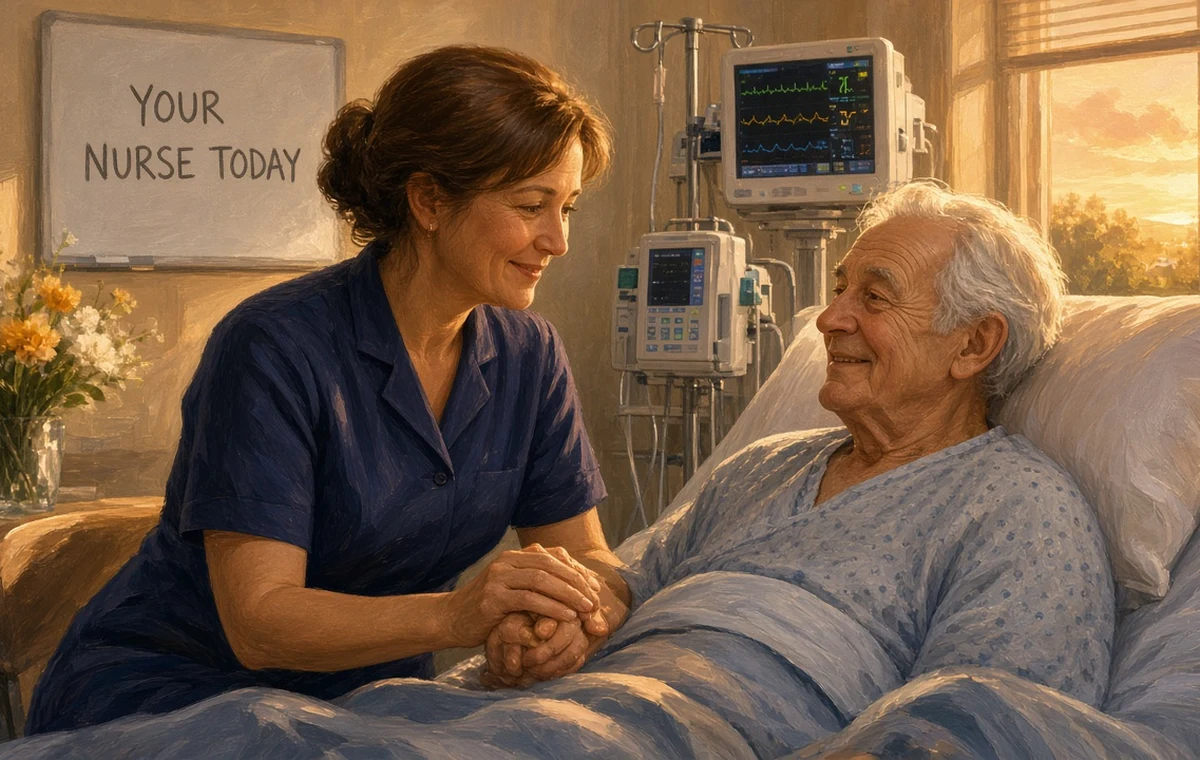
The essay's central concern is simple: when a machine fills the gap between people, the purpose of treatment itself can start to wobble.
Skimming the section headings first makes a long guide much easier to map out. Try writing down one question of your own as you read.
What is the nurse's role, as the essay sees it?
For the author, nursing does not stop at helping with the treatment of disease and injury. It means watching the patient's emotions, considering the environment they are in, and including their family. The nurse is pictured as the professional who stays closest to the patient of anyone in the healthcare team.
Behind this view lies a broad definition of treatment: relieving not only physical illness but also the psychological problems and emotional pressure a patient is carrying. In the UK, the Nursing and Midwifery Council's Code puts this first, asking nurses to "prioritise people" and treat them with kindness, respect and compassion.
England's 2012 national nursing strategy, Compassion in Practice, summed up the same idea as the "6Cs": care, compassion, competence, communication, courage and commitment. Competence sits in the middle of that list, alongside the human qualities rather than above them.
Why should expertise not depend on machines?
The essay insists that nurses must not lean too heavily on advanced equipment and should stay deeply aware of their own duties and responsibilities. As chronic illness and population ageing grow, nursing work becomes more varied and demanding, so a higher level of professional skill is needed.
- Check the machine's numbers against how the patient actually looks
- Assess the emotional needs of patients and families
- Fill communication gaps created by technology with conversation
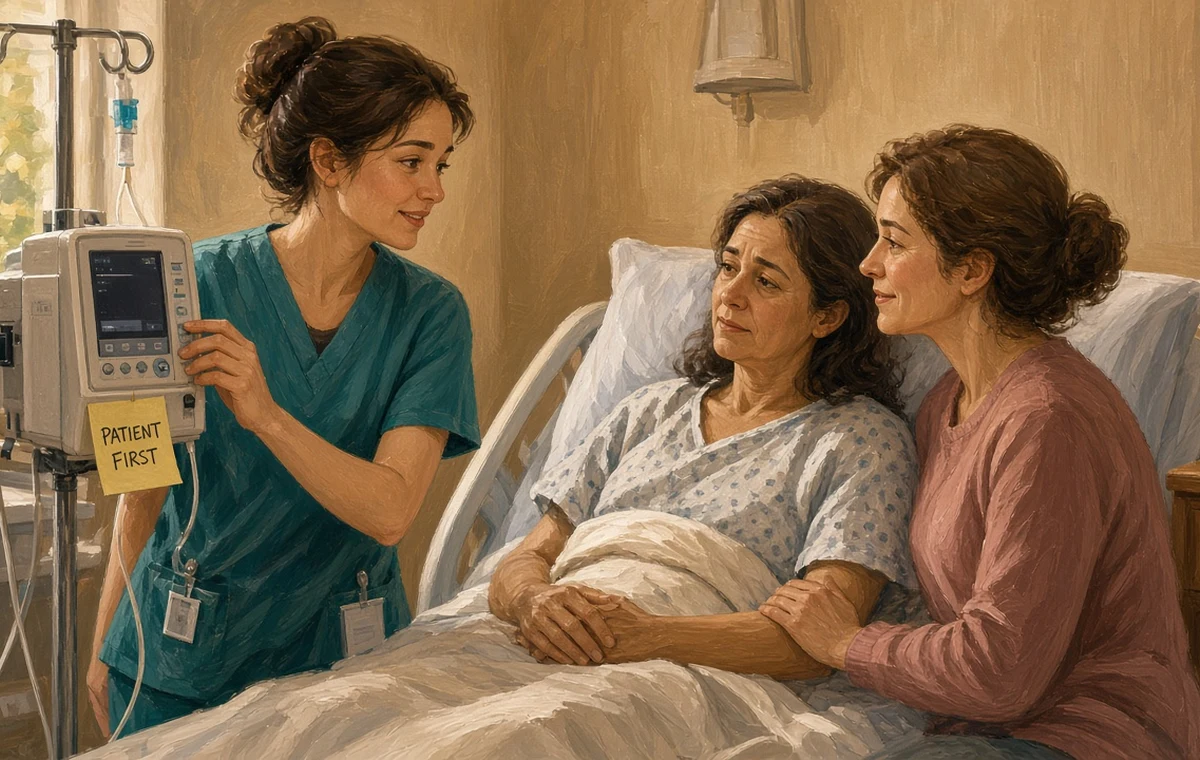
Skill with technology and skill in understanding people have to come together if nursing is to keep its core values in a high-tech age.
What does "high tech, high touch" mean in nursing?
The phrase "high tech, high touch" was popularised by futurist John Naisbitt in his 1982 book Megatrends. The more technology spreads through society, he argued, the more people crave human contact and warmth. Nursing writers often quote it to mean handling devices expertly while never losing the hand on the shoulder and the eye contact.
The idea goes back to the very start of modern nursing. In Notes on Nursing (1859), Florence Nightingale named fresh air, light, warmth, cleanliness, quiet and suitable diet as the heart of nursing, and she warned that unnecessary noise harms patients. Her ideas are summarised in Nightingale's environmental theory.
Some nursing theories refuse to set technology against care altogether. Rozzano Locsin argued that technological competency can itself be an expression of caring, because devices can help nurses know the patient more fully. A number on a monitor becomes a window onto the person rather than a wall between them when the nurse uses it to understand what is happening right now.
Why is alarm fatigue a patient safety issue?
Intensive care units are full of devices that alarm: cardiac monitors, infusion pumps and ventilators. Many studies have found that a large share of these alarms do not need any action. Constant exposure to meaningless alarms can make staff less sensitive, so they respond more slowly to the alarms that really matter. This is called alarm fatigue.
In the United States, The Joint Commission issued a sentinel event alert on medical device alarm safety in 2013 and then made alarm management a National Patient Safety Goal for accredited hospitals. Recommended steps include tailoring alarm limits to each patient, changing electrodes on time and switching on only the alarms that are needed.
| Cause | Example | Nursing response |
|---|---|---|
| Poorly set limits | Same default settings for every patient | Adjust alarm limits to the patient's condition |
| Technical alarms | Loose electrodes, displaced sensors | Check and replace electrodes and sensors on schedule |
| Unnecessary monitoring | Monitoring parameters that are not needed | Keep only the monitoring that is clinically required |
| Noise build-up | Several devices alarming at once | Set alarm priorities and a clear response system |
Alarms affect patients too. Beeping through the night disrupts sleep and raises anxiety, and noise, sleep loss and the blurring of day and night are among the recognised risk factors for delirium in intensive care. Dimming lights at night, cutting needless noise and letting daylight in can help, which is Nightingale's light and quiet returning to the high-tech ward.
Why does a bedside chair still matter?
A seat that says "someone is staying"
A ward is full of drip stands and equipment, but a chair beside the bed marks a place where a person stays. When a nurse or relative sits for a moment at eye level, the patient feels cared for by a human being, not a machine.
Student money tip on CampusDown Law Up: Medical bill sent to collections? What to check before you pay.
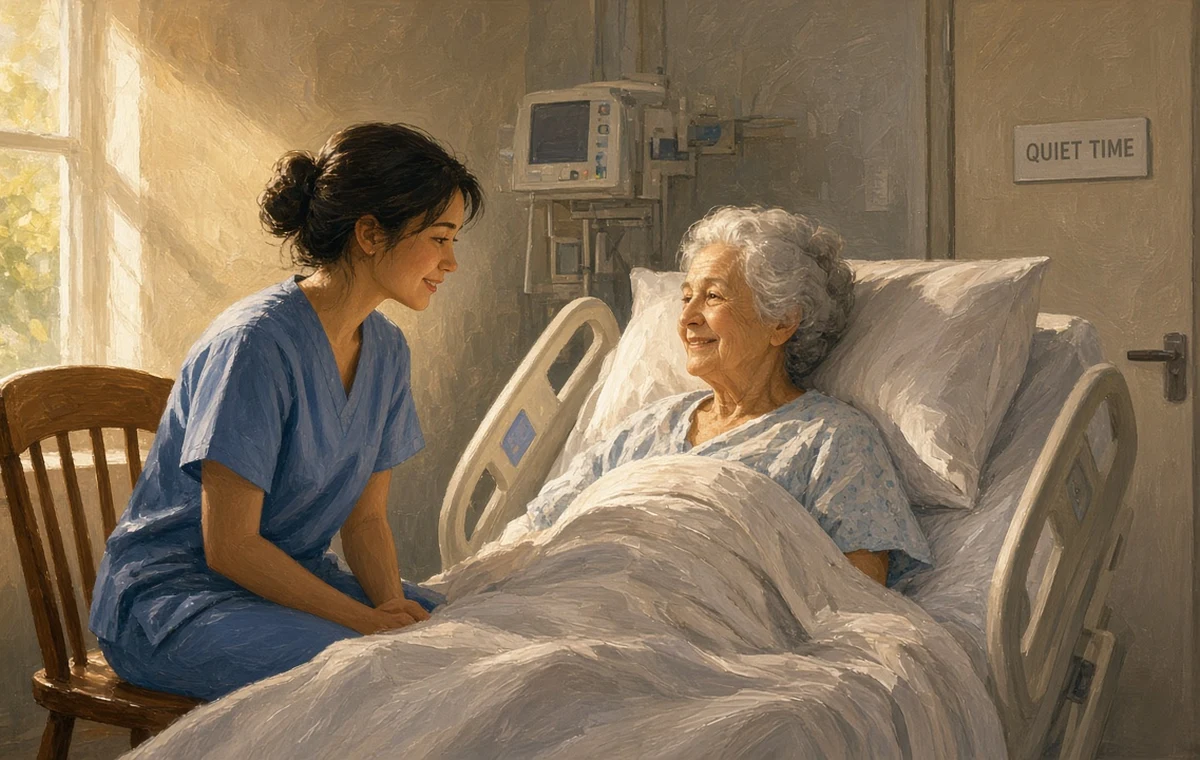
Daylight through the window echoes Nightingale's emphasis on light: light by day and darkness and quiet by night protect the patient's body clock. Describing a scene like this in the final paragraph of a nursing essay makes for a conclusion readers remember.
How to structure your own essay
The essay moves from the background of technological change, through benefits and limits, to a redefinition of the nursing role and the attitude nurses need. Following the same order keeps an argument flowing, and you can link each step to nursing theories such as Nightingale's or Locsin's. End with one or two sentences from your own placement experience to give the answer your own voice. The more technology leads, the brighter human care shines.
Compiled by the CampusDown editorial team from a Korean nursing studies essay, adapted with public information on Naisbitt's Megatrends, Nightingale's Notes on Nursing, Locsin's theory of technological competency as caring, The Joint Commission's alarm safety guidance, the Francis Report, the NMC Code and the 6Cs of Compassion in Practice. Reference: Sandelowski, M. (2000). Devices and Desires: Gender, Technology, and American Nursing. University of North Carolina Press. Reviewed November 2026.
FAQ
How can technology harm nursing care?
By reducing human involvement in treatment, which can weaken trust between clinicians and patients and reduce communication.
Should nurses trust device readings completely?
No. Reference ranges come from large trials and may not fit an unusual patient, so readings must be checked against the patient's actual condition.
What does 'high tech, high touch' mean?
A phrase popularised by John Naisbitt in 1982: the more technology spreads, the more people want human contact, so nurses must combine both.
What is alarm fatigue?
Desensitisation caused by frequent non-actionable device alarms, which can delay responses to dangerous ones; The Joint Commission treats it as a patient safety goal.
Why is Nightingale still relevant on high-tech wards?
Her focus on light, quiet and a healing environment matters again where alarms and constant light disturb patients' sleep.