
How Does a Newborn's Body Develop? Weight Loss, Primitive Reflexes and Jaundice Explained
- Newborns lose around 5–10% of their birth weight in the first days and usually regain it within about two weeks.
- Primitive reflexes disappearing on schedule is a sign of normal neurological development.
- Jaundice that appears in the first 24 hours is treated as pathological until proven otherwise.
Contents
- How much do newborns grow?
- When do the fontanelles close?
- Why check primitive reflexes?
- When is newborn jaundice a worry?
- How is the Apgar score given?
- What matters most in the first month at home?
- Why keep blankets and toys out of the cot?
- Screening and immunisations in the early weeks
- The first month at a glance
- Tying it together in an assignment
- FAQ
A newborn looks tiny and fragile, but its body changes remarkably fast. Weight dips and then climbs back, the soft gaps between the skull bones start to close, and reflexes the baby was born with drop away one by one. This guide pulls together the benchmarks that come up most in child health nursing and early development modules, and then turns to what parents need to know in the first month at home.
A small body with a physiology quite unlike an adult's: that is where newborn care begins.
How much do newborns grow?
Textbooks give a full-term baby's birth weight as roughly 3–3.5 kg, length around 50 cm and head circumference about 33–35 cm. Weight usually doubles by four to five months and triples by the first birthday.
Student money tip from CampusDown Life UpHow to Find Unclaimed Money in Your Name — How to find unclaimed money in your name for free: official state databases via NAUPA and MissingMoney.com, federal searches like Treasury…

In the first three or four days, fluid loss and small feeds cause physiological weight loss of around 5–10% of birth weight. Most babies are back to birth weight within 10 to 14 days. A bigger drop or a slow recovery is a cue to reassess feeding. In the UK, a midwife or health visitor weighs the baby at home in the first days and the results go into the Red Book, the personal child health record parents keep.

When do the fontanelles close?
The fontanelles are soft areas between the skull bones. They let the head mould during birth and leave room for the brain to grow. The posterior fontanelle closes at around six to eight weeks, the anterior one at 12 to 18 months. A markedly sunken anterior fontanelle can point to dehydration; a tense, bulging one can suggest raised intracranial pressure, so nurses check it gently with a fingertip during assessment.
Skimming the section headings first makes a long guide much easier to map out. Try writing down one question of your own as you read.
Why check primitive reflexes?
Newborn reflexes line up with the first sub-stage of the sensorimotor period in Piaget's theory of cognitive development, the stage of simple reflexes. Whether each reflex appears and then fades on time is a window into how the nervous system is maturing.
- Moro reflex: a loud noise or sudden drop makes the baby fling the arms out and then bring them in. It fades by four to six months.
- Rooting reflex: stroking the cheek makes the baby turn towards it and open the mouth. Gone by about three to four months.
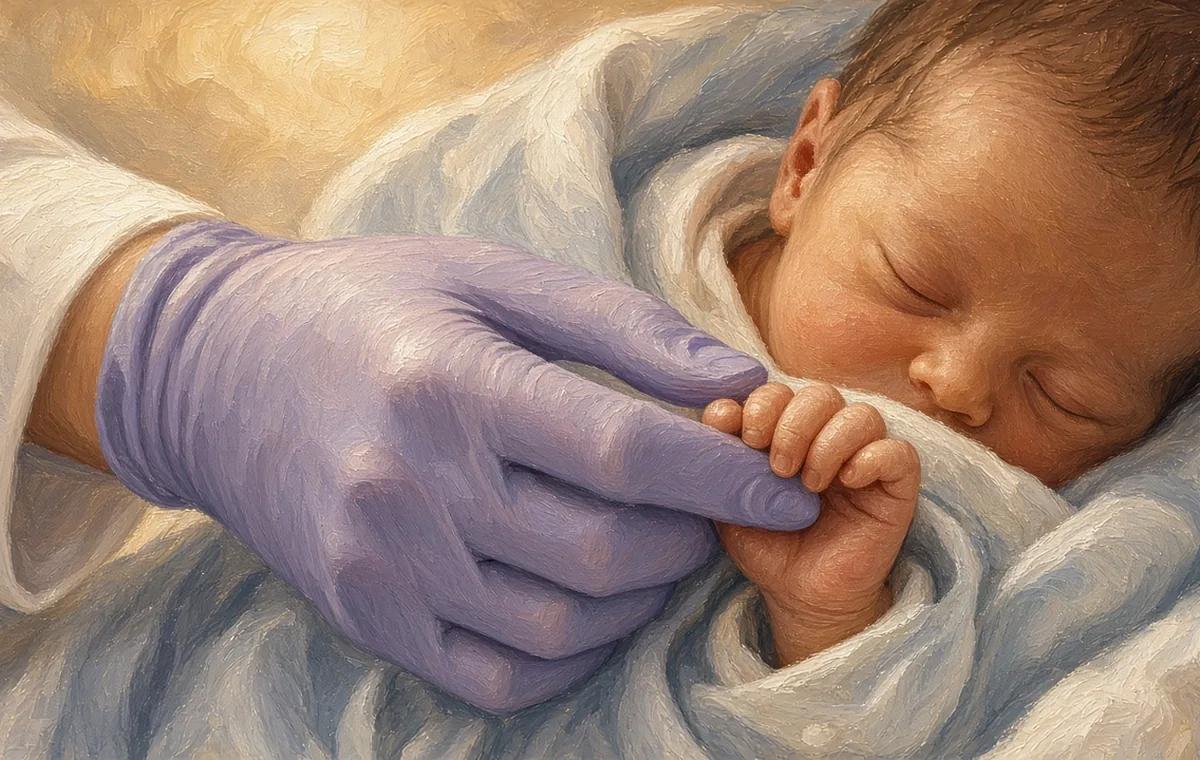
- Palmar grasp: a finger placed in the palm is gripped tightly. Also gone by three to four months.
- Babinski reflex: stroking the outer sole makes the toes fan out. It usually disappears after the first year.
A reflex that persists well past its expected age calls for a neurological assessment.
When is newborn jaundice a worry?
Physiological jaundice happens because newborns break down a lot of red blood cells while the liver is still immature. In term babies it appears on day two or three, peaks around days three to five and then fades. Jaundice that shows up within the first 24 hours, bilirubin that climbs rapidly, or yellowing that lasts more than two weeks should be investigated as pathological. The American Academy of Pediatrics revised its guideline on managing hyperbilirubinaemia in babies of 35 weeks or more in 2022.
Nurses check skin and the whites of the eyes in good light, record the number of feeds and wet nappies, and during phototherapy protect the eyes and monitor temperature and hydration.
How is the Apgar score given?
Proposed by the American anaesthetist Virginia Apgar in 1953, the score rates heart rate, breathing, muscle tone, reflex response and skin colour from 0 to 2 each, at one minute and five minutes after birth. A total of 7–10 is generally reassuring.
What matters most in the first month at home?
Safe sleep comes first. To reduce the risk of sudden infant death, babies should be put down on their backs on a firm, flat mattress with a fitted sheet and nothing else. NHS and Lullaby Trust advice is for the baby to sleep in the same room as the parents, in their own cot or Moses basket, for the first six months.
Feeding is about reading cues. Many newborns feed eight to twelve times a day, though babies vary. Lip-smacking and hand-sucking are early hunger signs; crying is a late one. Wet nappies and weight gain show whether intake is enough, and the key check is whether the baby is back to birth weight by about two weeks.
Points worth giving parents in writing:
- Back to sleep, with no soft items in the cot.
- Feed on hunger cues and count wet nappies.
- Keep the umbilical stump clean and dry.
- Test bath water with your wrist or elbow first.
- Seek help straight away for fever, refusing feeds, worsening jaundice or floppiness.
The last point matters most. A temperature of 38°C or above in a baby under three months needs urgent medical advice.

Why keep blankets and toys out of the cot?
Newborns can't yet turn their heads away or push something off their faces, so a soft blanket or toy can obstruct breathing. A baby sleeping bag that fits, or a firmly tucked thin blanket no higher than the shoulders, keeps the baby warm without the risk. Don't overdress the baby or overheat the room; a room temperature of about 16–20°C is the usual guide. Smoking around the baby raises both breathing problems and the risk of sudden infant death.
Screening and immunisations in the early weeks
In the UK, the newborn blood spot test, or heel prick, is done ideally on day five to screen for several rare but serious conditions, including sickle cell disease, cystic fibrosis and congenital hypothyroidism. Vitamin K is offered at birth to prevent bleeding. A hepatitis B dose at birth is given to babies whose mothers have hepatitis B; for everyone else, the routine hepatitis B vaccine starts at eight weeks as part of the six-in-one. Exact schedules differ between countries, so follow the programme where the baby is born.
The first month at a glance
| Timing | Main checks | Parent education |
|---|---|---|
| At birth | Apgar score, vitamin K | Skin-to-skin contact and first feed |
| Around day 5 | Weight loss, jaundice, heel prick test | How to spot yellowing |
| Around 2 weeks | Back to birth weight? | Feeding frequency and nappies |
| 6–8 weeks | Newborn and infant physical examination, first immunisations | The next appointments |
New parents are tired and tense, so short, focused information works better than a flood of leaflets. A one-page sheet with pictures, or a demonstration before discharge, is what sticks. Keep an eye on the parents too: low mood lasting more than two weeks after birth deserves professional support.
Tying it together in an assignment
Link physical characteristics to home care. Knowing about the Moro reflex helps parents stay calm when the baby startles in the bath; knowing about physiological weight loss gives a basis for feeding advice. Child development theories help frame why these early weeks matter beyond the numbers. CampusDown's child health nursing notes lay out the same benchmarks in a revision table. Behind every figure in this guide is a small body that changes from one day to the next, and that is worth remembering when you study newborn development.
Student money tip on CampusDown Life Up: How to Find Unclaimed Money in Your Name.
Reviewed by the CampusDown editorial team, November 2026. Sources: Hockenberry, M. J., Wilson, D. & Rodgers, C. C. Wong's Essentials of Pediatric Nursing; American Academy of Pediatrics (2022). Management of hyperbilirubinemia in the newborn infant 35 or more weeks of gestation. Pediatrics, 150(3); Apgar, V. (1953). Current Researches in Anesthesia & Analgesia, 32(4); NHS, Newborn blood spot test.
FAQ
How much weight do newborns normally lose?
About 5–10% of birth weight, usually regained within 10–14 days.
When does the anterior fontanelle close?
Usually between 12 and 18 months.
When should newborn jaundice raise concern?
When it appears within the first 24 hours, rises quickly, or lasts beyond two weeks in a term baby.
When is the Apgar score taken?
At one minute and five minutes after birth.