
How Much Does a Baby Grow by Their First Birthday? Infant Growth, Two Growth Patterns and the Parent's Role
- Babies typically roughly double their birth weight by about 4 to 5 months and triple it by their first birthday.
- Growth runs from head to toe and from the centre of the body outwards.
- Parents' example at mealtimes and warm, responsive attachment shape babies' development and self-esteem.
Contents
In their first year, babies typically grow about 50 per cent longer and roughly triple their birth weight. They grow head-first (cephalocaudal) and from the trunk outwards (proximodistal), and parents shape that growth through relaxed feeding and warm, responsive attachment. Anyone who has packed away a drawer of newborn babygros by the third month knows how fast this happens. The first birthday photo next to the hospital one can look like a different child.
This guide began as a Korean child development study note based on Laura Berk's textbook. We have rebuilt it for readers in the UK and US, swapping in the WHO growth standards, the Red Book and health visitor reviews, and American well-child visits. We have also corrected a few numbers along the way.
How much do babies grow in the first two years?
The Korean source quoted figures of about 81 cm at one year and 91 cm at two, which come from older American averages and run high. The WHO Child Growth Standards, which the UK and US both use for babies, put the median length at 12 months at about 76 cm for boys and 74 cm for girls. At 24 months it is roughly 86 to 88 cm. A baby born at around 50 cm is therefore about half as long again by the first birthday.
Student money tip from CampusDown Life UpHow to Find Unclaimed Money in Your Name — How to find unclaimed money in your name for free: official state databases via NAUPA and MissingMoney.com, federal searches like Treasury…
| Age | Typical weight | Compared with birth |
|---|---|---|
| About 4 to 5 months | About 6.4 to 7.5 kg | Roughly double |
| 12 months | About 9 kg (girls) to 9.6 kg (boys) | Roughly triple |
| 24 months | About 11.5 kg (girls) to 12.2 kg (boys) | Heading towards four times, usually reached a little later |
The source said weight quadruples by age two. On WHO figures most children reach that closer to two and a half, so treat "four times" as a rough guide rather than a deadline. Few periods after birth match infancy for speed, which is exactly why small changes on a growth chart get attention.

What does growing from the head down mean?
The cephalocaudal trend means growth and control move from head to toe. Before birth the head develops fastest, which is why a newborn's head is about a quarter of its body length. After birth the same pattern shows in movement: babies control their heads first, then their arms and trunk, and only later sit, pull to stand and walk.
That is the logic behind tummy time. The NHS and the American Academy of Pediatrics both advise putting babies to sleep on their backs, and giving supervised time on their tummies when awake, so they can practise lifting their heads and strengthen neck and shoulder muscles.

The order of milestones, from head control to rolling, sitting, crawling, standing and walking, is broadly the same for most children even though the timing varies by months.
Skimming the section headings first makes a long guide much easier to map out. Try writing down one question of your own as you read.
What is proximodistal growth?
The second pattern, proximodistal, means growth moves from the centre of the body outwards. In the womb the head, chest and trunk develop first, then the arms and legs, and finally the hands and feet. After birth babies swipe with their whole arm before they can reach accurately, and pick things up with the whole hand before they manage the neat pincer grip of finger and thumb, often around nine to twelve months.
Not every tissue grows at the same pace. Berk notes that muscle tissue increases only slowly during infancy and does not peak until adolescence, while fat builds up quickly in the first year, which gives babies their chubby look before they slim down as toddlers.
Two patterns at a glance
- Cephalocaudal: head to toe, so head control before sitting and walking
- Proximodistal: centre to edges, so arm movements before fine finger skills
Together the two trends explain why babies around the world tend to pass the same milestones in the same order, and they give students a neat framework for any observation assignment.
How can parents support healthy eating?
The source advises against forcing babies to finish their food. Encouraging them simply to taste works better, and because babies copy how adults treat food, parents eating a variety of foods in front of them matters. This fits current advice: the NHS recommends starting solid foods at around six months, offering a range of tastes and textures, and letting babies explore and sometimes reject a food many times before they accept it.
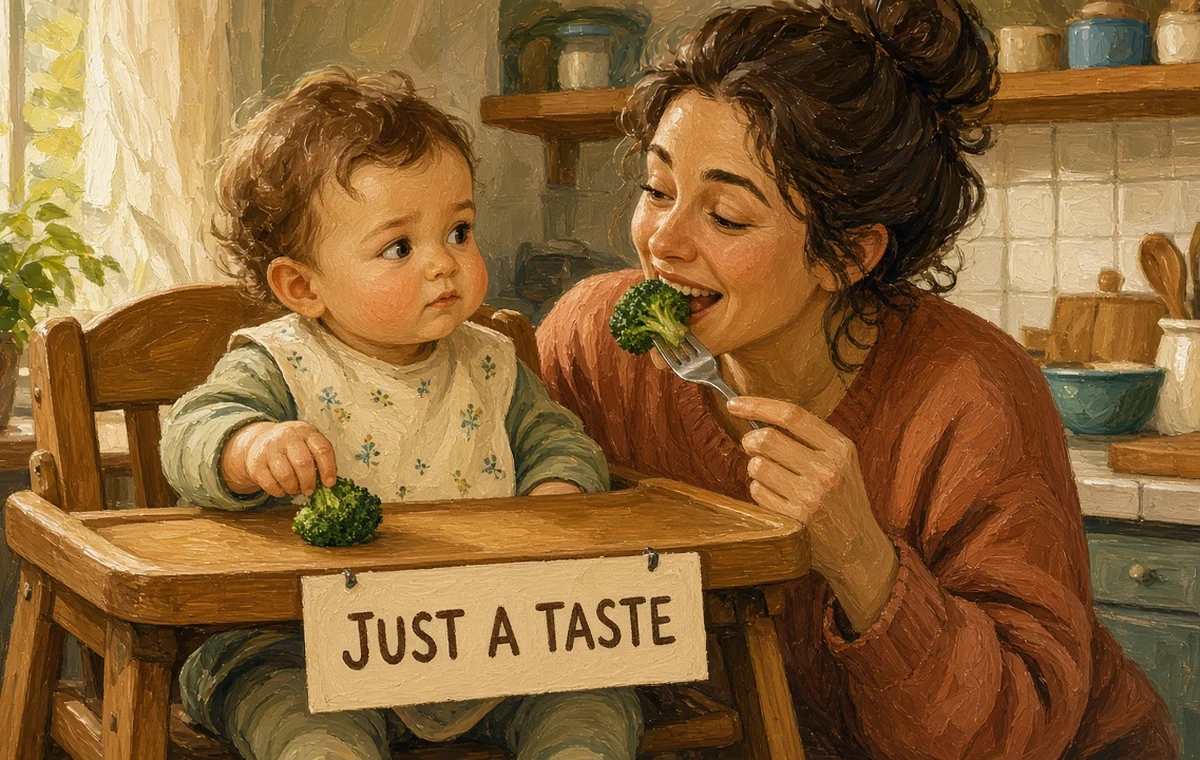
Mealtimes are about nutrition, but they are also lessons in copying. A relaxed table where food is offered, not pushed, sets up better habits than a battle over the last spoonful.
Why does attachment matter for development?
The source explains that when parents offer warm, reliable attachment, babies develop healthy self-esteem and come to trust themselves. That idea goes back to John Bowlby's work after the Second World War, and you can read more in Bowlby's attachment theory.
- Respond consistently to crying and other signals
- Offer cuddles and eye contact for emotional security
- Try new foods and experiences together rather than forcing them
Responsive care does not mean answering every whimper within a second. It means the baby learns, over thousands of small moments, that someone will come and help, which becomes the secure base for exploring the world.
What else do health checks look at besides height and weight?
Clinicians also track head circumference, the soft spots on the skull, reflexes, motor milestones and teeth. The anterior fontanelle on top of the head usually closes between about 12 and 18 months, and the smaller one at the back closes within the first few months. A bulging fontanelle can suggest raised pressure and a sunken one can suggest dehydration, so nurses always check it.
Student money tip on CampusDown Life Up: How to Find Unclaimed Money in Your Name.
Head circumference grows fast in the first year because the brain is growing fast. A single measurement matters less than the trend over time.
Reading the growth chart
Percentiles show where a baby sits compared with 100 healthy babies of the same age and sex. A baby on the 9th percentile is not necessarily underweight. What matters is whether they follow their own curve. A drop across two or more major percentile lines is usually a reason to look more closely.
In the UK, parents record these measurements in the Personal Child Health Record, the "Red Book", on UK-WHO growth charts. Health visitors carry out reviews at set points, including around 6 to 8 weeks, about a year and two to two and a half years, alongside the GP's 6 to 8 week check. In the US, the CDC recommends WHO charts for children under two, and the American Academy of Pediatrics' Bright Futures schedule sets regular well-child visits through the first two years.
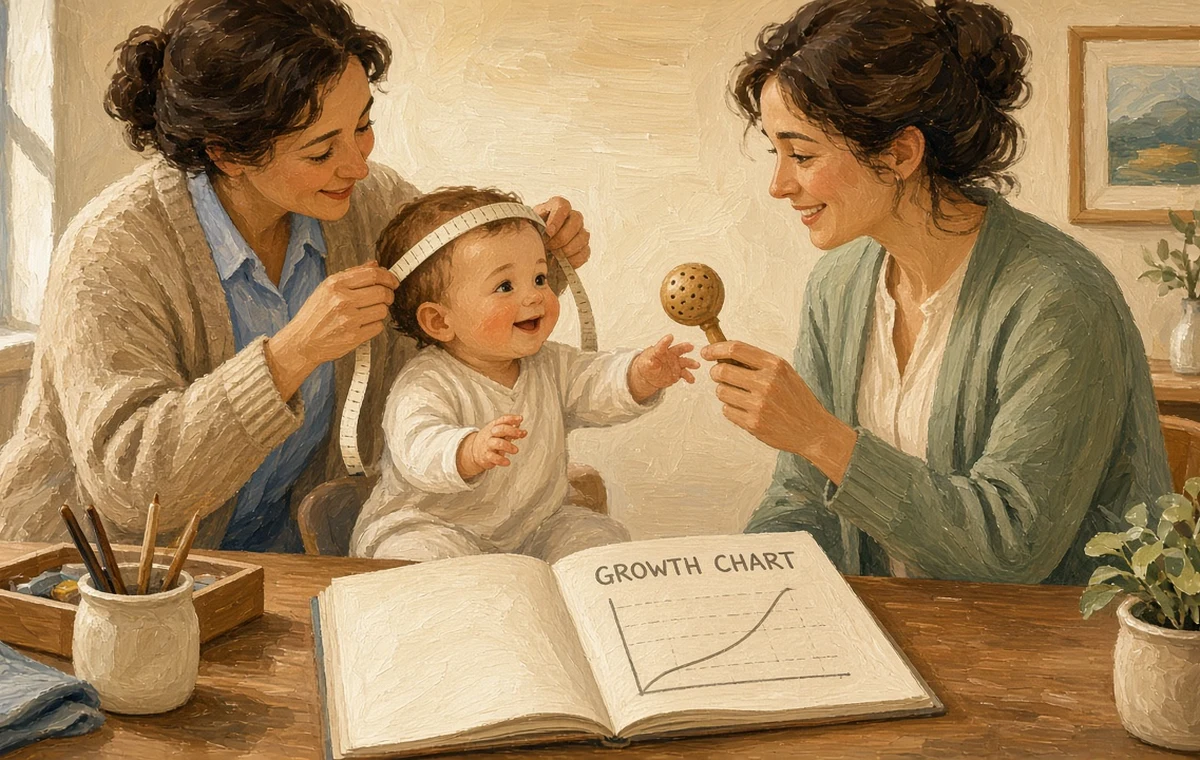
Pairing measurement with play helps in practice too. A baby who is calm and distracted by a rattle gives a more accurate reading, and the way they follow and grab the toy tells you something about their vision and motor development.
| Reflex | What you see | Usually fades |
|---|---|---|
| Moro (startle) | Arms fling out, then come together | Within the first few months |
| Palmar grasp | Fingers close tightly on an object in the palm | Within the first few months |
| Rooting | Turns towards a touch on the cheek | Within the first few months |
| Babinski | Big toe fans upward when the sole is stroked | Usually by about 1 to 2 years |
Textbooks give slightly different ages for when each reflex fades, so for exams follow the one your course uses. For coursework, a strong structure is: growth figures in a table, the two growth patterns, then the parent's role through feeding and attachment, finishing with what routine checks measure. Watch each day's growth with warmth.
Compiled by the CampusDown editorial team from a Korean child development study summary, corrected and adapted with public information on the WHO Child Growth Standards, UK-WHO growth charts and the Red Book, the Healthy Child Programme, NHS weaning advice, CDC growth chart guidance and AAP Bright Futures. Reference: Berk, L. E. (2018). Development Through the Lifespan (7th ed.). Pearson. Reviewed November 2026.
FAQ
When does a baby triple its birth weight?
Usually around the first birthday, when WHO median weights are about 9 kg for girls and 9.6 kg for boys.
How tall is a typical one-year-old?
On WHO standards the median length at 12 months is about 76 cm for boys and 74 cm for girls.
What are the two patterns of infant growth?
Cephalocaudal growth from head to toe and proximodistal growth from the centre of the body outwards.
Is a low percentile on the growth chart a problem?
Not on its own. What matters is whether the baby follows their own curve; dropping across two or more major lines is worth checking.
How does attachment affect babies?
Warm, consistent responses help babies build self-esteem and trust, giving them a secure base to explore from.