
What Does Miranda Mean? US Miranda Rights vs the UK Police Caution, Explained
- In a legal context, Miranda means the warning US police must give before custodial interrogation: the right to silence and to a lawyer.
- After Berghuis v. Thompkins, American suspects must invoke silence clearly, while the UK PACE caution warns that silence can harm a later defence.
- A missed warning usually excludes a statement; it does not automatically end the case or prove innocence.
Contents
"Miranda" in a legal or police context almost always means the Miranda warning: the set of rights American police must explain before questioning someone in custody, chiefly the right to remain silent and the right to a lawyer. The name comes from a 1966 US Supreme Court case, not an acronym. If you met the word in an astronomy book or a Shakespeare essay, it is a different Miranda altogether: Uranus's moon Miranda is named after the heroine of The Tempest.
| Context | Likely meaning | Clue |
|---|---|---|
| Arrest, interrogation, "lawyer up" | Miranda warning / Miranda rights | Police, custody, statements, attorney |
| Uranus, Voyager 2, moons | The moon Miranda | NASA and planetary science pages |
| Plays, novels, a person's name | A proper name | Check the character or person, do not translate it as a legal term |
Anyone who has binge-watched Law & Order can recite the script: "You have the right to remain silent. Anything you say can and will be used against you in a court of law..." The trouble is that television squeezes a subtle body of constitutional law into a ten-second arrest scene, and British dramas such as Line of Duty use a completely different caution. This guide unpacks the real rules on both sides of the Atlantic.
Where did the Miranda warning come from?
In March 1963 police in Phoenix, Arizona arrested Ernesto Miranda, a 22-year-old labourer, in connection with a kidnapping and rape. After about two hours in an interrogation room he signed a written confession. Nobody had told him he could stay silent or ask for a lawyer, yet the typed form claimed he confessed "with full knowledge of my legal rights." In Miranda v. Arizona, 384 U.S. 436 (1966), Chief Justice Earl Warren, writing for a 5-4 majority, held that the Fifth Amendment privilege against self-incrimination applies inside the police station, not just in the courtroom.
Related on CampusDown Law UpDo Campus Cops Have to Read You Miranda Rights? A Broke Student's Breakdown — Campus police want to "just chat"?
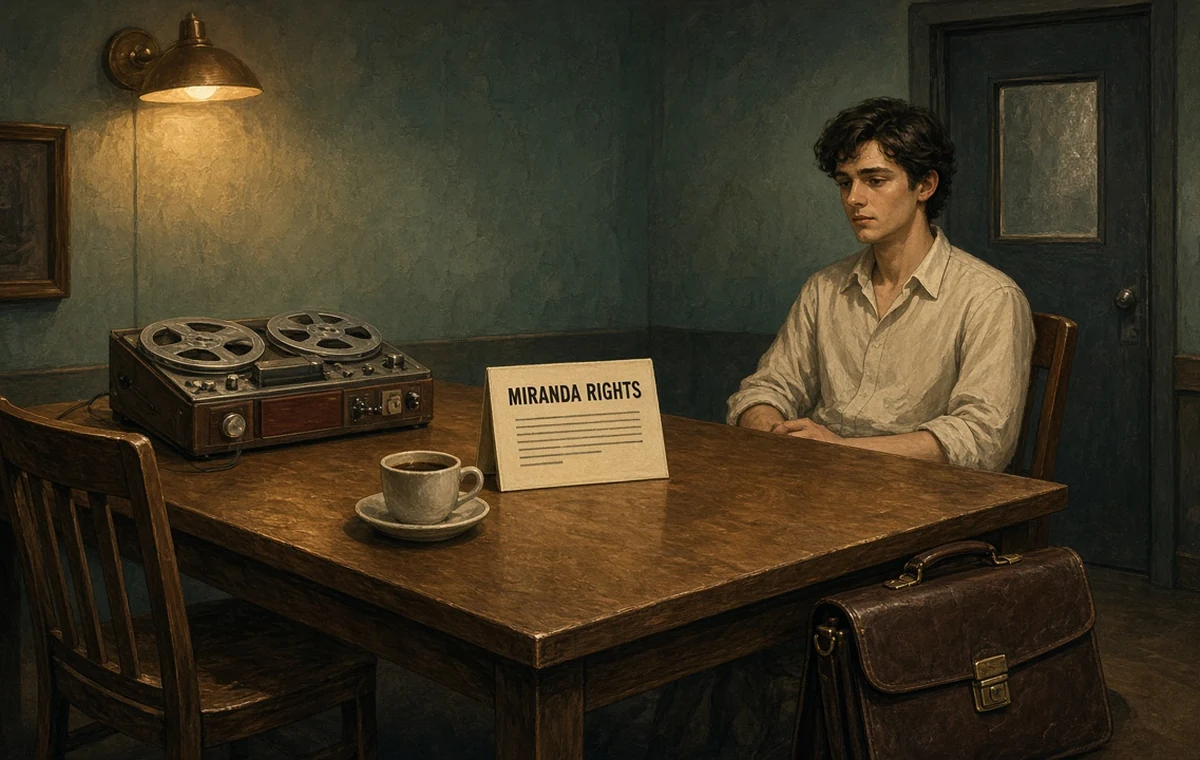
The Court reasoned that custodial interrogation is "inherently compelling": isolation, unfamiliar surroundings and trained questioners can wear down anyone. So before questioning a person in custody, police must warn that they have the right to remain silent, that anything they say can be used against them, that they have the right to a lawyer during questioning, and that a lawyer will be appointed if they cannot afford one. The two trigger words are custody and interrogation. A chat on the doorstep, a voluntary interview where you are free to leave, or a statement you blurt out unprompted generally does not trigger the warning at all.
The story has a twist worthy of a crime drama. Miranda's conviction was overturned, but prosecutors retried him in 1967 without the confession, using other evidence, and he was convicted again. He was killed in a bar fight in Phoenix in 1976; the suspect arrested for his death was, fittingly, read his Miranda rights. That history is a neat reminder that a Miranda violation affects which evidence can be used, not whether the defendant is innocent.

What has the Supreme Court said since 1966?
Miranda has been trimmed and tested for six decades, and three cases are worth knowing by name. In Dickerson v. United States, 530 U.S. 428 (2000), Congress's attempt to override Miranda with a statute (18 U.S.C. section 3501) failed. Chief Justice William Rehnquist, once a critic, wrote that the warnings had "become part of our national culture" and were a constitutional rule Congress could not simply legislate away.
Then came the case every student should underline. In Berghuis v. Thompkins, 560 U.S. 370 (2010), a murder suspect sat almost completely silent for roughly two hours and forty-five minutes of questioning. When a detective asked whether he prayed to God to forgive him for "shooting that boy down," he answered "Yes." The Court held that his long silence did not invoke the right; a suspect must invoke it unambiguously, and a later answer can amount to an implied waiver. Combined with Davis v. United States (1994), where "Maybe I should talk to a lawyer" was found too vague, the practical lesson is blunt: in the United States, silence must be spoken out loud. Saying "I am invoking my right to remain silent and I want a lawyer" does what staring at the wall does not.
The exceptions TV rarely shows
- Public safety: New York v. Quarles (1984) lets officers ask urgent questions, such as where a discarded gun is, before giving warnings.
- Impeachment: under Harris v. New York (1971), an unwarned statement may still be used to challenge a defendant who testifies differently at trial.
- No lawsuit for the warning alone: Vega v. Tekoh (2022) held that a Miranda violation by itself does not support a civil damages claim under 42 U.S.C. section 1983.
- Pre-arrest silence: in Salinas v. Texas (2013), a man who simply went quiet in a voluntary interview, without expressly claiming the privilege, saw that silence used against him.
None of this makes the warning meaningless. It still shapes millions of police encounters every year, and statements obtained in breach of it are routinely excluded from the prosecution's main case. It does mean that the real-world protection depends heavily on whether the person in the chair understands how to use it.
Skimming the section headings first makes a long guide much easier to map out. Try writing down one question of your own as you read.
How is the UK police caution different?
Cross the Atlantic and the script changes. In England and Wales, the Police and Criminal Evidence Act 1984 (PACE) and its Code C govern detention and questioning. Before an interview, officers give the caution: "You do not have to say anything. But it may harm your defence if you do not mention when questioned something which you later rely on in court. Anything you do say may be given in evidence."
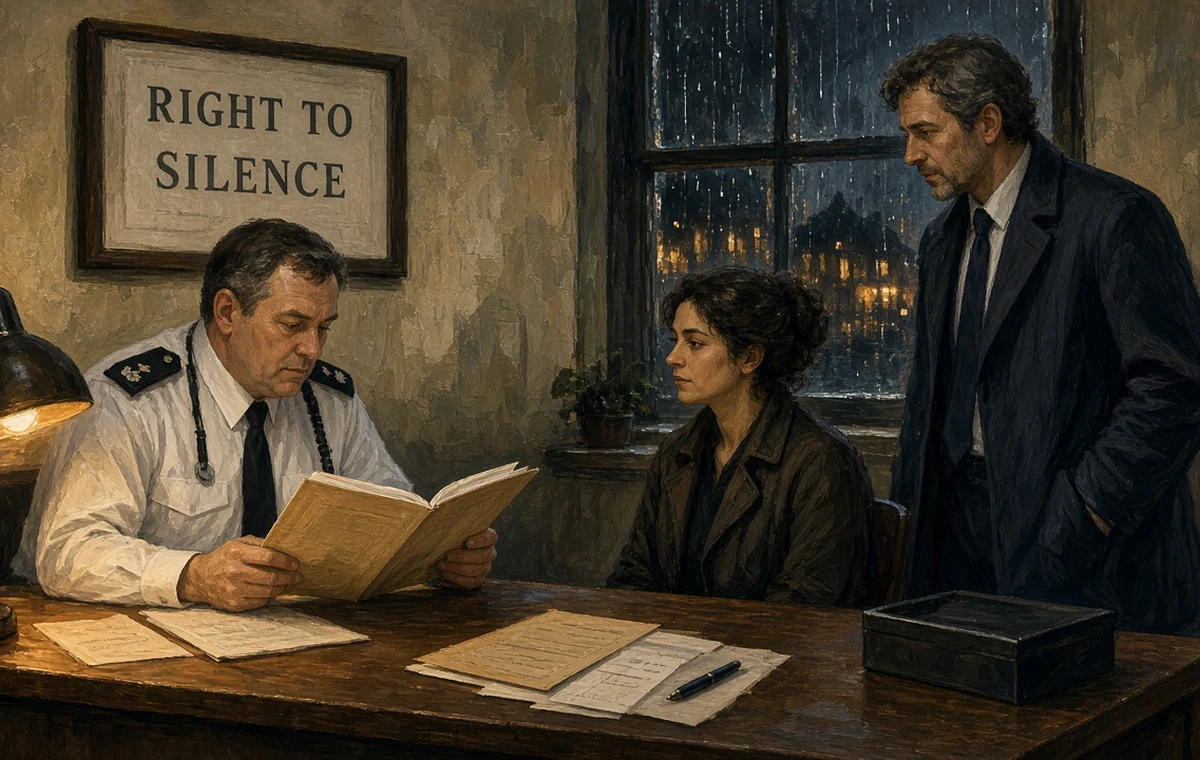
That middle sentence is the crucial difference. Since the Criminal Justice and Public Order Act 1994 (sections 34 to 37), a court or jury may draw "proper" adverse inferences if a suspect stays silent in interview and later produces a defence they could reasonably have mentioned. The right to silence still exists, and nobody can be convicted on silence alone, but in Britain staying quiet carries a potential price that an American suspect does not pay in the same way. The European Court of Human Rights accepted this model in John Murray v. United Kingdom (1996) while stressing safeguards, and in Condron v. United Kingdom (2000) it found unfairness where the jury was not properly directed.
The UK compensates with a strong right to legal advice. Under PACE section 58 anyone detained at a police station can consult a solicitor privately, free of charge, often through the 24-hour duty solicitor scheme. Interviews are audio-recorded, and a custody officer is responsible for the detainee's welfare and paperwork. Many solicitors still advise "no comment" interviews, but it is a tactical decision made with that inference risk in mind, frequently paired with a prepared written statement.
| Question | United States | England and Wales |
|---|---|---|
| Legal source | Fifth Amendment, Miranda v. Arizona (1966), Dickerson (2000) | PACE 1984 and Code C; Criminal Justice and Public Order Act 1994 |
| When it is given | Before custodial interrogation | On arrest and before an interview under caution |
| Can silence count against you? | Post-warning silence generally cannot be used as evidence of guilt | Courts may draw proper adverse inferences in defined situations |
| Lawyer | Right to counsel during questioning; appointed if indigent | Free, private legal advice at the station via duty solicitor |
| How to invoke | Must be clear and unambiguous (Berghuis) | "No comment" answers are recorded; inference risk explained in the caution |
Scotland, with its own legal system, uses a different common-law caution and does not have the English inference provisions, which is one more reason never to say "British law" when you mean the law of England and Wales.
Does a missing warning mean the case gets thrown out?
No, and this is the single biggest myth the TV version creates. In the US, the usual remedy for a Miranda failure is that the unwarned statement cannot be used in the prosecution's case-in-chief. Physical evidence, witness testimony and other lawful proof survive. Ernesto Miranda himself was convicted again without his confession. In England and Wales, a breach of PACE or Code C may lead a judge to exclude evidence under section 78 of PACE if admitting it would make the proceedings unfair, but that is a discretionary judgment, not an automatic acquittal.
So the accurate sentence for an essay is: "A failure to warn can make a particular statement inadmissible; it does not by itself establish innocence or end the prosecution." Whether a specific breach matters always depends on the facts, the jurisdiction and the evidence that remains, which is why real cases need a qualified lawyer rather than a blog post.
Where do students usually trip up?
Most marked-down answers make the same three moves: they treat Miranda as a universal rule, they forget the custody-plus-interrogation trigger, and they jump from "rights not read" to "case dismissed." Fixing those three lines turns a TV-quiz answer into a solid legal one.
Try this mini case
Imagine a student essay that says: "Because the officer in London forgot to say 'you have the right to remain silent,' the suspect must be released." Rewrite it by naming the jurisdiction (England and Wales), quoting the PACE caution instead of the American script, and explaining that any breach would be weighed under section 78 rather than ending the case automatically.
Three common mistakes
- Applying the American Miranda script to a British, Scottish or other non-US arrest.
- Assuming that simply staying quiet invokes the right in the US after Berghuis v. Thompkins.
- Equating exclusion of one statement with an automatic not-guilty verdict.
Quick self-check
- Did you say which country's law you mean?
- Did you identify custody and interrogation before invoking Miranda?
- Did you mention the UK adverse inference rule when comparing the two systems?
- Did you keep evidence rules separate from the final verdict?
For the full background of the 1966 ruling, continue with our wiki entry on Miranda v. Arizona (1966), and for the wider concept across legal systems read the right to silence.
Sources and scope
- US Supreme Court, Miranda v. Arizona, 384 U.S. 436 (1966)
- US Supreme Court, Dickerson v. United States, 530 U.S. 428 (2000); Berghuis v. Thompkins, 560 U.S. 370 (2010); Vega v. Tekoh, 597 U.S. 134 (2022)
- Police and Criminal Evidence Act 1984, section 58 and Code C (Home Office, legislation.gov.uk)
- Criminal Justice and Public Order Act 1994, sections 34 to 37
- NASA Science, Miranda (moon of Uranus)
Related on CampusDown Law Up: Do Campus Cops Have to Read You Miranda Rights? A Broke Student's Breakdown.
Compiled by the CampusDown editorial team from the original US Supreme Court opinions, UK legislation and official guidance. Reviewed: November 2026.
FAQ
Is Miranda an acronym?
No. It comes from the name of Ernesto Miranda, the defendant in the 1966 US Supreme Court case Miranda v. Arizona. The moon Miranda is a separate name taken from Shakespeare's The Tempest.
Do US police have to read Miranda rights at every arrest?
Not at the moment of every arrest. The warning is required before custodial interrogation. Without questioning, or without custody, the Miranda requirement is generally not triggered.
Is staying silent enough to invoke the right in the US?
Not reliably. In Berghuis v. Thompkins (2010) the Supreme Court said a suspect must invoke the right unambiguously, so it is safer to say clearly that you are remaining silent and want a lawyer.
What is the police caution in England and Wales?
Under PACE Code C officers say: You do not have to say anything. But it may harm your defence if you do not mention when questioned something which you later rely on in court. Anything you do say may be given in evidence.
If police forget the warning, is the suspect found not guilty?
No. In the US the unwarned statement is usually excluded from the main case, and in England and Wales a judge may exclude evidence under PACE section 78, but other evidence can still lead to a conviction.