
How Do Civil and Criminal Trials Differ? Korean Procedure, Summary Orders and the Burden of Proof, Compared with the US and UK
- A civil case starts with a plaintiff's complaint, a criminal case with a prosecutor's indictment.
- Civil liability needs a high probability, criminal guilt proof beyond reasonable doubt, so outcomes can differ.
- Minor criminal cases can be settled on the papers by summary order or a quick summary trial.
Contents
How can the same person be ordered to pay damages in a civil court yet walk free from a criminal court over the very same incident? It sounds like a contradiction, but it is built into the system: the two kinds of trial have different goals, different procedures and different standards of proof. Based on a Korean introduction-to-law assignment, this guide lines up a Korean civil lawsuit and a criminal trial step by step, shows where they split, compares them with American and British practice, and then applies the rules to a mock-trial case about posting a celebrity's photo online.
How do civil and criminal trials differ at a glance?
In a civil case one private party sues another to settle a dispute over money, property, contracts or harm. In a criminal case the state, through a public prosecutor, accuses a person of a crime and asks the court to impose punishment. That single difference explains almost everything else in the comparison below.
Student money tip from CampusDown Law UpHow to File a Title IX Complaint Against My College: The Two Paths — How to file a Title IX complaint against your college: use the campus Title IX office, file with the Office for Civil Rights, save…
| Stage | Civil trial | Criminal trial |
|---|---|---|
| Who starts it | The plaintiff files a complaint | A prosecutor files an indictment |
| Preparation | Preparatory proceedings: written briefs and a preparatory hearing when needed | Pre-trial preparation and disclosure of evidence |
| Shortcut procedures | Court-recommended settlement decisions | Summary orders on the papers; summary trials for petty offences |
| Standard of proof | A high degree of probability | Beyond reasonable doubt |
| Challenging the result | Appeal, final appeal, retrial | Appeal, final appeal, retrial, extraordinary appeal |
Setting the two procedures side by side in the same order makes it obvious where they part ways, and that makes the comparison paragraph of a law assignment far easier to organise. Keep this table in mind as we walk through each stage in more detail.

How does a Korean civil case move forward?
A civil court treats the two sides as equals, and each must prove the facts that support its own claim. Korea's 2002 overhaul of the Civil Procedure Act built a stage in which the parties exchange written briefs and narrow down the real points of dispute before the main hearing, so that the courtroom hearing itself can be short and focused. The overall flow is summarised in the wiki entry on civil procedure steps.

The source presents preparatory proceedings as the heart of every civil case, which needs one update. Since a 2008 amendment, Korean courts generally set a hearing date first and send a case to preparatory proceedings only when it actually needs them. Where those proceedings are used, a party who fails to raise an argument or piece of evidence there may, as a rule, be barred from raising it later, although the law allows exceptions. Organising your claims early is therefore still decisive.
Skimming the section headings first makes a long guide much easier to map out. Try writing down one question of your own as you read.
Why does a Korean criminal trial put the defendant's rights first?
On one side of a criminal trial stands the state, with police and prosecutors behind it; on the other stands an individual. Because the power gap is so large, Korea's Constitution guarantees due process (Article 12) and the presumption of innocence until a conviction becomes final (Article 27(4)), and doubtful facts are resolved in the defendant's favour.
Shortcuts for minor cases
- Summary order: for less serious cases a court can impose a fine, a petty fine or confiscation on the papers alone, without a public trial (Criminal Procedure Act, Article 448). The defendant can still request a formal trial.
- Summary trial: a judge quickly decides petty offences punishable by a fine of up to 200,000 won, short detention or a petty fine.
- Citizen participation trial: introduced in 2008, it lets jurors deliberate in certain serious cases, but their verdict is only advisory.
Matching the procedure to the seriousness of the case lets the system be both quick and protective of defendants, which is a defining feature of Korean criminal procedure.
Why is the standard of proof different?
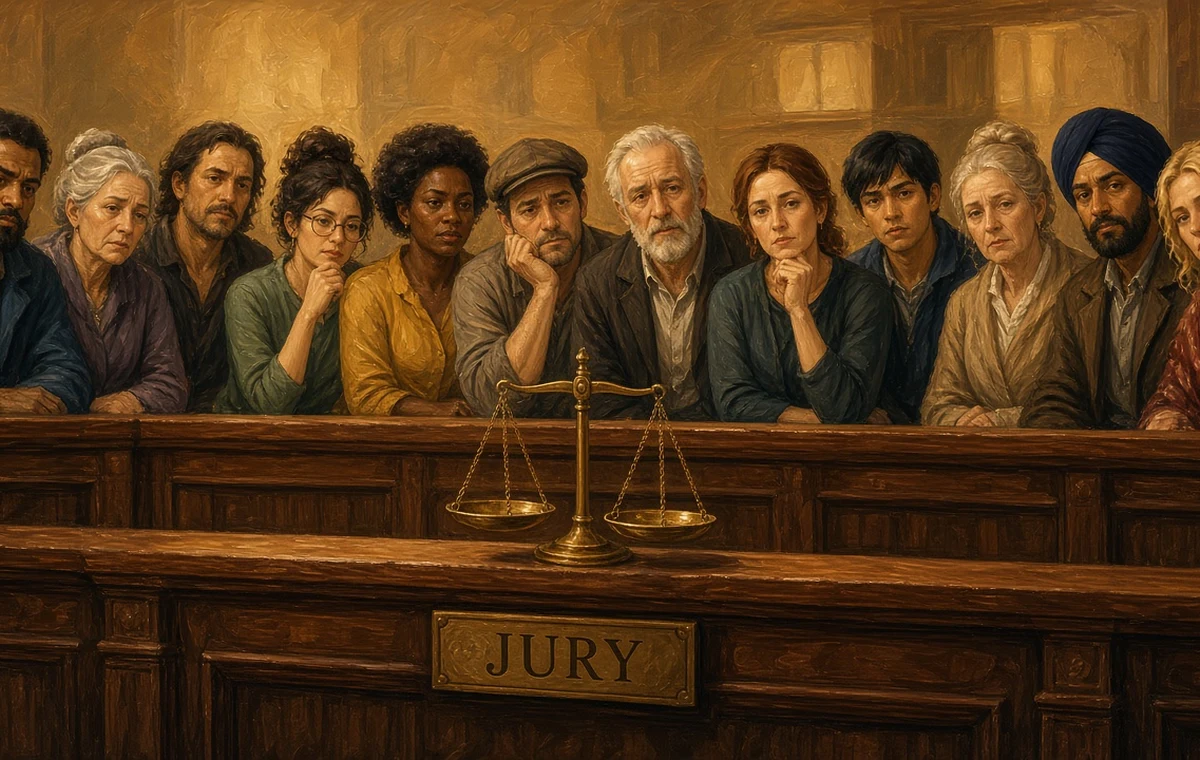
In a Korean civil case it is enough for the judge to be convinced that a fact is highly probable. To convict in a criminal case, the prosecution must prove guilt to the point that no reasonable doubt remains (Criminal Procedure Act, Article 307(2)). Punishment takes away a person's liberty, so the bar is higher, and that is why civil liability and a criminal acquittal can coexist for the same event.
Interestingly, the Korean civil standard of a high degree of probability is generally regarded by commentators as more demanding than the Anglo-American civil test. That contrast becomes clear when we look at how the United States and the United Kingdom handle the same divide, which is the focus of the next section.
How do the US and UK compare?
United States
American civil cases are decided on a preponderance of the evidence, meaning a claim must simply be more likely true than not, while criminal guilt must be proved beyond a reasonable doubt. The best-known illustration is O. J. Simpson, acquitted of murder in 1995 and then found liable for damages in a civil suit in 1997. American civil litigation also features broad pre-trial discovery under the Federal Rules of Civil Procedure, including depositions and document requests, and most civil cases settle before trial. On the criminal side, the Sixth Amendment guarantees a jury trial whose verdict binds the court, and the great majority of convictions come from plea bargains rather than trials.
United Kingdom
In England and Wales, civil claims are decided on the balance of probabilities, and the Civil Procedure Rules of 1998 introduced active case management and pre-action protocols that play a role similar to Korea's preparatory proceedings. In criminal cases, juries are told they must be sure of guilt. Magistrates' courts deal with the vast majority of criminal cases, and since 2015 the Single Justice Procedure allows many minor offences to be decided on the papers, much like a Korean summary order.
| Item | Korea | United States | England and Wales |
|---|---|---|---|
| Civil standard | High degree of probability | Preponderance of the evidence | Balance of probabilities |
| Criminal standard | Beyond reasonable doubt | Beyond a reasonable doubt | Sure of guilt |
| Lay participation | Advisory jury since 2008 | Binding jury verdicts | Binding jury verdicts in the Crown Court |
| Paper-based shortcut | Summary order | Plea bargains, citations | Single Justice Procedure |
The comparison shows that every system separates compensation from punishment, but each draws the lines in its own way. Keeping Korea's stricter civil standard and advisory jury in view helps you avoid assuming that American courtroom dramas describe Korean law.
How would you assess the mock-trial celebrity photo case?
In the mock trial, one side complained that a celebrity's photo had been taken and posted without permission and stayed online even after the agency asked for its removal. The other side argued that it simply reported something the public was interested in, and that the camera had been used for another purpose.
Student money tip on CampusDown Law Up: How to File a Title IX Complaint Against My College: The Two Paths.
The assignment concluded that keeping the post up after a removal request amounted to defamation, that taking the photo alone was hard to punish, and that the public's interest in a celebrity was unlikely to justify the conduct. A careful analysis should add one caveat: defamation requires a statement of fact that lowers a person's social reputation, so a photo that implies nothing false or degrading is more often a civil question of portrait and publicity rights than a crime. Korean law can, however, punish even true statements that damage reputation unless they serve the public interest. The legal background is covered in the wiki entry on defamation in Korea.
Splitting each side's arguments by issue turns a mock-trial reflection into genuine legal analysis rather than a simple impression.
- Did you separate the civil claim from any criminal charge?
- Did you name the standard of proof for each?
- Did you check whether a false or degrading fact was actually stated?
- Did you consider portrait and publicity rights as an alternative?
- Did you weigh the public-interest defence?
FAQ
Can a summary order be challenged?
Yes. The defendant can request a formal trial and contest the case in open court.
What is an extraordinary appeal?
A criminal-only remedy in which the Prosecutor General asks the Supreme Court to correct a final judgment that violated the law.
Is a Korean jury verdict binding?
No. In citizen participation trials the jury's verdict is only advisory.
Why can someone be liable in civil court but acquitted in criminal court?
Because the criminal standard of proof is stricter, so evidence that satisfies a civil court may still leave reasonable doubt.
Is posting a celebrity's photo always defamation?
No. Defamation needs a damaging statement of fact; many photo cases are civil portrait or publicity-right disputes instead.