
How Does an Idea Become a Patent? Five Legal Gates From Novelty to First-to-File, Compared With US and UK Law
- An invention becomes a patent only after filing and examination, not when it is finished.
- Novelty asks whether it is new; inventive step asks whether a skilled person would find it obvious.
- When two people file the same invention, the earlier applicant wins, now in the US too.
Contents
- What does an invention need before it becomes a patent?
- How are novelty and inventive step different?
- Why do the earlier-application rules confuse everyone?
- How does the United States apply the same gates?
- What changes in the United Kingdom?
- How do Korea, the US and the UK compare?
- Where do students get stuck?
- FAQ
You have a brilliant idea, a working prototype and a family who gasped when you pulled the cloth off it. Congratulations. You still do not have a patent. A patent is not something you earn by inventing; it is something an examiner grants after your application clears a series of legal gates. This guide walks through the five gates in Korean patent law, explains the difference between novelty and inventive step, and shows how the same ideas look under US and UK law, where the details trip up students and inventors alike.
What does an invention need before it becomes a patent?
Patentability requirements are the legal conditions an invention must meet before the state grants exclusive rights. Finishing the invention gives you nothing on its own. You must file an application with the patent office and survive examination, where the examiner asks in turn whether the invention can be used in industry, whether it is new, whether it would have been obvious and whether someone else got there first.
Related on CampusDown Law UpCan I Patent an Idea From My College Class Project? — a broke student's plain guide to ownership, public disclosure, and USPTO basics.
The source is a 19-page study note that organises Korean patent requirements into five strands: industrial applicability, novelty, inventive step, the status of an enlarged earlier application, and the first-to-file principle. A useful study trick is to attach one plain question to each gate, such as "could a factory actually use this?" or "is it different from what is already known?", so you can spot the live issue the moment you read a problem question.
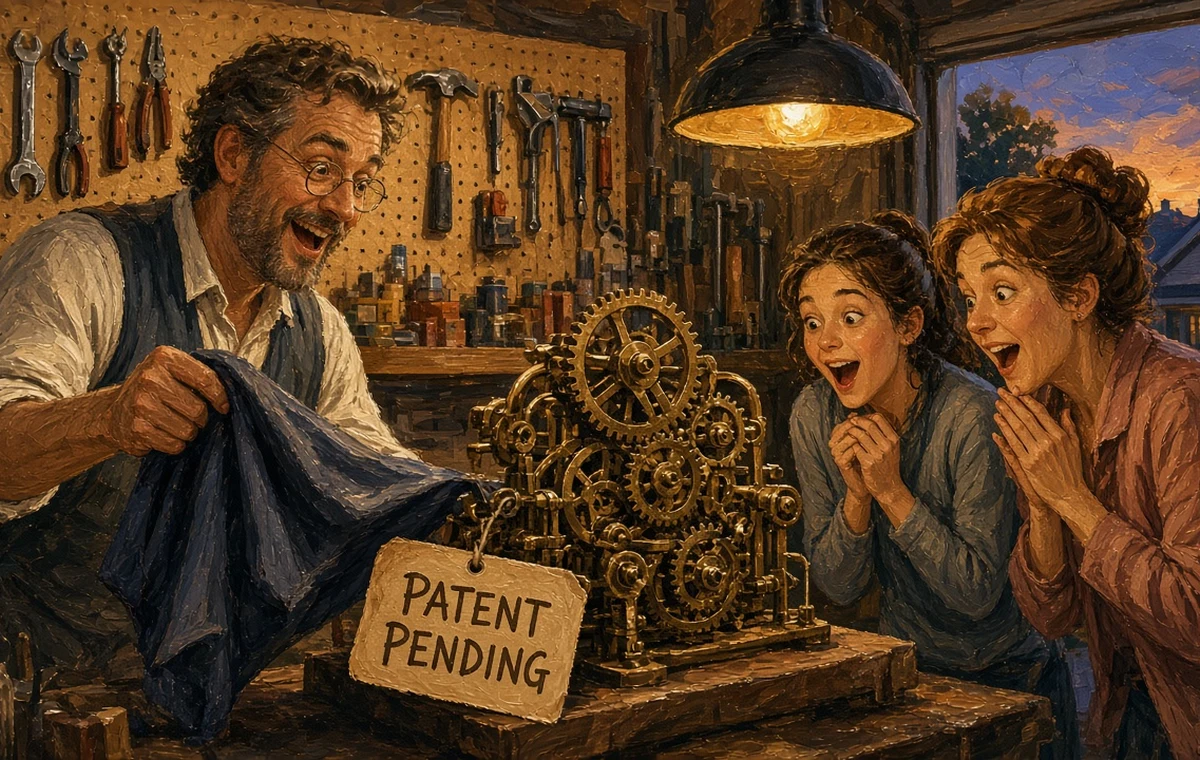
That proud unveiling is lovely, but it is also exactly the kind of public disclosure that can come back to haunt an inventor who has not yet filed, which brings us to novelty.

How are novelty and inventive step different?
Novelty asks whether the same invention was already known before your filing date, whether through public knowledge, public use or publication. Inventive step asks a harder question: would a person skilled in that field have found the invention easy to arrive at? An invention can be new in every detail and still fail because the step from the prior art was too small.
The trap in inventive step is hindsight. Once you see the solution, it always looks obvious, just as a finished puzzle looks simple. Examiners and courts therefore try to reconstruct what the skilled person knew before the invention, not after. Our wiki page on patentability requirements sets out the main tests side by side.
Korea also gives inventors a safety net called the grace period for their own disclosures. If you present the invention at a conference or post it online, you can still file within the statutory period, which Korea extended from six months to twelve. Many students still memorise the old six-month figure.
Skimming the section headings first makes a long guide much easier to map out. Try writing down one question of your own as you read.
Why do the earlier-application rules confuse everyone?
Two rules deal with competing applications. The first-to-file principle says that when two people apply for the same invention, the earlier applicant wins. The enlarged earlier application rule goes further: if an earlier application, published only after you filed, describes your invention anywhere in its specification, you cannot get a patent for it even though nobody could have read that application on your filing date.
The two differ in what gets compared, the claims or the whole specification, and in what happens when the applicant is the same person. A one-page table of these differences, with the article numbers beside each row, saves real panic in an exam hall.

The race above is comic, but it captures a real policy choice. Rewarding whoever files first gives certainty and speed, at the cost of occasionally favouring the quicker paperwork over the earlier inventor.
How does the United States apply the same gates?
From first-to-invent to first-inventor-to-file
For most of its history the United States was the odd one out, awarding patents to the first person to invent rather than the first to file. The Leahy-Smith America Invents Act of 2011 changed that, and applications filed from 16 March 2013 follow a first-inventor-to-file system. Unlike many countries, the US keeps a one-year grace period for the inventor's own disclosures, and many start-ups use a cheaper provisional application to lock in a filing date for twelve months while they test the market.
Eligibility, novelty and non-obviousness
US law splits the gates across sections of Title 35 of the US Code: section 101 for patent-eligible subject matter and utility, section 102 for novelty and section 103 for non-obviousness. The Supreme Court's 1966 decision in Graham v. John Deere set the framework for obviousness and warned against hindsight, and the 2007 KSR v. Teleflex decision made the test more flexible. Eligibility has its own drama: after Alice v. CLS Bank in 2014, many software and business-method patents fell as abstract ideas. Medical treatment methods can be patented in the US, but a special rule largely shields doctors from infringement claims for performing them, a striking contrast with Korea's approach.
The US is also home to the most famous abuses of the system. Companies that buy patents purely to demand licence fees, without making anything, are discussed on our page about the patent troll.
What changes in the United Kingdom?
The UK Patents Act 1977, aligned with the European Patent Convention, asks that an invention be new, involve an inventive step and be capable of industrial application. Methods of treating or diagnosing the human or animal body are excluded, much as in Korea, while new medical devices and drugs remain patentable. Courts test inventive step with the structured Windsurfing approach, refined in the Pozzoli case in 2007: identify the skilled person, the inventive concept, the difference from the prior art, and whether that difference would have been obvious.
The biggest practical shock for students is that the UK and Europe offer almost no general grace period. Show your invention publicly before filing and you may have destroyed your own novelty, with only narrow exceptions such as breach of confidence. European law does, however, contain its own version of the enlarged earlier application idea, treating the whole contents of earlier but later-published applications as prior art for novelty. Applications are examined by the Intellectual Property Office, and specialist patent attorneys handle most filings.
How do Korea, the US and the UK compare?
| Gate | Korea | United States | United Kingdom |
|---|---|---|---|
| Industrial use | Industrial applicability; medical treatment methods excluded in practice | Utility and subject-matter eligibility | Industrial application; treatment methods excluded |
| Newness | Novelty | Novelty under section 102 | Novelty |
| Obviousness | Inventive step | Non-obviousness under section 103 | Inventive step, Windsurfing and Pozzoli test |
| Priority | First to file | First inventor to file since 2013 | First to file |
| Own disclosure | Grace period, now twelve months | One-year grace period | Almost none |
The table shows why international inventors are told to file before they talk. A disclosure that is harmless in Seoul or Silicon Valley can be fatal in London.
Where do students get stuck?
The exceptions cause the most trouble, especially the grace period and the industrial applicability of medical inventions. Common slips include learning the old grace period, treating a medical procedure and a medical device as the same thing, and memorising conclusions without the cases that support them.
Also on CampusDown Law Up: Can I Patent an Idea From My College Class Project?
A good revision method is to copy out the key articles of the Patent Act yourself, pair each requirement with one leading case, and fit the result on a single summary page.
- Have you organised all five gates in the same format?
- Have you separated novelty from inventive step?
- Have you checked the articles in the current statute?
- Have you confirmed the current grace period?
- Have you paired each requirement with a case?
Then pick an everyday gadget and run it through all five gates in order; it is the fastest way to see whether you really understand them.
Who will find this useful?
This guide suits students of patent law or intellectual property and anyone preparing for a patent attorney qualification.
FAQ
Can I patent a medical treatment method?
Korea and the UK exclude treatment methods, though devices and drugs can be patented; the US allows them but shields doctors from most infringement claims.
What is a grace period?
A window in which your own public disclosure does not count against your novelty; the US allows one year, while the UK offers almost none.
When did the US switch to first-to-file?
Under the America Invents Act, applications filed from 16 March 2013 follow a first-inventor-to-file system.
Who judges inventive step?
The notional person skilled in the relevant field, judged without hindsight.
Where can I read UK patent law?
The Patents Act 1977 is on legislation.gov.uk, and the Intellectual Property Office publishes its Manual of Patent Practice.