
How to Tell the Five Percussion Sounds Apart: Resonance, Tympany, Dullness and More in Nursing Assessment
- Percussion means tapping the body surface and listening to the sound to estimate how dense the tissue underneath is.
- A normal lung gives resonance, the stomach gives tympany and the liver gives dullness.
- The abdomen is assessed in the order inspection, auscultation, percussion, palpation.
Contents
- What is percussion for?
- How do you perform percussion?
- What are the five percussion sounds?
- Why do hollow and solid things sound different?
- What do abnormal findings mean?
- In what order do you use the four techniques?
- Positioning and comparing both sides
- A checklist before practice
- How to document what you hear
- FAQ
Tapping a finger on someone's chest looks simple, but telling the sounds apart takes a clear rule of thumb. Once you grasp one principle, that the more air there is the more the sound rings, and the denser the tissue the duller it becomes, the five percussion sounds fall into place. These study notes cover the percussion section of a nursing health assessment course, from technique to documentation.

What is percussion for?
Percussion is an assessment method in which you tap the body surface and use the resulting sound and vibration to judge whether the organ underneath is filled with air, fluid or solid tissue. It is also used to check the size and borders of organs, such as the lower edge of the lungs or the span of the liver. The technique has a long history: the Viennese physician Leopold Auenbrugger described it in 1761, reportedly inspired by watching his father, an innkeeper, tap wine barrels to judge how full they were.
Student money tip from CampusDown Repair UpLight Switch Warm to the Touch: When to Worry — Light switch feeling warm?
In nursing education, percussion is taught as one of the core skills of assessment, the first step of the nursing process, alongside inspection, palpation and auscultation. A percussion finding only has meaning when it is interpreted together with other data: the patient's history, vital signs, breath sounds and how they look and feel. On its own, a dull note is a clue, not a diagnosis.

How do you perform percussion?
The method you will use most is indirect (mediate) percussion. Press the middle finger of your non-dominant hand firmly against the skin, keeping the other fingers lifted so they do not dampen the sound. With the tip of the middle finger of your dominant hand, strike the distal interphalangeal joint, the last knuckle of the pressed finger, twice in quick succession. The movement comes from a loose, flexible wrist, not from the forearm or shoulder. Lift the striking finger away immediately after each tap; leaving it in place muffles the note. Short fingernails on the striking hand are essential, both for comfort and for a clean sound.
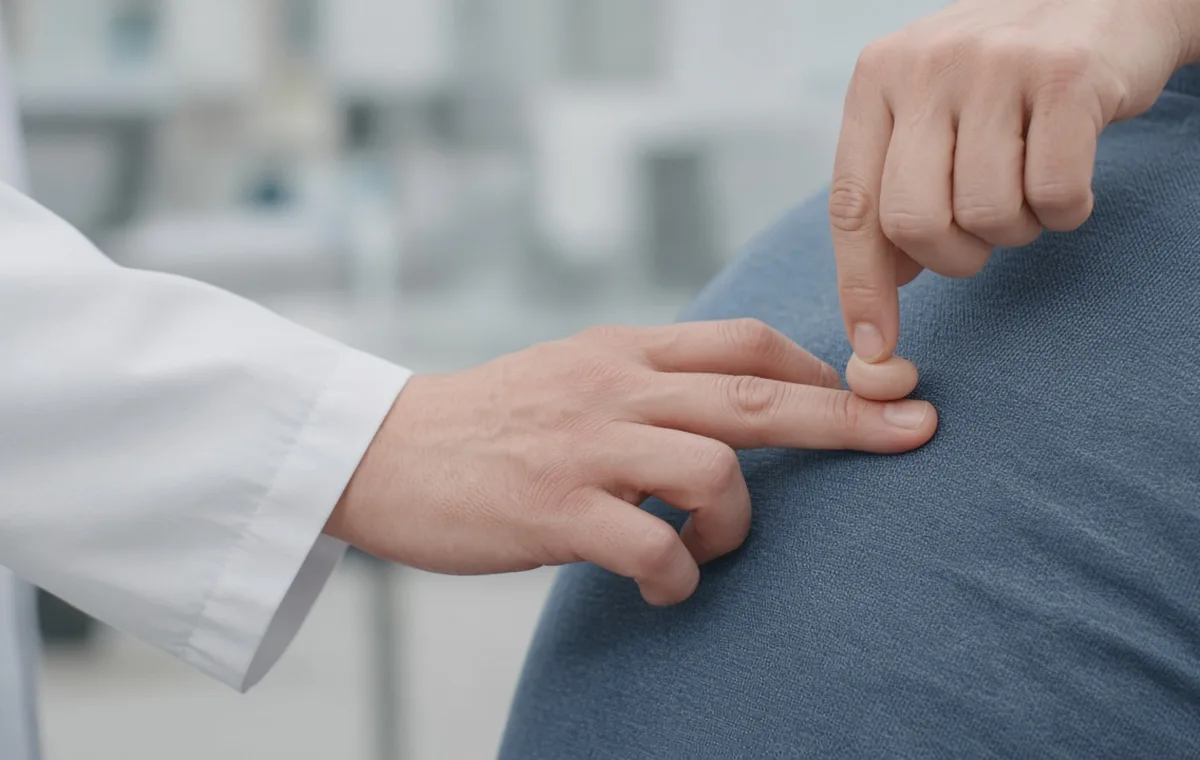
Direct (immediate) percussion means tapping the body itself with a finger or fist. Fingertip tapping is used over the sinuses, and gentle fist percussion over the costovertebral angle is used to check for kidney tenderness, where the question is whether the blow causes pain rather than what it sounds like.
Skimming the section headings first makes a long guide much easier to map out. Try writing down one question of your own as you read.
What are the five percussion sounds?
| Sound | Character | Typical location | Abnormal example |
|---|---|---|---|
| Resonance | Low-pitched, hollow, long | Normal lung | (normal finding) |
| Hyperresonance | Lower, booming, longer | Not normal in adults | Emphysema, pneumothorax |
| Tympany | High-pitched, drum-like | Stomach, gas-filled bowel | Large tympanic area in a distended abdomen |
| Dullness | Medium pitch, short, thud-like | Liver, heart | Pneumonia, pleural effusion over the lung |
| Flatness | High-pitched, very short, no resonance | Thigh muscle, bone | Large pleural effusion |
Resonance is the low, hollow sound of a normal, air-filled lung. Hyperresonance is lower and more booming, and appears when there is too much air, as in emphysema or a pneumothorax. Tympany is the high, drum-like sound over the stomach or a gas-filled bowel. Dullness is a short thud heard over dense organs such as the liver or heart. Flatness is the dullest and shortest of all, the sound you get over a thigh muscle or bone.
Why do hollow and solid things sound different?
The principle behind percussion is much like striking a drum. When a space is filled with air, the vibration spreads widely and lasts; when it is filled with fluid or solid tissue, the vibration is quickly absorbed and the sound becomes short and dull. Tapping a melon to judge its ripeness works on the same idea. You can train your ear before you ever touch a patient by tapping everyday objects: an empty cardboard box, a solid desk, a bottle of water, a half-filled bottle. Listening to how the sound changes with what is inside makes the clinical sounds familiar very quickly.
What do abnormal findings mean?
If you hear dullness over the lung fields, where resonance would be expected, suspect tissue consolidated by pneumonia or fluid in the pleural space from a pleural effusion. Conversely, when air is excessive, as in a pneumothorax or emphysema, the note becomes hyperresonant. The change in sound is effectively telling you about a change in the tissue underneath.
Breathing is listed first among Virginia Henderson's 14 basic needs, a reminder of how central respiratory assessment is, so record respiratory findings carefully and in detail.
The same principle works in the abdomen. With the patient lying on their back, fluid settles to the sides, so the flanks sound dull while the central area, where gas-filled bowel floats, sounds tympanic. If you then turn the patient onto one side and the border of dullness moves, this is called shifting dullness and supports a suspicion of ascites. Percussion is also used to estimate the liver span along the right midclavicular line, usually given as about 6 to 12 cm in adults, by finding where resonance over the lung changes to dullness over the liver above, and where dullness changes to tympany below.
Record findings like these as clues for reporting and further investigation, not as a diagnosis. A nurse documents that dullness was heard and where, reports it, and the team decides what tests are needed.
In what order do you use the four techniques?
Physical assessment combines four techniques. Inspection gathers what you can see: skin colour, symmetry, movement and swelling. Palpation uses the hands to check temperature, tenderness, lumps and vibration. Percussion uses tapping to find out whether air, fluid or solid tissue lies beneath. Auscultation uses a stethoscope to listen to breath sounds, heart sounds and bowel sounds.
| Technique | What it tells you | Point to watch |
|---|---|---|
| Inspection | Skin colour, symmetry, movement, swelling | Good lighting and adequate exposure |
| Palpation | Temperature, tenderness, lumps, vibration | Touch painful areas last |
| Percussion | Distribution of air, fluid and solid tissue | Compare left and right at the same level |
| Auscultation | Breath, heart and bowel sounds | Place the stethoscope directly on the skin |
Most body areas, including the chest, are assessed in the order inspection, palpation, percussion, auscultation. The abdomen is the exception: after inspection you auscultate first, then percuss and palpate. Tapping or pressing first can stimulate bowel movement and change the bowel sounds you are trying to hear. This comes up often in exams, so remember it simply: in the abdomen, listen before you touch.
Positioning and comparing both sides
Position makes a big difference to accuracy. To percuss the back of the chest, sit the patient up and ask them to fold their arms across the front of their body; this moves the shoulder blades apart and exposes more of the lung fields. For the abdomen, lay the patient flat and ask them to bend their knees slightly so the abdominal muscles relax.
Comparing left and right is the most basic way to detect an abnormality. If one lung gives resonance but the same spot on the other side gives dullness, that difference is itself an important finding. Get into the habit of moving side to side at the same level, in a ladder pattern down the back, rather than percussing all of one side and then all of the other. When a sound is ambiguous, tap the matching spot on the opposite side again, and check your interpretation against what you hear on auscultation.
A checklist before practice
- Are your hands warm and your fingernails short?
- Have you explained what you are going to do and obtained consent?
- Is the room quiet and well lit, with only the necessary area exposed?
- Are you following inspection, auscultation, percussion, palpation for the abdomen?
- Are you comparing both sides symmetrically?
Assessment happens within a relationship of trust. However good your technique, touching someone suddenly with cold hands or lifting their clothes without explanation makes them tense up, and tense muscles reduce the accuracy of palpation and percussion. Get into the habit of saying what you are about to do at each step, such as 'I'm going to tap gently on your tummy now.'

How to document what you hear
When you document, record both the location and the sound. Rather than simply writing 'normal', note where you percussed and what you found, for example: 'Dullness on percussion over the right lower lobe posteriorly; resonance on the left.' Recording the comparison between sides lets the next nurse see changes easily. Follow your institution's assessment standards and documentation format.
Student money tip on CampusDown Repair Up: Light Switch Warm to the Touch: When to Worry.
Practise with a classmate before placements by percussing each other's chest and abdomen, and try to find the point where the sound changes at the border of the liver. Feeling that change under your own fingers stays with you far longer than any exam question. It is normal for the sounds to seem hard to tell apart at first. Keep listening to the same areas again and again, and at some point the differences will start to sound clear.
CampusDown Editorial Team, reviewed November 2026. Sources: Jarvis, C., Physical Examination and Health Assessment; Bickley, L. S., Bates' Guide to Physical Examination and History Taking; Henderson, V., The Nature of Nursing.
FAQ
What percussion sound does a normal lung make?
Resonance.
What percussion sound is heard in emphysema?
Hyperresonance.
What is the order of abdominal assessment?
Inspection, auscultation, percussion, palpation.