
Do Unions and Management Always Fight? Five Types of Labour Relations, US and UK Law and Codetermination
- Labour relations are bargaining between employers and workers over pay and conditions.
- They range from absolute control and open conflict to armed truce, harmony and cooperation.
- US law rests on the NLRA and NLRB, while the UK relies on ACAS and strike ballot rules.
Contents
Do management and unions only ever fight? The news tends to show the dramatic moments: picket lines, walkouts and late-night talks. Yet most of the time employers and unions are doing something duller and more interesting, which is bargaining, compromising and occasionally solving problems together. This guide reworks a Korean student report on the five types of labour relations, then shows how the same patterns play out under American and British law.
What are labour relations?
The report defines labour relations as the bargaining relationship between the owners of the means of production, the employers, and the owners of labour power, the workers, over wages and working conditions. That gives the relationship a dual character. It is a relationship between an employer and an employee, and at the same time a relationship between management as an organisation and a trade union as a collective. The report stresses that no single angle explains it; you have to look at many conditions together.
Student money tip from CampusDown Repair UpRenters insurance water claim denied? What to do next — get the reason in writing, match it to your policy wording, gather proof and ask for a review.
It also explains why the topic grew so important. As globalisation and open markets exposed firms to fierce competition, the quality of labour relations became tied to the livelihoods of whole societies. In Korea the turning point was the 1997 financial crisis. The new government that took office in early 1998 pushed structural reform across finance, corporations, the public sector and labour, and in the labour field the push for flexible employment made collective dismissals a central issue, which sharpened conflict between workers and employers.

Through which lenses can we study them?
The report offers three dimensions. The legal dimension treats labour relations as contracts, rights and duties. The economic dimension sees them as a market in which labour is bought and sold. The human-relations dimension focuses on people working together inside hierarchical organisations. These views do not exclude one another, and the same dispute can look quite different depending on which one you choose.
In a redundancy dispute where livelihoods are at stake, for example, legal and economic logic alone rarely settles the conflict. A human-relations view, which deals with trust between the people at the table, becomes necessary as well. That is a useful point to make in any essay that moves from theory to a real case study.
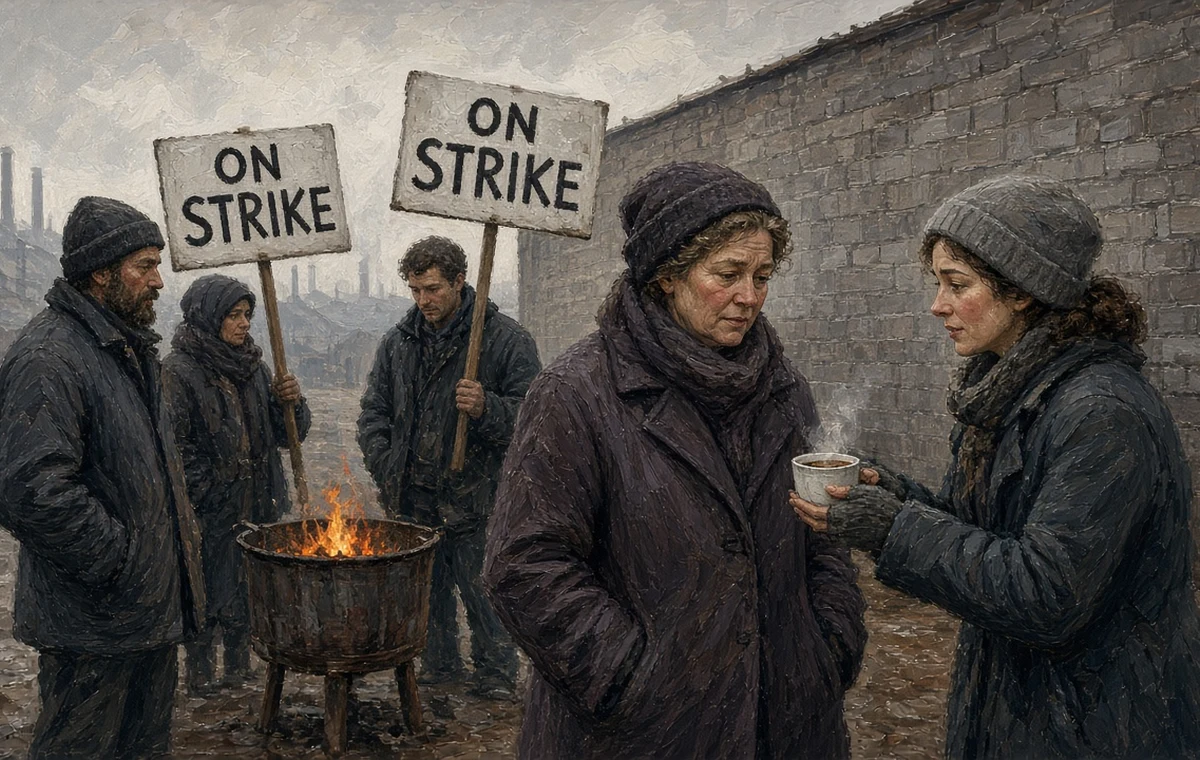
The picture captures the emotional side of conflict that numbers miss: a strike is a hard decision made by people who would usually rather be at work.
Skimming the section headings first makes a long guide much easier to map out. Try writing down one question of your own as you read.
What are the five types of labour relations?
The report lays out a ladder from domination to partnership. Under absolute labour relations, wages and conditions are set solely by the employer. In open conflict, management confronts the union and refuses to give ground. Under an armed truce, power still faces power, but collective bargaining keeps the struggle within rules. Working harmony is a middle stage found in a socially mature setting. In union-management cooperation, the two sides respect each other and tackle shared problems together; the report notes this is seen mostly in smaller firms, a view best presented as part of its typology rather than a general fact.
One correction is worth making. The reference behind the typology, Harbison and Coleman's 1951 study of collective bargaining, focused mainly on three patterns: armed truce, working harmony and union-management cooperation. The two harsher stages at the bottom of the ladder are common textbook additions. Moving down the list, dialogue gradually replaces confrontation, and the principle that the parties settle their own affairs is respected more and more. Bargaining strategy itself is covered in our guide to negotiation theory.

The tired faces around that table show what an armed truce feels like in practice. Nobody has given up their interests, but everyone has agreed to argue by the rules instead of in the car park.
How do the US and UK frame labour relations?
United States: the NLRA and the NLRB
American private-sector labour law rests on the National Labor Relations Act of 1935, often called the Wagner Act. It protects workers' rights to organise, bargain collectively and take part in concerted activity such as strikes, and it created the National Labor Relations Board to run union elections and decide unfair labour practice cases. The Taft-Hartley Act of 1947 added limits on unions and allowed states to pass so-called right-to-work laws, which bar contracts requiring workers to pay union fees as a condition of employment. Bargaining usually happens firm by firm, and once a union wins recognition the employer must bargain in good faith.
The US also shows the whole typology at once. Some industries have long histories of bitter open conflict, others settle into an armed truce of tough contract rounds every few years, and a few have experimented with joint labour-management committees that look like the cooperative end of the ladder.
United Kingdom: ACAS and strike ballots
Britain built its system on voluntary collective bargaining with relatively little law, though statute has grown since the 1980s. The Advisory, Conciliation and Arbitration Service, or ACAS, offers free conciliation before many employment tribunal claims and helps resolve collective disputes. A strike is lawful only after a properly run postal ballot, and the Trade Union Act 2016 added a turnout threshold of at least half of eligible members, with extra support requirements in important public services. Recent legislation has moved to loosen several of these rules.
British debates about worker voice also echo continental ideas, with recurring proposals to put workers on company boards. That brings us to the comparison with Korea and Germany.
How do bargaining and joint councils compare?
In Korea, Article 33 of the Constitution guarantees the three labour rights: to organise, to bargain collectively and to take collective action. The Trade Union and Labour Relations Adjustment Act gives them detail. A collective agreement takes precedence over individual contracts and work rules, and its maximum term is fixed by law; a 2021 amendment extended that cap from two years to three. Separately, the Act on the Promotion of Worker Participation and Cooperation requires labour-management councils at workplaces above a certain size to discuss productivity, training, grievances, safety and health.
| Item | Collective bargaining | Labour-management council |
|---|---|---|
| Legal basis | Trade Union and Labour Relations Adjustment Act | Worker Participation and Cooperation Act |
| Parties | Trade union and employer | Worker members and employer members |
| Character | Adjusting conflicting interests | Cooperation on shared concerns |
| Outcome | Collective agreement | Consultation and resolutions |
| Closest UK or US equivalent | Union contract or recognition agreement | Joint consultative committee |
At national level, Korea set up a tripartite commission of labour, business and government during the 1998 crisis, renamed the Economic, Social and Labor Council in 2018 to include young people, women, non-regular workers and small firms. Germany is the classic model of codetermination: elected works councils take part in personnel decisions, and in large companies employee representatives hold a substantial share of supervisory board seats. Korea introduced worker directors on the boards of public institutions in 2022, though whether to extend the idea to private firms is still debated.
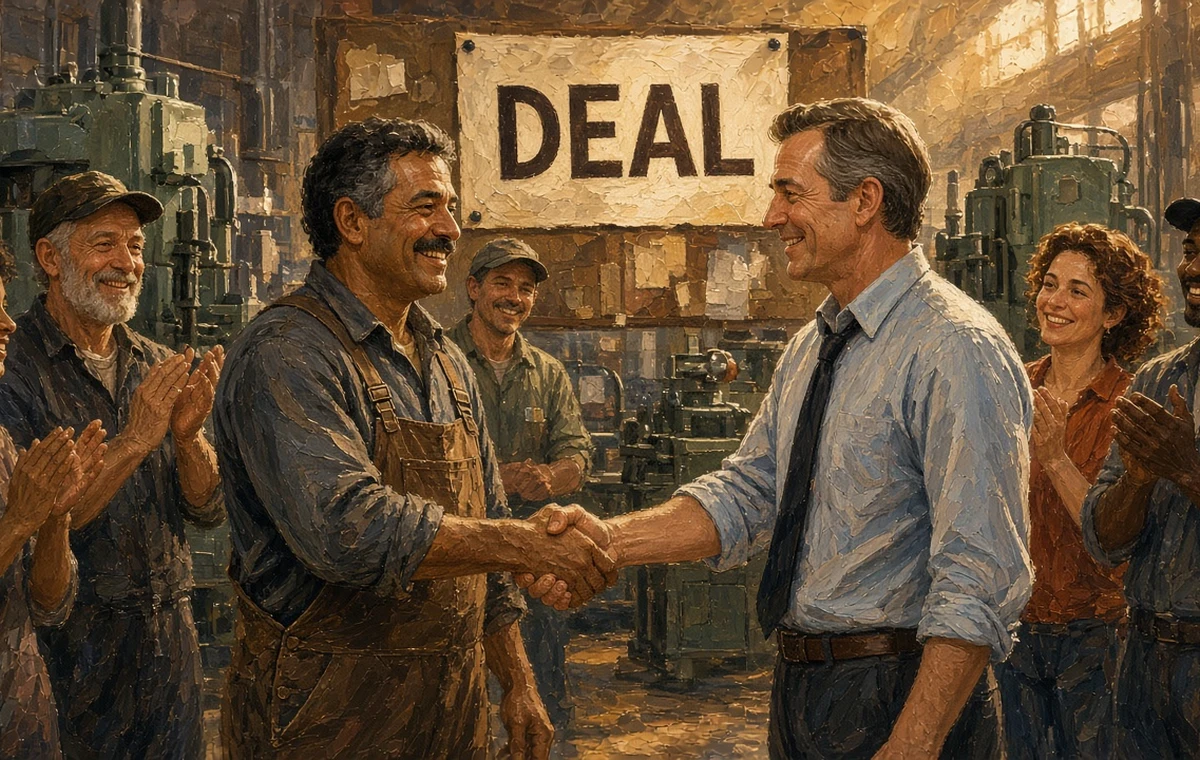
The handshake in the picture is the moment the ladder is meant to reach. It does not end disagreement, but it turns conflict into a rulebook both sides helped to write.
How should you write the assignment?
A natural order is: definition and dual character, why the subject became important, the three analytical dimensions, then a comparison of the five types. To connect the topic with company strategy, our page on strategic human resource management is a good companion.
Student money tip on CampusDown Repair Up: Renters insurance water claim denied? What to do next.
- Have you explained the dual character of labour relations?
- Have you used at least two of the three lenses?
- Have you credited the typology to its source and noted the textbook additions?
- Have you compared bargaining with joint councils?
- Have you placed your own country on the ladder with reasons?
Finish by judging where your own society sits on the ladder and what conditions would move it from confrontation towards cooperation. That gives the conclusion a view of its own.
Who will find this useful?
This structure suits students of business, human resource management, sociology and employment law.
FAQ
What does the National Labor Relations Act do?
It protects US private-sector workers' rights to organise and bargain collectively and created the NLRB to enforce them.
What is ACAS?
Britain's Advisory, Conciliation and Arbitration Service, which offers free conciliation and helps settle workplace disputes.
What is an armed truce in labour relations?
Both sides keep their power and interests but agree to settle conflict through collective bargaining rules.
Where does the five-type ladder come from?
It builds on Harbison and Coleman (1951), who described armed truce, working harmony and cooperation; textbooks add the harsher stages.
What is codetermination?
A German system in which works councils and employee board members share in key company decisions.