
Cultural Relativism Examples: Food Taboos, Gestures, the Jeju Refugee Case and Where It Stops
- Cultural relativism means understanding a practice in its own culture before judging it.
- Food taboos, eating by hand and gestures are classic everyday examples.
- It does not excuse harm such as FGM or abuse, where universal human rights apply.
Contents
Cultural relativism means trying to understand a practice within the culture that produced it before judging it by your own standards. The classic everyday examples are food taboos, such as Hindus not eating beef and Muslims not eating pork, eating with the hand rather than cutlery, and gestures like nodding or eye contact that mean different things in different places. Its limit is equally important: understanding a practice is not the same as accepting harm, so universal human rights still apply. The idea was popularised by the American anthropologist Ruth Benedict in Patterns of Culture (1934), and it remains one of the most useful lenses for essays, nursing and social-care courses, and for living in a diverse country such as the UK. This guide gives clear examples, a real refugee case, the limits of relativism and a framework for analysing any case.
What is the difference between cultural relativism and ethnocentrism?
The simplest way to remember the difference is "judge first, or understand first". Ethnocentrism treats your own culture as the yardstick and labels anything different as strange, backward or wrong. Cultural relativism asks what a practice means to the people who follow it, and what job it does in their lives, before any verdict.
Related on CampusDown Life UpMoving Checklist: Every Change of Address You Need — A paperwork-first moving checklist: the official USPS change of address ($1.25 online, free in person), IRS Form 8822, DMV and voter…
| Ethnocentrism | Cultural relativism | |
|---|---|---|
| Starting point | My culture is normal | Every culture has its own logic |
| First reaction | "That's weird" | "Why do they do it that way?" |
| Typical result | Stereotypes, prejudice, conflict | Curiosity, respect, better communication |
Benedict argued that each culture selects a few traits from a huge range of human possibilities and builds them into a coherent pattern. A behaviour that looks irrational in isolation often makes sense once you see the pattern around it.

What are everyday examples of cultural relativism?
- Food: Hindus avoid beef, Muslims and Jews avoid pork, and many Britons find eating horse or dog unthinkable
- Eating: in much of India, the Gulf and East Africa people eat with the right hand; elsewhere cutlery or chopsticks are the norm
- Gestures: in Bulgaria and parts of the Balkans a nod can mean "no", while a sideways head wobble in South India often means "yes"
- Eye contact: in Britain steady eye contact signals honesty, but in parts of East Asia and some Indigenous cultures, lowering the eyes before an elder shows respect
None of these is right or wrong. Each is a solution a community found to the question of how to eat, greet and show respect.
Why don't Hindus eat cows?
The anthropologist Marvin Harris offered a famous practical explanation. In rural India, cattle pull ploughs, give milk and provide dung for fuel and fertiliser. A family that ate its cow in a lean year would lose its means of farming the next. Over generations, protecting cattle became sacred. Whether or not you accept the whole theory, it shows how a practice that looks puzzling from outside can rest on solid local reasons.
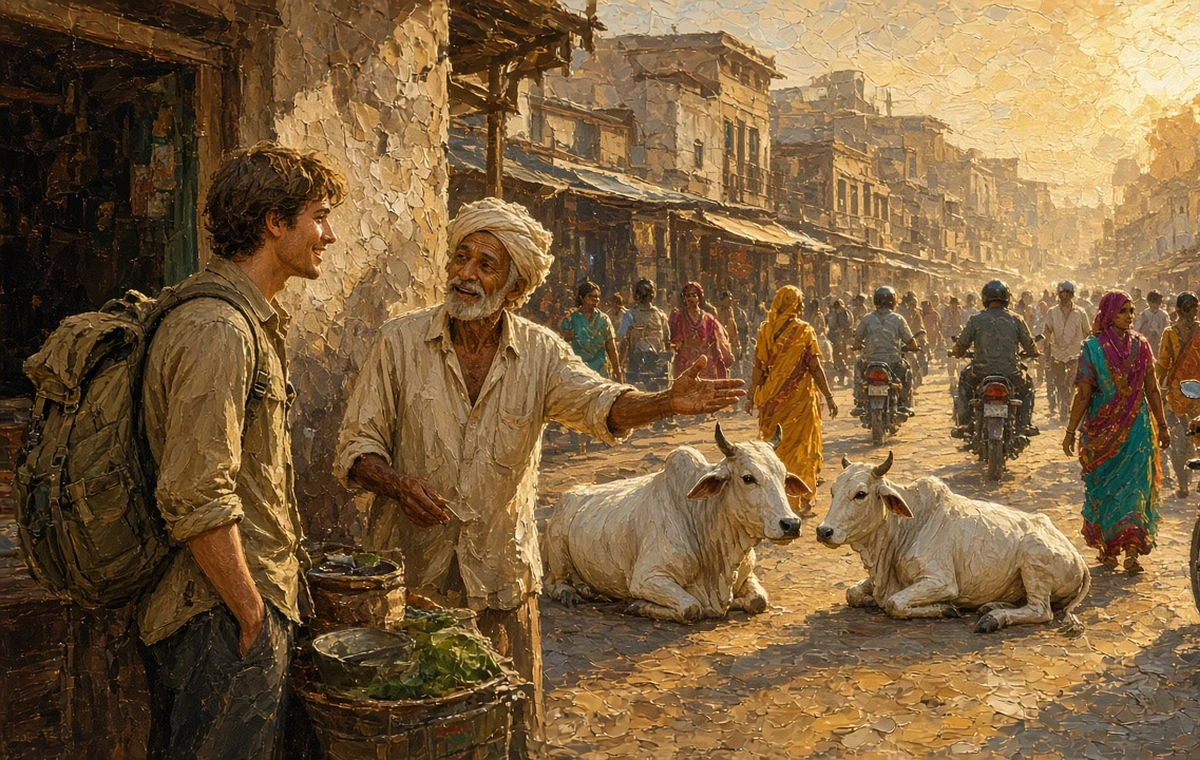
For nurses and carers, the same thinking underpins culturally competent care. Madeleine Leininger's Culture Care Theory asks professionals to preserve, accommodate or gently re-pattern a patient's cultural practices, rather than override them.
In a UK ward that might mean offering halal or vegetarian meals, a same-sex carer for personal care, or flexibility around prayer times and fasting.
Skimming the section headings first makes a long guide much easier to map out. Try writing down one question of your own as you read.
How did the Jeju refugee case test cultural relativism?
In 2018, around 500 Yemenis fleeing civil war arrived on South Korea's Jeju Island, which allowed visa-free entry. The reaction split the country. An online petition calling for their removal gathered more than 700,000 signatures, while the actor Jung Woo-sung, a UNHCR Goodwill Ambassador, publicly urged compassion and was flooded with abuse.
| Concern | What it reflected | What a relativist lens adds |
|---|---|---|
| "Muslim men are dangerous" | Stereotypes about a whole religion | Judge individuals, not a group |
| "Our safety and jobs come first" | Real anxieties about crime and resources | Concerns deserve evidence-based answers, not dismissal |
| "They are refugees, not migrants" | International protection obligations | Understanding why people flee |
The case is a good reminder that cultural relativism is not only about distant customs. The UK has its own long-running debate over asylum seekers, and the same mix of fear, stereotype and genuine concern appears whenever newcomers arrive. A fair analysis treats prejudice as prejudice but does not wave away people's worries as mere bigotry.

For newcomers themselves, the first months are a crash course in unwritten rules, from queueing etiquette to how to register an address, and small kindnesses from neighbours make a large difference.
Where does cultural relativism stop?
Relativism is a method for understanding, not a licence for anything. Practices that cause serious harm, such as child abuse, female genital mutilation (FGM) and so-called honour killings, cannot be defended by saying "it's their culture". These violate the basic rights set out in the Universal Declaration of Human Rights, which applies to everyone regardless of where they were born.
In the UK, FGM has been a criminal offence since 1985 and is now covered by the Female Genital Mutilation Act 2003, with mandatory reporting duties for health and social-care professionals and teachers when a girl under 18 discloses it or it is observed.
| Practice | Try to understand it? | Accept it? |
|---|---|---|
| Eating with the hand, food taboos | Yes | Yes, a matter of custom |
| Arranged introductions with free consent | Yes | Yes, if both people can say no |
| Forced marriage of a minor | Yes, to address the causes | No, it violates rights |
| FGM, honour violence | Yes, to change it from within | No, it causes serious harm |
How can harmful practices change without imposing outside values?
Experience suggests change lasts longest when it comes from inside a community. Campaigns led by local women, religious leaders and health workers have reduced FGM in parts of West Africa far more effectively than outside condemnation alone. The relativist insight helps here: when you understand why a practice persists, you can address the real reasons, such as marriage prospects or social belonging.
So the mature position combines both ideas: respect and curiosity towards difference, with firm lines where human dignity is at stake.
How do you analyse a case of cultural difference?
Essay questions often present a scenario and ask you to apply cultural relativism. A four-step framework keeps your answer structured:
Also on CampusDown Life Up: Moving Checklist: Every Change of Address You Need.
- Describe the practice neutrally, without loaded words
- Explain its meaning and function within the culture
- Identify your own culture's assumptions and reactions
- Assess it against universal standards such as human rights and harm
Using these steps shows the examiner that you can tell understanding from approval, which is exactly the distinction that separates a strong answer from a weak one. It also works in daily life, whether you are sharing a flat with an international student or caring for a patient from a background unlike your own.
Compiled by the CampusDown editorial team from a Korean article on cultural relativism and its examples, adapted for UK and US readers with context on asylum debates and UK FGM law. Source: Benedict, R. (1934). Patterns of Culture. Houghton Mifflin. Reviewed November 2026. This is general educational information.
FAQ
Who came up with cultural relativism?
Franz Boas laid the groundwork, and his student Ruth Benedict popularised it in Patterns of Culture (1934).
Is cultural relativism the same as moral relativism?
No. Cultural relativism is a method for understanding practices; it does not claim that every practice is morally acceptable.
What is the opposite of cultural relativism?
Ethnocentrism, which judges other cultures by the standards of your own.
What is cultural cringe?
The opposite error: assuming another culture is superior and your own is inferior, which is just as uncritical as ethnocentrism.
Why does cultural relativism matter in nursing?
It helps staff respect patients' beliefs about food, modesty and religion, which improves trust and care.