
What Changes If You Spot It Before Five? Canada's FairStart Preschool Screening, Korea's Childcare Funding Clash and How the US and UK Screen Early
- Korea pays childcare fees or allowances for every child aged 0–5, but central and local governments clashed over funding.
- Canada's FairStart began in Ontario in 1996 as a school-council and community screening partnership.
- It offers free vision, hearing, social, language and motor checks from 18 months, much like US well-child and UK health visitor reviews.
Contents
Canada's FairStart is a community-led screening programme from Ontario that offers free checks of vision, hearing, social skills, language, physical fitness and fine motor control to children from 18 months until they start school, so problems are caught before age five. If a child's hearing loss or speech delay is discovered only in first grade, who gives back the lost years? The Korean case material behind this article argues that Korea's child welfare spending grew fast in size but not in quality, and it holds up FairStart as an alternative. Here we compare the two, then add how the US and UK approach early screening.
Why did child welfare become the government's job?
Raising and teaching young children used to be a family matter. As society grew more complex, the source explains, that role moved steadily into the public sphere. More women entered paid work, the number of working married women rose, and demand surged for places where parents could leave their children with confidence. That pressure is the background to government-led child welfare in Korea, and it put trained childcare teachers at the heart of the system.
Student money tip from CampusDown Repair UpMy Tablet Died Mid-Lecture and I Took It Personally — Tablet battery draining fast during class?
The source adds that judging any policy means looking at its goals, such as equality or efficiency, along with who pays, who qualifies and what form the benefit takes, whether cash, services or vouchers.

Where did Korea's childcare policy run into trouble?

The Korean government extended childcare fees or a home-care allowance to every child from birth to age five. As universal benefits widened, local governments struggled to fund their share. According to the source, when the central government offered to raise its childcare subsidy by 10 percentage points, the association of provincial governors demanded at least 20.
Because the full roll-out went ahead without enough agreement, parents feared the benefits might suddenly stop. The diagnosis in the case material is blunt: without a settled deal on who pays, the conflict will keep coming back.
That pattern is familiar in the English-speaking world as well, where the question of who funds early years support regularly pits national budgets against local providers.
Skimming the section headings first makes a long guide much easier to map out. Try writing down one question of your own as you read.
How did FairStart begin?
FairStart grew out of a voluntary initiative proposed by school councils in Ontario in 1996. Health and family support agencies, volunteers, teachers, police and community groups, and local businesses joined in, and the source presents it as a model for community-based welfare policy.
Its driving idea was simple: the years before five shape the rest of a child's life, and the earlier a problem is found, the easier it is to address. That principle matches the evidence summarised by child development theories, which stress how fast language, motor and social skills develop in the early years.
The interesting part is not just that FairStart screens children, but how it turns a check-up into something families trust and actually use.
How does the screening work?
FairStart lets children from 18 months until school entry take checks across several developmental areas free of charge. Results are managed on computer; when a child needs a closer look, the family is referred on to public health or medical services, and the record stays within the province's student data system.
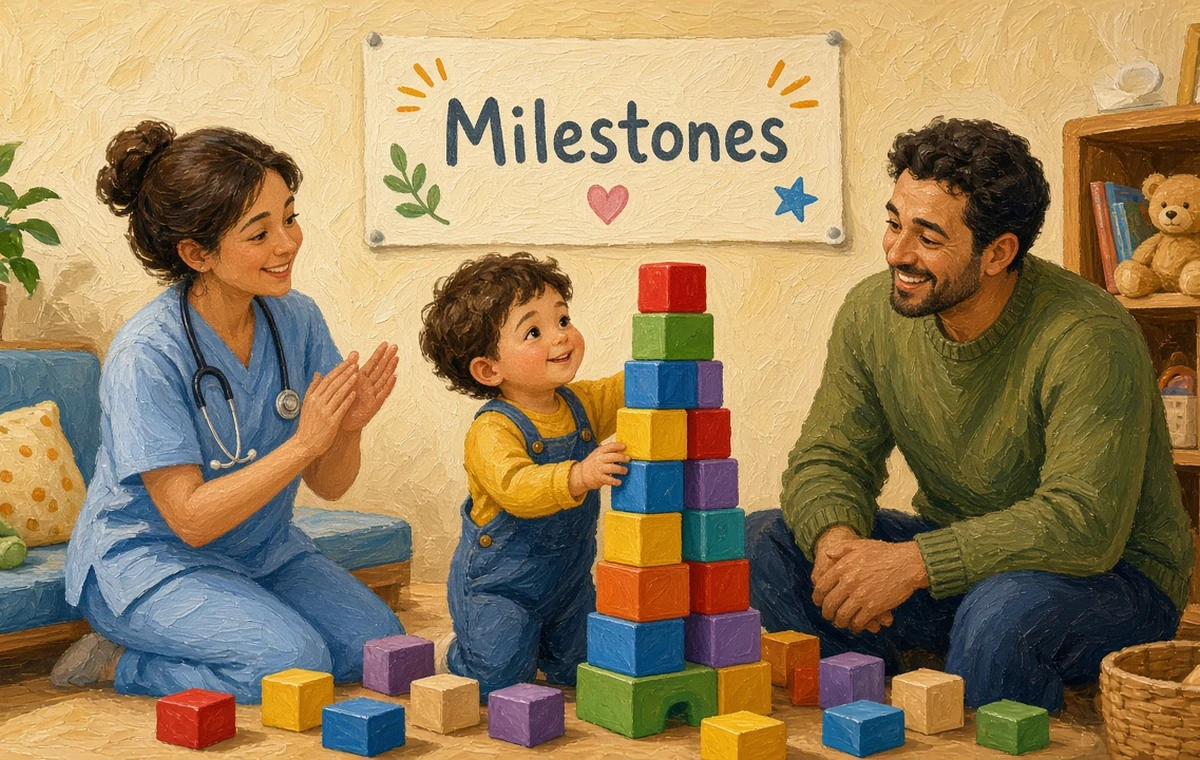
- Vision and hearing
- Social skills and language
- Physical fitness and fine motor control
Strict rules keep individual records from leaking outside the system. That privacy promise is arguably what made the whole community willing to take part.
The United States and the United Kingdom both have early screening, but they deliver it through very different machinery than a school-council partnership.
How do the US and UK catch problems early?
In the United States, the American Academy of Pediatrics' Bright Futures guidelines recommend general developmental screening at the 9, 18 and 30-month well-child visits, plus autism-specific screening at 18 and 24 months. When a delay is suspected, Part C of the Individuals with Disabilities Education Act (IDEA) funds early intervention for children from birth to age three, and schools' "Child Find" duty under Part B picks up from age three. Medicaid's EPSDT benefit covers screenings for eligible low-income children, and Head Start, founded in 1965, adds health and developmental checks for its families.
In England, the NHS Healthy Child Programme sends health visitors to families, with a review at around two to two and a half years that commonly uses a parent questionnaire called ASQ-3 to look at communication, motor, problem-solving and personal-social skills. Sure Start children's centres, launched in 1998, pioneered one-stop local support, and many areas are now rebuilding that idea as Family Hubs. England has also widened funded childcare for working parents, and nurseries and councils continue to argue over whether the hourly funding rates cover real costs, a debate that echoes Korea's.
Put side by side, the systems show a clear split between paying for care and finding problems early.
How do the models compare?
| Item | Korea | Canada FairStart | United States | England |
|---|---|---|---|---|
| Target age | 0–5 | 18 months to school entry | Well-child visits from birth; IDEA Part C to age 3 | Health visiting from birth; review at about 2–2½ |
| Main tool | Childcare fees and home-care allowance | Free checks across developmental areas | Pediatric screening plus early intervention | Health visitor reviews plus funded childcare |
| Key tension | Central vs local funding of free welfare | Protecting screening data | Coverage gaps between insurance and states | Funding rates and pressure on health visiting |
| Origin | Government-led | School-council proposal and community partners | Federal law and medical guidelines | National NHS programme |
Student money tip on CampusDown Repair Up: My Tablet Died Mid-Lecture and I Took It Personally.
Korea's approach centres on cash and childcare fees, while FairStart focuses on finding problems early and connecting families to help. The source concludes that, to support families weakened by smaller households and rising female employment, policy must move beyond simply getting bigger and set priorities around the most urgent needs. The debate between universal and targeted welfare sits right at the centre of that choice.
Reference: Heckman, J. J. (2006). Skill formation and the economics of investing in disadvantaged children. Science, 312(5782), 1900–1902, on why early investment pays off.
FAQ
What is Canada's FairStart?
It is a community-based early screening programme that began in Ontario in 1996 on the proposal of school councils.
Who can be screened through FairStart?
Children from 18 months of age until they start school.
What does FairStart check?
Vision, hearing, social skills, language, physical fitness and fine motor control, free of charge.
When are US children screened for developmental delays?
The American Academy of Pediatrics recommends developmental screening at 9, 18 and 30 months and autism screening at 18 and 24 months.
What is the two-year review in England?
It is a health visitor check at around two to two and a half years, often using the ASQ-3 questionnaire, under the NHS Healthy Child Programme.