
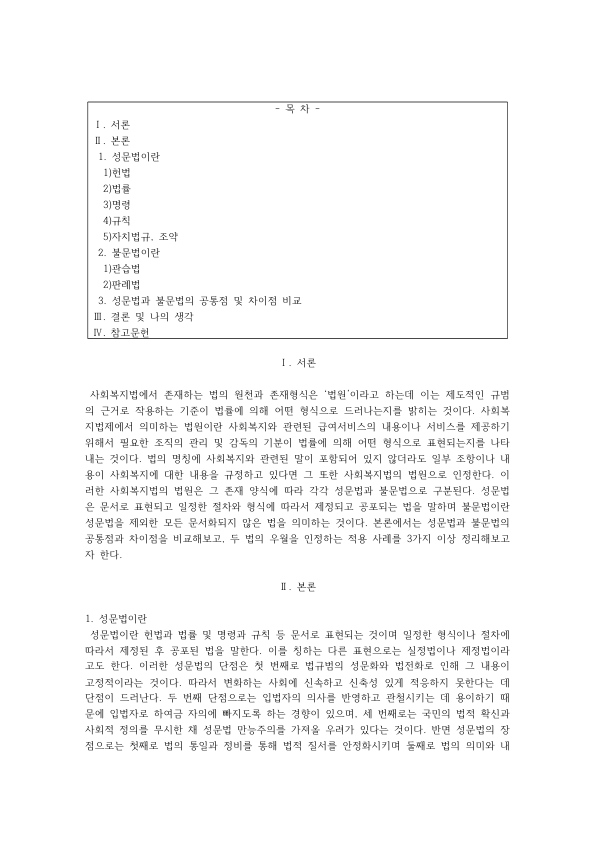
Page 1 is shown as is; from page 2 on, the preview is blurred. Buy it to download the complete original file right away (the file itself is written in Korean).
Packed with real examples and experience. Download it now and save time.
Save your valuable time
Buyer ratings
Fast, accurate and useful.
No ratings yet. Be the first to rate it.

Written Law vs. Unwritten Law in Korea: Constitution, Statutes, Decrees, Customary Law and Case Law as Sources of Social Welfare Law
※ You can preview page 1 as is. Buy it to download the complete original file right away. The file itself is written in Korean.
■ Written Law vs. Unwritten Law in Korea: Constitution, Statutes, Decrees, Customary Law and Case Law as Sources of Social Welfare Law — Overview
A 4-page Korean social welfare law paper on the sources of law. It explains the strengths and weaknesses of written law, walks through the constitution, statutes, executive decrees, rules, local ordinances and treaties, then covers customary law and case law and compares civil-law and common-law treatment of precedent. It closes with Article 1 of the Korean Civil Act, which applies statutes first and customary law only to fill gaps.
■ Written Law vs. Unwritten Law in Korea: Constitution, Statutes, Decrees, Customary Law and Case Law as Sources of Social Welfare Law — Excerpt from the original document (English translation)
Looking more concretely at customary law, it means law that, through practices repeated in social life, has given the general public a legal conviction or awareness and has thus acquired legal value even though it is not codified. Customary law must have legitimacy and reasonableness that do not violate the entire legal order. Modern states did not recognize customary law. The requirements for customary law to arise are as follows: first, the custom must exist as a repeated practice, and its content must include legal value carrying the conviction or awareness of being a legal norm. In addition, the custom must not be contrary to public order and good morals, and it must not violate the entire legal order or must in principle concern matters not provided for in statutes.
Case law is law that takes on the character of a legal norm without going through codification where, as judgments to the same effect are repeated on a certain legal issue, their direction has become largely settled. Case law is a special form of customary law and differs from general customary law in being formed in the courts. Countries of the Anglo-American legal tradition adopt the principle of binding precedent, under which, once a higher court has rendered a judgment on a legal issue, that court or lower courts cannot afterward reach a result different from the earlier judgment when dealing with the same legal issue. Since countries of the continental legal tradition adopt the principle of written law, the principle is that courts are not bound by the judgments of courts of the same or higher level. Therefore, case law also has the limitation of being no more than a secondary source of law.
What written law and unwritten law have in common is that both are sources of law. A source of law is generally understood as the basis for recognizing law. Sources of law include, regardless of the form in which they appear, all guidelines and standards for conduct that fix the purposes or standards of administrative acts, prescribe models of conduct and decide judicial determinations of disputes. That is why not only written law but also unwritten law belongs to the sources of law.
On the other hand, the differences between the two are as follows. Article 1 of the Civil Act recognizes the superiority of written law over customary law, and customary law is in principle recognized as having supplementary effect only for matters on which written law has no provision. In particular, where written law recognizes the existence of customary law different from the content of its provisions, customary law is recognized as having the effect of amending or repealing the written law.
For reference, the material writes that if there is customary law different from written law, it is recognized as having the effect of changing the written law, but the case law holds that customary law has only supplementary effect to the extent it does not conflict with statutes. However, Article 1 of the Commercial Act provides that, for commercial matters on which the Commercial Act has no provision, commercial customary law applies first and then the Civil Act, so there is an exception in which customary law takes precedence over the Civil Act. As an example of customary law losing effect due to social change, also look at the 2005 Supreme Court en banc decision on the custom of regarding only adult men as members of a clan association.
■ Written Law vs. Unwritten Law in Korea: Constitution, Statutes, Decrees, Customary Law and Case Law as Sources of Social Welfare Law — Contents and key concepts
Does law have to be written down to count as law?
✦ At a glance
- The sources of law in a civil-law country
- Structure: written law → customary and case law → comparison
- Useful for intro to law and social welfare law classes
☰ What the paper covers
- Six kinds of written law
- Requirements for customary law
- Case law in civil-law systems
- Civil Act Article 1
✎ Sources of law in Korea and the U.S.
Korea is a civil-law country: statutes come first, and Article 1 of the Civil Act lets customary law, then reason (jori), fill gaps. Precedent formally binds only the case at hand, though Supreme Court rulings carry heavy practical weight.
In the U.S., common-law precedent binds lower courts through stare decisis, while statutes and constitutions sit above judge-made law.
Note: the paper itself is written in Korean and discusses Korean law. This page is general study information, not legal advice.
Related wiki: Common Law vs. Civil Law
■ Written Law vs. Unwritten Law in Korea: Constitution, Statutes, Decrees, Customary Law and Case Law as Sources of Social Welfare Law References
- 위키백과사전 - 성문법, 불문법 https://ko.wikipedia.org/wiki/%EC%84%B1%EB%AC%B8%EB%B2%95
Take a break with a quick personality test?
Ranked by actual participation. Results in about a minute.
Loading…
Most-read content
Loading view counts…

Campusdown is a lifelong-learning community in Korea offering study materials, information on government support, student loans and scholarships, and more. Don't miss our free resources.
Go to the Campusdown home page →Refund policy
- Change of mind / refund requested after partial use / more than 7 days after purchase
◆ Exceptions
- File errors / cannot download or open the file
◆ How to request a refund: send a 1:1 inquiry via Customer Service at the top