
Page 1 is shown as is; from page 2 on, the preview is blurred. Buy it to download the complete original file right away (the file itself is written in Korean).
Packed with real examples and experience. Download it now and save time.
Save your valuable time
Buyer ratings
Fast, accurate and useful.
No ratings yet. Be the first to rate it.


1 / 10
좌우로 밀어서 페이지를 넘겨보세요
관습이라는 이름으로 이어져 온 차별이 법 앞에서 다시 질문받는 순간을 보여 주는 보고서예요.
과제 개요
| 전체 페이지 수 | 10페이지 |
|---|---|
| 파일 형식 | 한글(HWP) |
| 등록일 | 2025.06.30 |
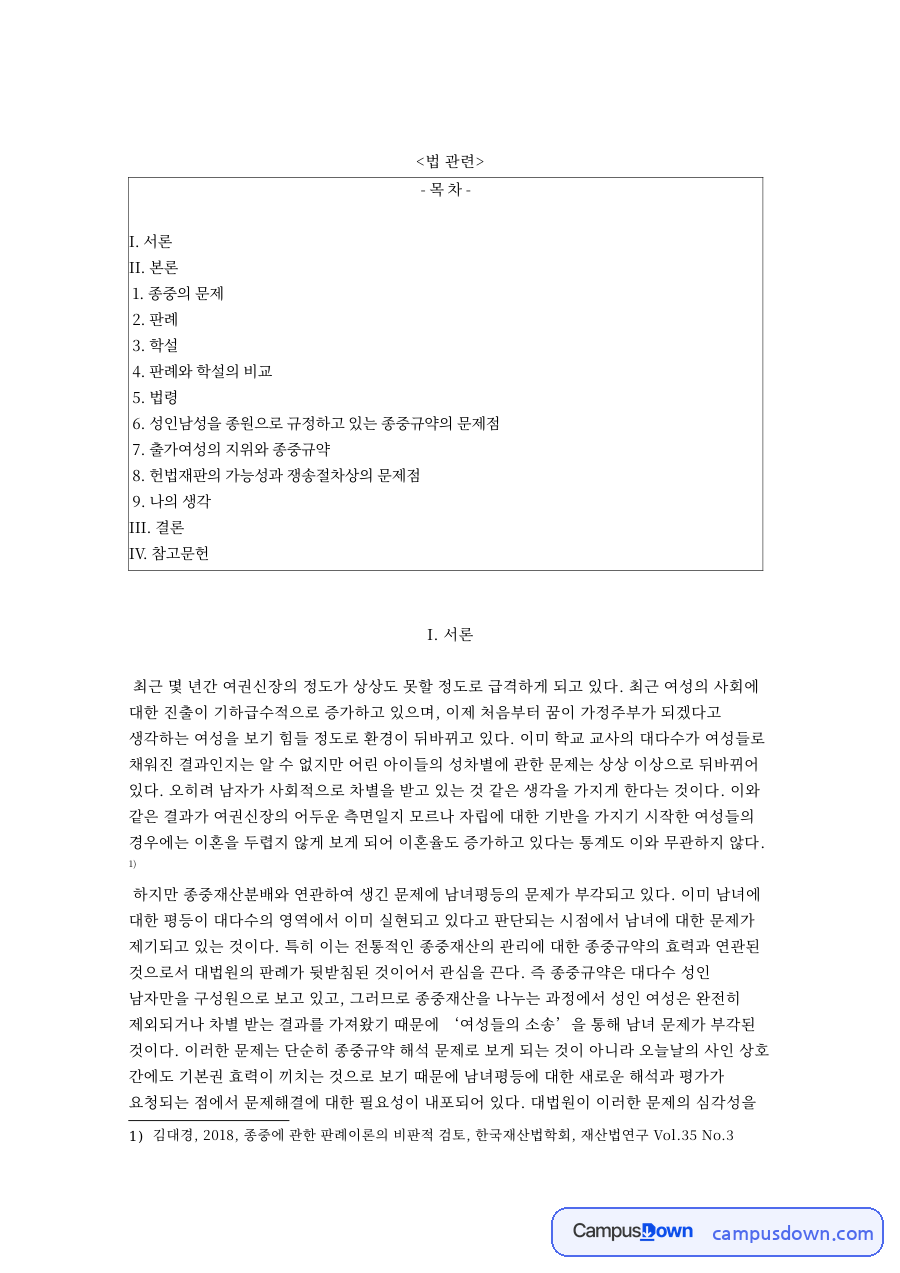
목차
- 1I. 서론
- 2II. 본론
- 2.11. 종중의 문제
- 2.22. 판례
- 2.33. 학설
- 2.44. 판례와 학설의 비교
- 2.55. 법령
- 2.66. 성인남성을 종원으로 규정하고 있는 종중규약의 문제점
- 2.77. 출가여성의 지위와 종중규약
- 2.88. 헌법재판의 가능성과 쟁송절차상의 문제점
- 2.99. 나의 생각
- 3III. 결론
- 4IV. 참고문헌
캠퍼스다운 도움말
해당 자료는 No AI 자료입니다. 인싸이트를 얻고 새롭게 가공해 보세요.
자료를 받아서 이용하면 품질이 확 올라갑니다.
- 종중 여성 종원
- 종중재산 분배
- 2002다1178 전원합의체
- 종중규약 효력
- 출가여성 종원 자격
Women Members of Korean Clan Associations (Jongjung) and the Division of Clan Property: Clan Bylaws, the 2005 Supreme Court En Banc Ruling and Academic Views
※ You can preview page 1 as is. Buy it to download the complete original file right away. The file itself is written in Korean.
■ Women Members of Korean Clan Associations (Jongjung) and the Division of Clan Property: Clan Bylaws, the 2005 Supreme Court En Banc Ruling and Academic Views — Overview
An 11-page Korean civil law paper on jongjung, the traditional clan associations that hold family land. It starts from a case where a clan paid land compensation only to adult male members and female descendants sued. The paper explains the clan's legal nature as an unincorporated association, the Supreme Court en banc judgment of July 21, 2005 (2002Da1178) holding that adult descendants become members regardless of sex, academic opinions, related statutes, the status of married daughters and the limits of clan bylaws.
관습이라는 이름으로 이어져 온 차별이 법 앞에서 다시 질문받는 순간을 보여 주는 보고서예요.
■ Women Members of Korean Clan Associations (Jongjung) and the Division of Clan Property: Clan Bylaws, the 2005 Supreme Court En Banc Ruling and Academic Views — Excerpt from the original document (English translation)
As revealed through case law, a jongjung (clan association), once organized, is a blood-based community, so its descendants are compulsorily members from birth, leave upon death, and are barred from joining or leaving while alive; this is where the difference appears. In addition, unlike an ordinary association, a jongjung is not made up only of people with capacity to act, so from the outset it has the characteristic of an association whose clan-member status and clan-association-member status must be constructed differently. (Lee Cheon-sun, 2019, A Study on Title Trusts of Real Estate: Focusing on Clan Property, Konkuk University, master's thesis)
The jongjung issue is an institution found only in Korea and sits in a borderline area between law and ethics; as a result, the legislators of the Civil Act deliberately did not legislate on it, and in practice jongjung problems have been resolved through case law. (Lee Sang-gyun, 2016, The Transformation of Clans and Clan Property near Seoul: Focusing on the Seogye-gong Branch of the Bannam Park Clan, The Academy of Korean Studies, Graduate School of Korean Studies, doctoral dissertation)
In particular, although jongjung matters should in principle be evaluated as falling within the sphere of private autonomy, a solution can be found on the basis that issues such as the distribution of clan property are not simply matters of private autonomy but matters of objective legal norms. (Gu Seong-jin, 2014, A Study on Clan Property Litigation, Daejin University Graduate School of Legal Affairs and Public Administration, master's thesis)
This is because, when disputes arise among clan members, state public authority must intervene to resolve them, and resolving such disputes inevitably calls on objective legal norms. Furthermore, the normative force of the law at the top of those legal norms is regarded as the highest value to be upheld even in relations between private persons, and this was presented as a key to resolving such cases. In other words, the specific content of clan bylaws is regarded as legally in the nature of autonomous regulations, and the point is that such clan bylaws must also be subject to the normative force of the Constitution.
First, considering that the jongjung institution differs from, yet is related to, marriage and the family system, the guarantee provisions on the family system set out in the law can be applied mutatis mutandis through interpretation. In that case, from the perspective of equal protection among children, which is part of the guarantee of the family system, discrimination against women in the distribution of clan property under clan bylaws is regarded as violating the provision of the law establishing "individual dignity and equality of the sexes."
Second, the essence of a jongjung is an unincorporated association, the basis of an unincorporated association is freedom of association, and compared with ordinary associations a jongjung has various distinctive features. Because of those features, clan bylaws that govern a jongjung's internal rules cannot be left entirely to private autonomy, and objectivity consistent with legal norms is required. In conclusion, clan bylaws may restrict women's eligibility as members of the clan association, but eligibility as a clan member is based on the blood relationship itself and therefore cannot be restricted; and since one takes part in the distribution of clan property in the capacity of a clan member, not in the capacity of a clan-association member, there is no reason to exclude women from it. Accordingly, clan bylaws that discriminate against women violate the right to equality under the law required to realize the freedom of association, together with the provisions on dignity. (Ha Nae-ra-mo, 2014, A Study on the Jongjung System in Industrial Society: Focusing on the Point of Transition from Agrarian to Industrial Society, Korea University Graduate School of Law, master's thesis)
Therefore, rather than being bound by past precedents, judges should render new, reasonable judgments consistent with today's trend of gender equality and the spirit of the law. (Lee Jae-ik, 2014, Unincorporated Associations and the Attribution of Property, Kyungpook National University Graduate School, master's thesis)
If the Supreme Court were to ignore this constitutional spirit and try to resolve the problem by clinging to tradition and its own precedents, it would be turning away from the spirit of the times and would meet strong resistance and distrust.
Since the en banc decision 2002Da1178, the Supreme Court has continued the line of holding void even resolutions that, in distributing compensation for expropriated clan land, gave smaller shares only to female clan members or differentiated by whether they had married out. So when writing about the distribution of clan property, you need to connect clan-member eligibility, the limits of general-meeting resolutions, and the attribution of property of an unincorporated association (collective ownership, chongyu). This material can be used directly for assignments in Civil Act general provisions, property law and family law, and for law debates on gender equality and customary law. There is a separate list of reference cases, so it is easy to look up the original texts by case number.
■ Women Members of Korean Clan Associations (Jongjung) and the Division of Clan Property: Clan Bylaws, the 2005 Supreme Court En Banc Ruling and Academic Views — Contents and key concepts
Can clan bylaws keep daughters out of family property?
✦ At a glance
- When a customary rule loses its legal force
- Structure: facts → precedents → theories → comparison → bylaws → opinion
- Good for civil law, family law and gender and law papers
☰ What the paper covers
- The Yongin Lee clan compensation dispute
- Legal nature of clan associations
- The 2005 en banc ruling (2002Da1178)
- Academic views and statutes
- Married daughters and clan bylaws
✎ Customary law and clan property
Clan property is owned collectively by all members, so decisions about selling it or splitting compensation go through the clan general meeting.
The Supreme Court said the custom of counting only adult men as members no longer had legal force because it conflicted with the constitutional value of gender equality.
Note: the paper itself is written in Korean and discusses Korean law. This page is general study information, not legal advice.
■ Women Members of Korean Clan Associations (Jongjung) and the Division of Clan Property: Clan Bylaws, the 2005 Supreme Court En Banc Ruling and Academic Views References
- 진상욱, 2017, 종중재산의 귀속과 분배, 한국토지법학회, 土地法學 Vol.33 No.2 송인권, 2015, 종중에 관한 판례이론의 문제점, 법조협회 2015 法曹 Vol.64 No.8 김대경, 2018, 종중에 관한 판례이론의 비판적 검토, 한국재산법학회, 재산법연구 Vol.35 No.3 김일회, 2016, 종중(宗中)의 구조와 그 활동에 관한 연구, 호서대학교 사회과학연구소, 社會科學硏究 Vol.35 No.1 배병일, 2015, 일제하 법령과 조선고등법원판결에 내재하는 종중재산법리의 왜곡, 한국외국어대학교 외국학종합연구센터 법학연구소, 외법논집 Vol.39 No.1 이대화, 2017, 근대 호적제도의 변화가 종중촌락의 관습에 미친 영향 - 경북 김천시 구성면의 사례를 중심으로-, 한국민속학회, 韓國民俗學 Vol.66 No.- 성미애, 2019, 1991년 가족법 개정 이후 종중과 제사 관련 대법원 판례에 나타난 유교적 가부장제 분석, 한국가정관리학회, 한국가정관리학회지 Vol.37 No.3 김일회, 2015, 종중의 법률관계에 관한 연구, 호서대학교 일반대학원, 국내박사 최기훈, 2016, 종중의 법적 지위에 관한 연구 :종중소송의 당사자 문제를 중심으로, 중앙대학교 대학원, 국내석사 이천순, 2019, 부동산 명의신탁에 관한 연구 :종중재산을 중심으로, 건국대학교, 국내석사 이상균, 2016, 서울 근교 종중과 종중재산의 변용 :반남박씨 서계공파를 중심으로, 韓國學中央硏究院 韓國學大學院, 국내박사 구성진, 2014, 종중재산소송에 관한 연구, 대진대학교 법무행정대학원, 국내석사 河內羅模, 2014, 産業社會에서의 宗中제도에 대한 硏究 :農耕社會에서 産業社會를 이룬 시점을 중심으로, 高麗大學校 法務大學院, 국내석사 이재익, 2014, 법인 아닌 사단과 재산귀속, 경북대학교 대학원, 국내석사 안서연, 2014, 외관행위자의 민사책임과 처분수권, 동국대학교, 국내석사 -참고판례 대법원 2007. 9. 6.
- 선고 2007다34982 판결 대법원 2011. 2. 24.
- 선고 2009다17783 판결 대법원 1997. 11. 14.
- 선고 96다25715 판결 대법원 1992. 2. 28.
- 선고 91다41507 판결 대법원 2011. 2. 10.
- 선고 2010다83199,83205 판결 대법원 2005. 7. 21.
- 선고 2002다1178 전원합의체 판결 대법원 2005. 7. 21.
- 선고 2002다13850 전원합의체 판결 대법원 2008. 11. 20.
- 선고 2007다27670 전원합의체 판결
Keyword Prompt
전문가가 만들었어요과제를 직접 쓰는 데 도움이 되는 영어 프롬프트예요.
Tip! Prompt 에 자신의 생각을 추가해서 하면 훨씬 더 ✨ 좋습니다.
캠퍼스다운에서 레포트 받고 잘 쓰는 법 3가지, AI로 참고자료 제대로 재가공하기 →Prompt 1
I'm writing a university assignment on "종중 여성 종원 자격과 종중재산 분배: 종중규약의 효력, 2002다1178 전원합의체 판결과 학설 비교". Help me build an outline (introduction, 2-3 body sections, conclusion) that covers 종중 여성 종원, 종중재산 분배 and 2002다1178 전원합의체. Don't write the paper for me - give me guiding questions for each section. My own perspective: [자신의 생각 넣는 곳] Please respond in Korean.
Prompt 2
Explain the key concepts "종중 여성 종원" and "종중재산 분배" in simple terms, then show how they connect to the topic "종중 여성 종원 자격과 종중재산 분배: 종중규약의 효력, 2002다1178 전원합의체 판결과 학설 비교". Point out common misunderstandings students have about them. My own perspective: [자신의 생각 넣는 곳] Please respond in Korean.
Prompt 3
Suggest 3 real-world cases or examples I could analyze in an assignment on "종중 여성 종원 자격과 종중재산 분배: 종중규약의 효력, 2002다1178 전원합의체 판결과 학설 비교", focusing on "2002다1178 전원합의체". For each, tell me what I should look up and verify in official or academic sources. My own perspective: [자신의 생각 넣는 곳] Please respond in Korean.
Prompt 4
Review my draft paragraph on "종중 여성 종원 자격과 종중재산 분배: 종중규약의 효력, 2002다1178 전원합의체 판결과 학설 비교" (key idea: "종중규약 효력"). Give feedback on logic, evidence and clarity, and mark where I need a citation. My paragraph: [paste here] My own perspective: [자신의 생각 넣는 곳] Please respond in Korean.
Take a break with a quick personality test?
Ranked by actual participation. Results in about a minute.
Loading…
Most-read content
Loading view counts…

Campusdown is a lifelong-learning community in Korea offering study materials, information on government support, student loans and scholarships, and more. Don't miss our free resources.
Go to the Campusdown home page →Refund policy
- Change of mind / refund requested after partial use / more than 7 days after purchase
◆ Exceptions
- File errors / cannot download or open the file
◆ How to request a refund: send a 1:1 inquiry via Customer Service at the top