
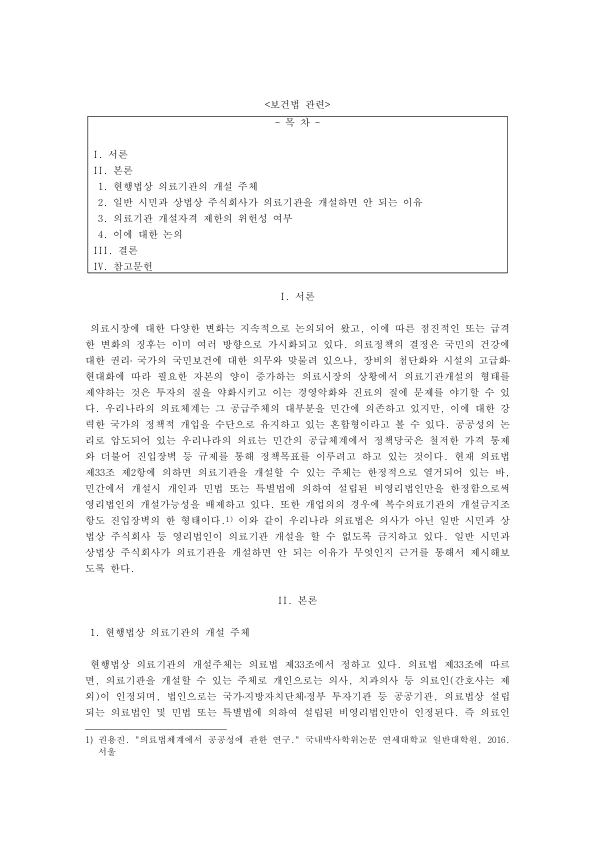
Page 1 is shown as is; from page 2 on, the preview is blurred. Buy it to download the complete original file right away (the file itself is written in Korean).
Packed with real examples and experience. Download it now and save time.
Save your valuable time
Buyer ratings
Fast, accurate and useful.
No ratings yet. Be the first to rate it.


Who May Open a Hospital in Korea: Medical Service Act Article 33, Non-Doctor-Owned Clinics, and the 2005 Constitutional Court Ruling
※ You can preview page 1 as is. Buy it to download the complete original file right away. The file itself is written in Korean.
■ Who May Open a Hospital in Korea: Medical Service Act Article 33, Non-Doctor-Owned Clinics, and the 2005 Constitutional Court Ruling — Overview
A 6-page Korean health law paper on why non-doctors and for-profit corporations can't open medical institutions in Korea. It lists who may open one under Article 33 of the Medical Service Act, explains a 2003 Supreme Court ruling voiding a deal with a non-doctor owner and the 2005 Constitutional Court decision upholding the ban, and weighs arguments for opening the market.
■ Who May Open a Hospital in Korea: Medical Service Act Article 33, Non-Doctor-Owned Clinics, and the 2005 Constitutional Court Ruling — Excerpt from the original document (English translation)
Changes in the environment around the medical market are putting pressure to amend the Medical Service Act. That is, the argument that for-profit medical corporations must be allowed in order to develop the medical industry through capital investment, such as opening the medical market or introducing advanced medical facilities, was raised early on. As long as the person performing medical care is a medical professional, it should not matter for public health who opened the institution, and the legislative purpose of the Medical Service Act can be achieved. Rather, if non-medical professionals and for-profit corporations were allowed to open medical institutions, the open combination of knowledge and capital could not only expand the scope and competitiveness of individual business activity, but also give the public more choice among medical institutions and give medical professionals more opportunities for research, so that various social benefits can be expected through synergy. Medical institutions are currently limited to individuals or nonprofit corporations, but on the fundamental question of whether these nonprofit corporations really act in a nonprofit way, that is, whether there is no distribution of profits to beneficiaries or members, it is a fact that activities to distribute profits are already taking place, so I think it is desirable to change this into a system that fits reality, granting tax benefits and other support only to medical institutions with genuine public character and excluding those that pursue profit.
Because of the provisions of the Medical Service Act, a certain group monopolizes the opening of medical institutions, which weakens competition among providers of health care services and, from the medical consumer's point of view, brings the disadvantage of a severely limited right of self-determination in choosing a medical institution that provides health care of the desired quality. Approached from this basic understanding, it is doubtful whether blocking non-medical professionals from opening medical institutions by employing medical professionals is an appropriate means of establishing the quality of care and medical order, and considering that it should not matter for public health who opens an institution as long as the person performing care is a medical professional, and that the legislative purpose of the Medical Service Act can still be achieved, this provision may violate the Constitution by infringing, contrary to the principle against excessive restriction in Article 37(2) of the Constitution, the freedom of occupation of those who wish to open medical institutions and medical consumers' right to choose a medical institution.
Even if the nature of the capital invested in opening medical institutions is limited to medical professionals or nonprofit medical corporations, profit-seeking behavior commonly occurs in medical practice. That is, the difference in the effect on clinical decision-making between investment in the form of equity and investment in the form of debt can be seen as minor. In addition, because medical institutions lack externally reviewed financial statements, most depend on short-term borrowing, and because these funds are invested in fixed assets and the like, a timing mismatch arises that acts as a source of financial pressure on medical institutions. Therefore, there is a need to open various opportunities for capital participation in medical institutions to strengthen private providers, while nonprofit medical institutions should receive more support together with stronger supervision. For a real overhaul, various changes are possible, such as for-profit corporations, investment-type medical corporations and hospital management support companies.
Note that Article 33(2) of the Medical Service Act still allows only medical professionals, medical corporations, nonprofit corporations, the state and local governments, quasi-governmental agencies, regional medical centers and the Korea Veterans Health Service to open medical institutions, and it bars a single medical professional from opening or running two or more medical institutions (Article 33(8)). If a clinic is found to be run by a non-doctor owner, then apart from criminal penalties, the National Health Insurance Service recovers the insurance benefit payments it received as unjust enrichment under Article 57 of the National Health Insurance Act. For-profit hospitals are discussed as an exception only for foreign medical institutions in Jeju Special Self-Governing Province and free economic zones.
■ Who May Open a Hospital in Korea: Medical Service Act Article 33, Non-Doctor-Owned Clinics, and the 2005 Constitutional Court Ruling — Contents and key concepts
Why can't a non-doctor own a clinic in Korea?
✦ At a glance
- Hospital ownership limits under Korean law
- Structure: who may open → why others can't → constitutionality → debate
- Useful for health law and policy courses
☰ What the paper covers
- Who may open a medical institution
- Why non-doctors and companies can't
- Supreme Court 2003Da2390 and Constitutional Court 2001Hun-Ba87
- Freedom of occupation debate
- Author's conclusion
✎ Korea's rule and the U.S. comparison
In Korea, clinics secretly run by non-doctors ("office manager hospitals") face criminal penalties, and the National Health Insurance Service claws back the insurance payments they received.
Several U.S. states follow a similar corporate practice of medicine doctrine that bars lay corporations from employing doctors to practice medicine, though rules vary widely by state.
Note: the paper itself is written in Korean and discusses Korean law. This page is general study information, not legal advice.
■ Who May Open a Hospital in Korea: Medical Service Act Article 33, Non-Doctor-Owned Clinics, and the 2005 Constitutional Court Ruling References
- 권용진. "의료법체계에서 공공성에 관한 연구." 국내박사학위논문 연세대학교 일반대학원, 2016.
- 서울 임연희. "소비자 권익 관점의 비영리 의료법인과 영리의료법인에 대한 비교 고찰." 국내석사학위논문 성신여자대학교 일반대학원, 2016.
- 서울 김신복. "영리의료법인 도입에 따른 장단점에 대한 고찰." 국내석사학위논문 고려대학교 정책대학원, 2017.
- 서울 권용진. "의료법체계에서 공공성에 관한 연구." 국내박사학위논문 연세대학교 일반대학원, 2016.
- 서울 원인명. "불법개설 요양기관 폐해에 대한 고찰." 국내석사학위논문 상지대학교 일반대학원, 2021.
- 강원도 김종성. "공공의료기관의 경영효율성에 관한 서술적 연구." 국내석사학위논문 창원대학교, 2018. 경상남도
Take a break with a quick personality test?
Ranked by actual participation. Results in about a minute.
Loading…
Most-read content
Loading view counts…

Campusdown is a lifelong-learning community in Korea offering study materials, information on government support, student loans and scholarships, and more. Don't miss our free resources.
Go to the Campusdown home page →Refund policy
- Change of mind / refund requested after partial use / more than 7 days after purchase
◆ Exceptions
- File errors / cannot download or open the file
◆ How to request a refund: send a 1:1 inquiry via Customer Service at the top