
Page 1 is shown as is; from page 2 on, the preview is blurred. Buy it to download the complete original file right away (the file itself is written in Korean).
Packed with real examples and experience. Download it now and save time.
Save your valuable time
Buyer ratings
Fast, accurate and useful.
No ratings yet. Be the first to rate it.


1 / 10
좌우로 밀어서 페이지를 넘겨보세요
과제 개요
| 전체 페이지 수 | 10페이지 |
|---|---|
| 파일 형식 | 한글(HWP) |
| 등록일 | 2025.08.04 |
캠퍼스다운 도움말
해당 자료는 No AI 자료입니다. 인싸이트를 얻고 새롭게 가공해 보세요.
자료를 받아서 이용하면 품질이 확 올라갑니다.
- 민사소송 관할
- 토지관할
- 보통재판적
- 특별재판적
- 의무이행지
- 합의관할
- 사물관할
- 소액사건
- 사건 배당
Which Court Hears a Claim for Unpaid Purchase Money? A Korean Civil Procedure Case Problem on Venue, General and Special Forums and Case Assignment
※ You can preview page 1 as is. Buy it to download the complete original file right away. The file itself is written in Korean.
■ Which Court Hears a Claim for Unpaid Purchase Money? A Korean Civil Procedure Case Problem on Venue, General and Special Forums and Case Assignment — Overview
An 8-page Korean civil procedure case problem. A Seoul seller sold land in South Jeolla to a buyer in Daegu, who never paid. The paper explains the rules on venue, the defendant's domicile, the place of performance, real property and agreed forums, and walks through small claims, case assignment and review of the complaint.
■ Which Court Hears a Claim for Unpaid Purchase Money? A Korean Civil Procedure Case Problem on Venue, General and Special Forums and Case Assignment — Excerpt from the original document (English translation)
In a civil suit, once the complaint is filed with the court it is served on the defendant, and if service succeeds, the presiding judge reviews the case record after the deadline for the defendant's answer expires and decides how to proceed. The case then takes one of two paths depending on whether an answer was filed by the deadline. If the defendant filed no answer or filed one admitting the claim, the case is classified for judgment without pleadings. But if the defendant files an answer denying the claim and contests the case, the presiding judge reviews the record, classifies the case and decides how to conduct the hearing. In principle, the presiding judge should set the first hearing date as early as possible so that both parties can face the judge early. The first hearing gives both parties the chance to confirm the issues in front of the judge and rebut each other's claims, carrying out the spirit of oral proceedings. This lets both sides fully present their claims and appeals, and lets the court form its views transparently through oral hearings in open court, raising trust in and satisfaction with the trial. If the parties make clear at the first hearing what issues they dispute, later requests for and examination of evidence can focus on those confirmed issues. As hearings proceed, the plaintiff and defendant must submit their claims in preparatory briefs and complete all requests for and submission of evidence supporting them. Related documentary evidence should in principle be attached to the briefs, and requests for documents, fact inquiries, inspections, expert appraisals and even witness applications should, as a rule, all be completed at this stage. On the evidence date, all witnesses and parties to be examined on both sides are in principle examined together, and judgment is delivered shortly after the examination ends. In contested cases like this one, the court also aims to resolve the dispute peacefully at any stage through a recommended settlement decision or mediation, so if the parties agree, the suit can be withdrawn and ended. That is the course of a trial, and within it the process of assigning a judge to review the complaint after it is filed is called case assignment. Case assignment is overseen by the chief judge of each court or branch, and for small claims, civil application cases and civil execution cases the court administrator may be delegated the task. Assignment begins right after filing closes each day or at the start of business the next day, and courts with heavy caseloads may assign cases twice, in the morning and afternoon. Case assignment designates the responsible panel and the presiding judge at the same time, based on the court's allocation of duties.
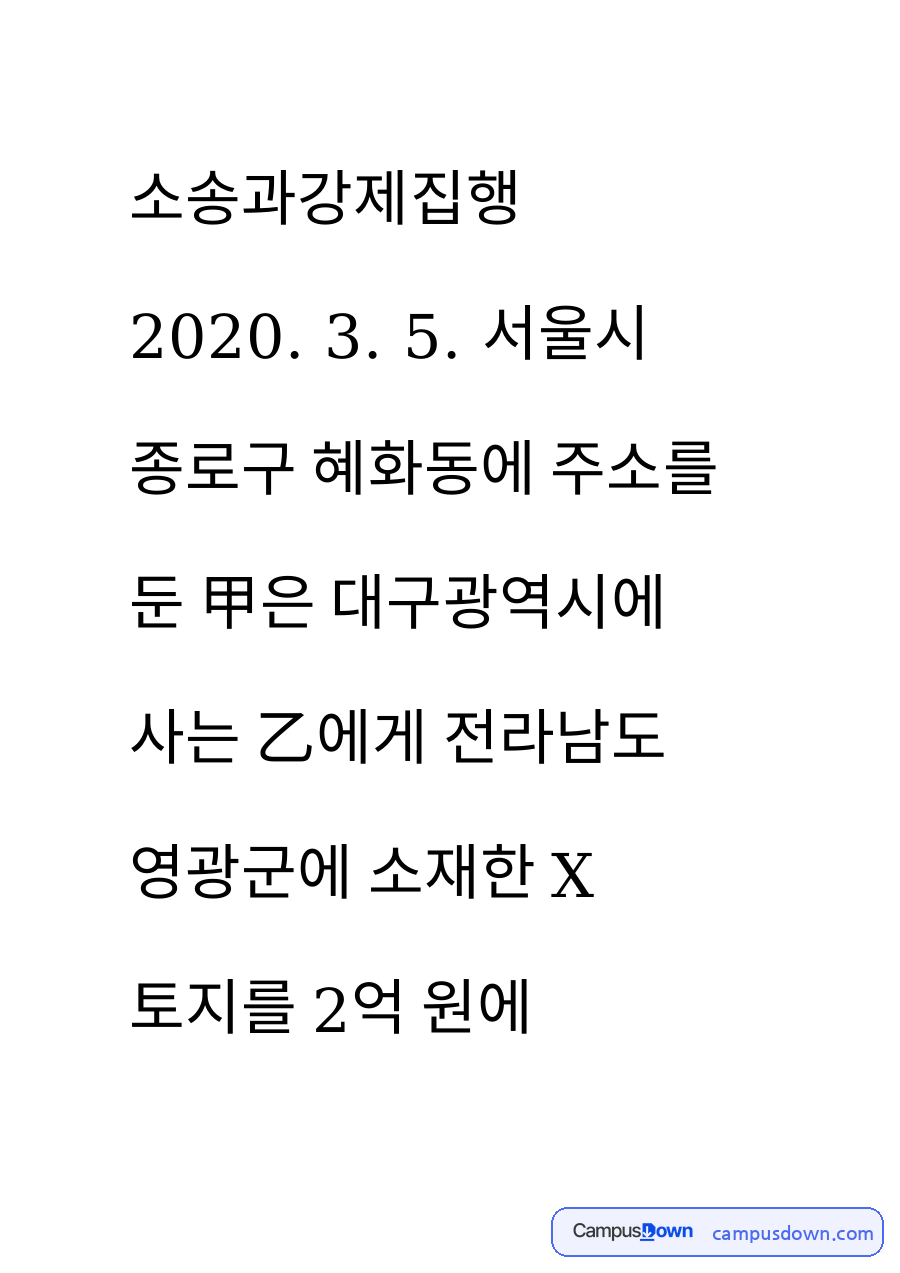
If the plaintiff A wants to sue B for the purchase price of the land, A must, as explained above, choose either the Daegu District Court or the Seoul District Court. If A follows the general forum, A should prepare and file a complaint with the Daegu District Court, and if A follows the special forum, A should sue in the Seoul District Court. The complaint must describe in detail the plaintiff's identity, the relief sought and the grounds for the claim, and documentary evidence must be presented.
To add: the 'Seoul District Court' in the paper today corresponds to the Seoul Central District Court, which covers Jongno-gu. A money debt must be paid at the creditor's current address unless otherwise agreed (Article 467(2) of the Civil Act), so the seller can sue in the court for his own address, but when the price is to be paid at the same time as delivery of the object sold, the place of delivery becomes the place of payment (Article 586). Since March 2022, civil cases go to a three-judge panel at first instance only when the amount in controversy exceeds 500 million won, so unlike the paper's explanation of subject-matter jurisdiction, this case is for a single judge. The small claims threshold is 30 million won or less.
■ Which Court Hears a Claim for Unpaid Purchase Money? A Korean Civil Procedure Case Problem on Venue, General and Special Forums and Case Assignment — Contents and key concepts
Where should a seller sue for unpaid purchase money?
✦ At a glance
- A Korean civil procedure case on venue
- Structure: facts → venue rules → case assignment → conclusion
- Useful for civil procedure courses
☰ What the paper covers
- Statutory venue
- Defendant's domicile
- Place of performance
- Real property forum
- Small claims and assignment
✎ Venue in Korea and the U.S.
Korea lets a plaintiff sue where the defendant lives or where a money debt must be paid, which is usually the creditor's address.
In the U.S., a court needs personal jurisdiction under the minimum contacts test of International Shoe (1945), and federal venue lies where a defendant resides or where the events occurred.
Note: the paper itself is written in Korean and discusses Korean law. This page is general study information, not legal advice.
Related wiki: Civil Procedure Steps
■ Which Court Hears a Claim for Unpaid Purchase Money? A Korean Civil Procedure Case Problem on Venue, General and Special Forums and Case Assignment References
- 대법원 전자민원센터-절차안내-민사-소액사건재판 「소액사건심판법」 제2조제1항, 「소액사건심판규칙」 제1조의2 대법원사건의 배당에 관한 내규 개정 2016. 7. 13.
- [내규 제471호, 시행 2016. 8. 1.] 제9조 (사건배당 주관자) 대법원사건의 배당에 관한 내규 개정 2016. 7. 13.
- [내규 제471호, 시행 2016. 8. 1.]제10조 (배당실시의 시기 등)
Keyword Prompt
전문가가 만들었어요과제를 직접 쓰는 데 도움이 되는 영어 프롬프트예요.
Tip! Prompt 에 자신의 생각을 추가해서 하면 훨씬 더 ✨ 좋습니다.
캠퍼스다운에서 레포트 받고 잘 쓰는 법 3가지, AI로 참고자료 제대로 재가공하기 →Prompt 1
I'm writing a university assignment on "민사소송 관할 사례 풀이: 매매대금 청구의 토지관할, 보통재판적과 의무이행지 특별재판적, 소장 접수와 사건 배당". Help me build an outline (introduction, 2-3 body sections, conclusion) that covers 민사소송 관할, 토지관할 and 보통재판적. Don't write the paper for me - give me guiding questions for each section. My own perspective: [자신의 생각 넣는 곳] Please respond in Korean.
Prompt 2
Explain the key concepts "민사소송 관할" and "토지관할" in simple terms, then show how they connect to the topic "민사소송 관할 사례 풀이: 매매대금 청구의 토지관할, 보통재판적과 의무이행지 특별재판적, 소장 접수와 사건 배당". Point out common misunderstandings students have about them. My own perspective: [자신의 생각 넣는 곳] Please respond in Korean.
Prompt 3
Suggest 3 real-world cases or examples I could analyze in an assignment on "민사소송 관할 사례 풀이: 매매대금 청구의 토지관할, 보통재판적과 의무이행지 특별재판적, 소장 접수와 사건 배당", focusing on "보통재판적". For each, tell me what I should look up and verify in official or academic sources. My own perspective: [자신의 생각 넣는 곳] Please respond in Korean.
Prompt 4
Review my draft paragraph on "민사소송 관할 사례 풀이: 매매대금 청구의 토지관할, 보통재판적과 의무이행지 특별재판적, 소장 접수와 사건 배당" (key idea: "특별재판적"). Give feedback on logic, evidence and clarity, and mark where I need a citation. My paragraph: [paste here] My own perspective: [자신의 생각 넣는 곳] Please respond in Korean.
Take a break with a quick personality test?
Ranked by actual participation. Results in about a minute.
Loading…
Most-read content
Loading view counts…

Campusdown is a lifelong-learning community in Korea offering study materials, information on government support, student loans and scholarships, and more. Don't miss our free resources.
Go to the Campusdown home page →Refund policy
- Change of mind / refund requested after partial use / more than 7 days after purchase
◆ Exceptions
- File errors / cannot download or open the file
◆ How to request a refund: send a 1:1 inquiry via Customer Service at the top