
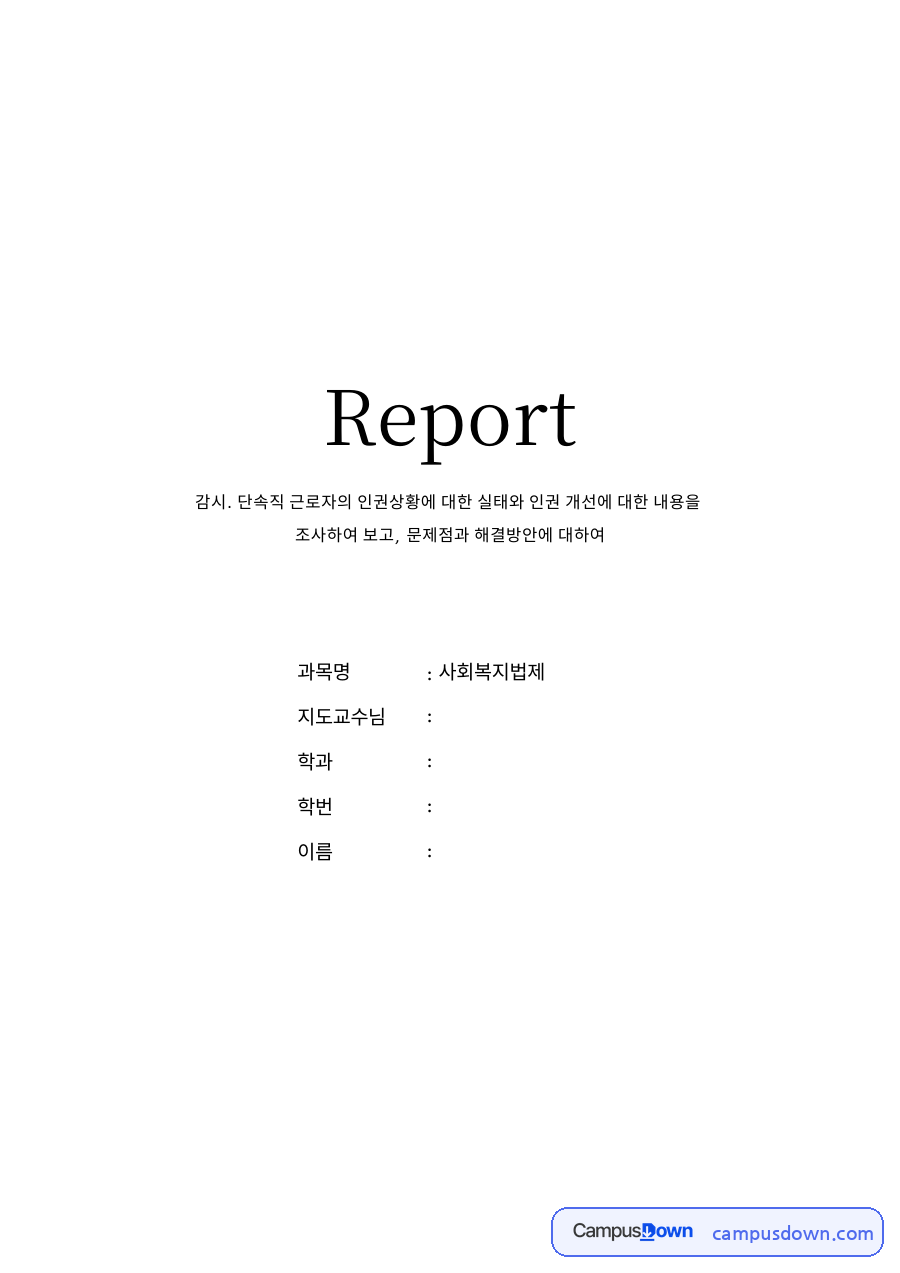
Page 1 is shown as is; from page 2 on, the preview is blurred. Buy it to download the complete original file right away (the file itself is written in Korean).
Packed with real examples and experience. Download it now and save time.
Save your valuable time
Buyer ratings
Fast, accurate and useful.
No ratings yet. Be the first to rate it.


1 / 5
좌우로 밀어서 페이지를 넘겨보세요
과제 개요
| 전체 페이지 수 | 5페이지 |
|---|---|
| 파일 형식 | 한글(HWP) |
| 등록일 | 2025.08.06 |
목차
- 1Ⅰ. 서론
- 2Ⅱ. 본론
- 2.11. 감시·단속직 근로자의 개념
- 2.22. 현재 감시·단속직 노인근로자의 직종
- 2.33. 감시·단속직 노인근로자의 인권상황 문제점
- 2.44. 개선방안
- 3Ⅲ. 결론
- 4Ⅳ. 참고문헌
캠퍼스다운 도움말
해당 자료는 No AI 자료입니다. 인싸이트를 얻고 새롭게 가공해 보세요.
자료를 받아서 이용하면 품질이 확 올라갑니다.
- 감시·단속적 근로자
- 아파트 경비원
- 근로기준법 제63조
- 최저임금 감액 적용
- 노동인권
- 사회복지법제
- 감시·단속직 근로자의 개념
- 현재 감시·단속직 노인근로자의 직종
- 개선방안
Watch and Intermittent Workers in Korea: Exclusion from Working-Hours Rules, Minimum Wage Phase-In for Security Guards, and Older Workers' Rights
※ You can preview page 1 as is. Buy it to download the complete original file right away. The file itself is written in Korean.
■ Watch and Intermittent Workers in Korea: Exclusion from Working-Hours Rules, Minimum Wage Phase-In for Security Guards, and Older Workers' Rights — Overview
A 5-page Korean labor and social welfare law paper on surveillance and intermittent workers such as apartment security guards. It explains how Article 63 of the Labor Standards Act excludes approved workers from rules on working hours, breaks and holidays, how the minimum wage was phased in for them, why full application threatened older guards' jobs, and proposes a separate minimum wage scheme.
■ Watch and Intermittent Workers in Korea: Exclusion from Working-Hours Rules, Minimum Wage Phase-In for Security Guards, and Older Workers' Rights — Excerpt from the original document (English translation)
With apartments and other multi-unit housing now widespread and people's demand for safety rising, the private security industry is growing day by day, and demand for facility security by private guards keeps increasing. Despite this steady demand, however, facility security workers are aging, and most older private security guards are on non-regular contracts in poor conditions. Below, I look at the concept of surveillance and intermittent workers and how the occupations of older workers in this category are classified. I also identify the problems in the human rights situation that older workers in these jobs face, as mentioned in the introduction, and describe ways to improve it.
The concept of surveillance and intermittent workers under Article 63, item 3 of the Labor Standards Act and Article 10(2) and (3) of its Enforcement Rule is as follows. A person engaged in surveillance work mainly performs monitoring duties with relatively little mental or physical fatigue; typical examples are gatekeepers, security guards, goods watchers and police-guards. A person engaged in intermittent work performs work that occurs intermittently with much rest or waiting time; typical examples are dedicated drivers, machine repairers and boiler operators.
To employ surveillance and intermittent workers, an employer must first report to the regional labor office and obtain the approval of the Minister of Employment and Labor. These workers are not covered by the statutory rules on working hours, minimum wage, breaks and holidays.
Note: Under the 2005 amendment to the Minimum Wage Act, surveillance and intermittent workers received 70% of the minimum wage in 2007 and 80% from 2008 to 2011. Full application was scheduled for 2012, but because of fears of mass dismissals the rate was changed to 90% for 2012 through 2014, and 100% has applied since January 1, 2015. The paper's statement that full application was planned for 2012 and then deferred for three years should be read with the 90% stage in mind.
■ Watch and Intermittent Workers in Korea: Exclusion from Working-Hours Rules, Minimum Wage Phase-In for Security Guards, and Older Workers' Rights — Contents and key concepts
Security guards in the blind spot of labor law
✦ At a glance
- Korea's watch and intermittent workers and their rights
- Structure: concept → occupations → problems → proposals
- Useful for labor law and social welfare law courses
☰ What the paper covers
- Article 63 exclusion
- Two types of work
- Minimum wage phase-in
- Older guards' jobs
- Proposals
✎ Exempt workers in Korea and the U.S.
In Korea, approved watch and intermittent workers are excluded from working-hours rules, and the full minimum wage has applied to them since 2015.
In the U.S., the Fair Labor Standards Act has its own exemptions and on-call time rules, under which waiting time may or may not count as paid hours.
Note: the paper itself is written in Korean and discusses Korean law. This page is general study information, not legal advice.
Related wiki: Minimum Wage and Overtime Law
■ Watch and Intermittent Workers in Korea: Exclusion from Working-Hours Rules, Minimum Wage Phase-In for Security Guards, and Older Workers' Rights References
- pmg 지식엔진연구소, 시사상식사전, 박문각
- 김관오, 감시 또는 단속적 근로자에 대한 최저임금 적용과 고용안정 방안에 관한 연구, 단국대학교, 2014
- 오규철 외 2, 노인 민간경비원의 근로조건에 관한 연구, 한국공안행정학회, 2013
Keyword Prompt
전문가가 만들었어요과제를 직접 쓰는 데 도움이 되는 영어 프롬프트예요.
Tip! Prompt 에 자신의 생각을 추가해서 하면 훨씬 더 ✨ 좋습니다.
캠퍼스다운에서 레포트 받고 잘 쓰는 법 3가지, AI로 참고자료 제대로 재가공하기 →Prompt 1
I'm writing a university assignment on "감시·단속적 근로자의 인권 실태와 개선 방안: 근로기준법 제63조 적용 제외, 경비원 최저임금 감액 적용, 고령 경비원 문제". Help me build an outline (introduction, 2-3 body sections, conclusion) that covers 감시·단속적 근로자, 아파트 경비원 and 근로기준법 제63조. Don't write the paper for me - give me guiding questions for each section. My own perspective: [자신의 생각 넣는 곳] Please respond in Korean.
Prompt 2
Explain the key concepts "감시·단속적 근로자" and "아파트 경비원" in simple terms, then show how they connect to the topic "감시·단속적 근로자의 인권 실태와 개선 방안: 근로기준법 제63조 적용 제외, 경비원 최저임금 감액 적용, 고령 경비원 문제". Point out common misunderstandings students have about them. My own perspective: [자신의 생각 넣는 곳] Please respond in Korean.
Prompt 3
Suggest 3 real-world cases or examples I could analyze in an assignment on "감시·단속적 근로자의 인권 실태와 개선 방안: 근로기준법 제63조 적용 제외, 경비원 최저임금 감액 적용, 고령 경비원 문제", focusing on "근로기준법 제63조". For each, tell me what I should look up and verify in official or academic sources. My own perspective: [자신의 생각 넣는 곳] Please respond in Korean.
Prompt 4
Review my draft paragraph on "감시·단속적 근로자의 인권 실태와 개선 방안: 근로기준법 제63조 적용 제외, 경비원 최저임금 감액 적용, 고령 경비원 문제" (key idea: "최저임금 감액 적용"). Give feedback on logic, evidence and clarity, and mark where I need a citation. My paragraph: [paste here] My own perspective: [자신의 생각 넣는 곳] Please respond in Korean.
Take a break with a quick personality test?
Ranked by actual participation. Results in about a minute.
Loading…
Most-read content
Loading view counts…

Campusdown is a lifelong-learning community in Korea offering study materials, information on government support, student loans and scholarships, and more. Don't miss our free resources.
Go to the Campusdown home page →Refund policy
- Change of mind / refund requested after partial use / more than 7 days after purchase
◆ Exceptions
- File errors / cannot download or open the file
◆ How to request a refund: send a 1:1 inquiry via Customer Service at the top