
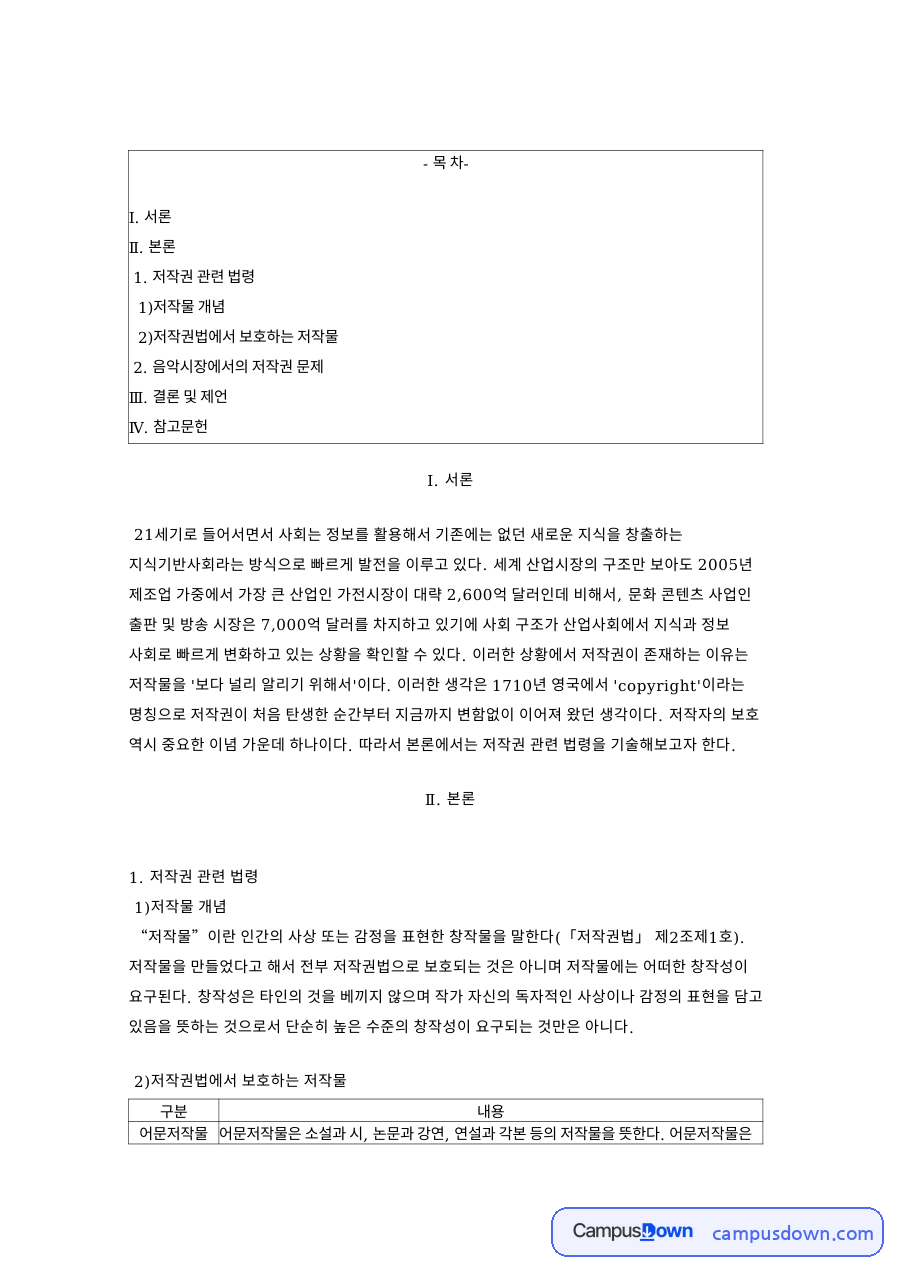
Page 1 is shown as is; from page 2 on, the preview is blurred. Buy it to download the complete original file right away (the file itself is written in Korean).
Packed with real examples and experience. Download it now and save time.
Save your valuable time
Buyer ratings
Fast, accurate and useful.
No ratings yet. Be the first to rate it.


1 / 4
좌우로 밀어서 페이지를 넘겨보세요
과제 개요
| 전체 페이지 수 | 4페이지 |
|---|---|
| 파일 형식 | 한글(HWP) |
| 등록일 | 2025.07.24 |
목차
- 1Ⅰ. 서론
- 2Ⅱ. 본론
- 2.11. 저작권 관련 법령
- 2.21)저작물 개념
- 2.32)저작권법에서 보호하는 저작물
- 2.42. 음악시장에서의 저작권 문제
- 3Ⅲ. 결론 및 제언
- 4Ⅳ. 참고문헌
캠퍼스다운 도움말
해당 자료는 No AI 자료입니다. 인싸이트를 얻고 새롭게 가공해 보세요.
자료를 받아서 이용하면 품질이 확 올라갑니다.
- 저작권법
- 저작물
- 2차적저작물
- 편집저작물
- 매장 음악 공연권
- 음원
- 저작권 분쟁
- 지식재산권 과제
- 결론 및 제언
Types of Copyrighted Works under Korean Law and Copyright Disputes in the Music Market: Originality, Derivative Works and Performance Rights in Stores
※ You can preview page 1 as is. Buy it to download the complete original file right away. The file itself is written in Korean.
■ Types of Copyrighted Works under Korean Law and Copyright Disputes in the Music Market: Originality, Derivative Works and Performance Rights in Stores — Overview
A 4-page Korean copyright paper. It explains the definition of a copyrighted work and the originality requirement under Korea's Copyright Act, describes each category from literary and musical works to computer programs, derivative works and compilations, and examines why music copyright disputes keep arising in digital distribution and in-store music.
■ Types of Copyrighted Works under Korean Law and Copyright Disputes in the Music Market: Originality, Derivative Works and Performance Rights in Stores — Excerpt from the original document (English translation)
Copyright disputes in the music market have intensified first because a new environment, with the spread of smartphones and the growth of online distribution, is rewriting the rules. Another reason is that copyright protection was strengthened with the implementation of the Korea-U.S. and Korea-EU free trade agreements, raising awareness of copyright, including legal use of music files. But the biggest reason music copyright disputes continue in Korea is the complexity of domestic rights and the one-sided way usage fees are set. Korea's Copyright Act itself is not especially complicated, but the copyright issues involved in actually running a music service are so complex that even experts find them hard to grasp; there were even reports that Samsung Electronics, which had already run music services abroad, put off its domestic launch. Even an article by a specialist reporter described the Korea Music Copyright Association, which manages authors' economic rights in trust, as also managing moral rights and the right to make derivative works, so it is hardly surprising that musicians with little awareness of copyright find it hard to protect their rights.
Public awareness of copyright and of the need to protect it has improved considerably, but users still often use works without permission because they do not clearly understand the scope of copyright. First, the culture ministry and related agencies should gather the views of experts and organizations to present realistic policies, and the National Assembly should promptly revise the law so that institutional changes do not cause confusion. As music consumption has shifted to digital files, amendments to the Copyright Act suited to the online era are being prepared, but conflicts among stakeholders and between the ruling and opposition parties have delayed their passage, only adding to the confusion.
To add: the August 2017 amendment to Article 11 of the Enforcement Decree of the Copyright Act broadened the scope of performance rights, so that from August 23, 2018 coffee shops and other non-alcoholic beverage outlets, beer bars and other pubs, fitness centers, multi-purpose shopping malls and other large stores must also pay performance fees (performance royalties and performance compensation) when they play commercial recordings. Businesses under 50 square meters and traditional markets are exempt. The paper's 'amendment on large stores' and its 2014 article describe the situation before this change. The rights of lyricists and composers (copyright) are distinct from those of singers and record producers (neighboring rights), and authors' economic rights are in principle protected for 70 years after the author's death.
■ Types of Copyrighted Works under Korean Law and Copyright Disputes in the Music Market: Originality, Derivative Works and Performance Rights in Stores — Contents and key concepts
Many rights in a single song
✦ At a glance
- Copyrighted works and music copyright disputes in Korea
- Structure: definition → categories of works → music market → proposals
- Useful for intellectual property and copyright courses
☰ What the paper covers
- Definition and originality
- Nine categories of works
- Derivative works and compilations
- Digital music disputes
- In-store music and dispute resolution
✎ Music copyright in Korea and the U.S.
Korea separates authors' copyright from performers' and record producers' neighboring rights, and since 2018 most cafés and gyms over 50 square meters pay for in-store music.
In the U.S., performing rights organizations such as ASCAP and BMI license public performance, and the Music Modernization Act of 2018 created a blanket license for streaming.
Note: the paper itself is written in Korean and discusses Korean law. This page is general study information, not legal advice.
Related wiki: Copyright Basics
■ Types of Copyrighted Works under Korean Law and Copyright Disputes in the Music Market: Originality, Derivative Works and Performance Rights in Stores References
- 저작권위원회- 저작권해설서 서울지방변호사회보(2014.06.02.) 특별기고 - 매장 음악 저작권. 최진원. (2014). 정부3.0 공공정보 개방을 위한 제도적 개선 방안. 경제규제와 법, 7(2), 38-55.
Keyword Prompt
전문가가 만들었어요과제를 직접 쓰는 데 도움이 되는 영어 프롬프트예요.
Tip! Prompt 에 자신의 생각을 추가해서 하면 훨씬 더 ✨ 좋습니다.
캠퍼스다운에서 레포트 받고 잘 쓰는 법 3가지, AI로 참고자료 제대로 재가공하기 →Prompt 1
I'm writing a university assignment on "저작권법이 보호하는 저작물의 종류와 음악시장의 저작권 문제: 창작성 요건, 2차적·편집저작물, 매장 음악 공연권". Help me build an outline (introduction, 2-3 body sections, conclusion) that covers 저작권법, 저작물 and 2차적저작물. Don't write the paper for me - give me guiding questions for each section. My own perspective: [자신의 생각 넣는 곳] Please respond in Korean.
Prompt 2
Explain the key concepts "저작권법" and "저작물" in simple terms, then show how they connect to the topic "저작권법이 보호하는 저작물의 종류와 음악시장의 저작권 문제: 창작성 요건, 2차적·편집저작물, 매장 음악 공연권". Point out common misunderstandings students have about them. My own perspective: [자신의 생각 넣는 곳] Please respond in Korean.
Prompt 3
Suggest 3 real-world cases or examples I could analyze in an assignment on "저작권법이 보호하는 저작물의 종류와 음악시장의 저작권 문제: 창작성 요건, 2차적·편집저작물, 매장 음악 공연권", focusing on "2차적저작물". For each, tell me what I should look up and verify in official or academic sources. My own perspective: [자신의 생각 넣는 곳] Please respond in Korean.
Prompt 4
Review my draft paragraph on "저작권법이 보호하는 저작물의 종류와 음악시장의 저작권 문제: 창작성 요건, 2차적·편집저작물, 매장 음악 공연권" (key idea: "편집저작물"). Give feedback on logic, evidence and clarity, and mark where I need a citation. My paragraph: [paste here] My own perspective: [자신의 생각 넣는 곳] Please respond in Korean.
Take a break with a quick personality test?
Ranked by actual participation. Results in about a minute.
Loading…
Most-read content
Loading view counts…

Campusdown is a lifelong-learning community in Korea offering study materials, information on government support, student loans and scholarships, and more. Don't miss our free resources.
Go to the Campusdown home page →Refund policy
- Change of mind / refund requested after partial use / more than 7 days after purchase
◆ Exceptions
- File errors / cannot download or open the file
◆ How to request a refund: send a 1:1 inquiry via Customer Service at the top