
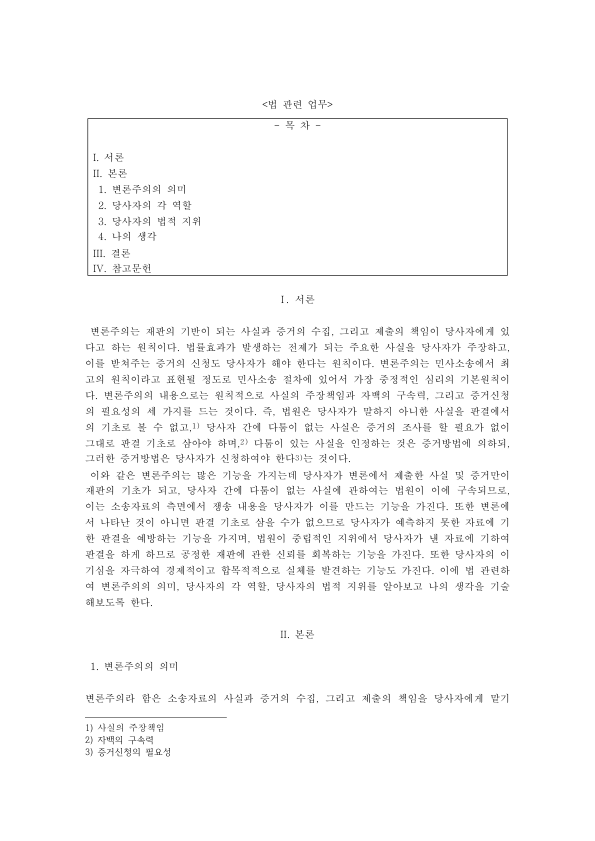
Page 1 is shown as is; from page 2 on, the preview is blurred. Buy it to download the complete original file right away (the file itself is written in Korean).
Packed with real examples and experience. Download it now and save time.
Save your valuable time
Buyer ratings
Fast, accurate and useful.
No ratings yet. Be the first to rate it.


The Party Presentation Principle in Korean Civil Procedure: Burden of Allegation, Binding Admissions and the Rights of Parties
※ You can preview page 1 as is. Buy it to download the complete original file right away. The file itself is written in Korean.
■ The Party Presentation Principle in Korean Civil Procedure: Burden of Allegation, Binding Admissions and the Rights of Parties — Overview
A 5-page Korean civil procedure paper on the party presentation principle (byeollonjuui), under which the parties, not the court, must allege the facts and offer the evidence a judgment rests on. It explains the burden of allegation, the binding effect of admissions and the duty to submit evidence, links the burden of allegation to the burden of proof and free evaluation of evidence, and surveys the procedural rights that make up a party's standing in court.
■ The Party Presentation Principle in Korean Civil Procedure: Burden of Allegation, Binding Admissions and the Rights of Parties — Excerpt from the original document (English translation)
A party is not merely an object of investigation, nor one who must simply wait for the court's gracious disposition; based on its status as a subject of the litigation, it is recognized as having various procedural rights. In Japan, these rights and powers that a party is recognized as having in procedure by virtue of its status as a subject of litigation are grasped as a whole and called "tōjisha-ken" (party rights). This became a single unified concept because the rights a party holds are not unrelated to one another but are connected as a whole from the perspective of realizing procedural justice, and the need for such a concept is recognized. In short, party rights are the collective term for the various procedural rights a party has in its status as a subject of litigation when undergoing a civil trial. They can be seen as the party's procedural rights or rights of participation, and guaranteeing party rights is called procedural guarantee.
The specific contents of party rights created under the Civil Procedure Act include: the right to apply for designation of a date, as a right to monitor the progress of proceedings and to receive a speedy and fair trial; the right to receive notice of dates; the right to receive service of the complaint and the judgment; the right to ask questions and the right to object regarding litigation procedure, as rights to supplement and correct deficiencies in the court's conduct of the proceedings on hearing dates; the right to apply for transfer and the right to apply for exclusion and recusal (Civil Procedure Act Articles 41 to 43, etc.); the right to prove and the right to inspect and copy the litigation record (Civil Procedure Act Articles 157 and 162); the right to be heard, which gives the opportunity to apply for a judgment and submit litigation materials; the right to state opinions on the issues; the right to specify and dispose of the subject matter of the suit; and the right to appeal against an unfavorable judgment.
The principle of party presentation and the parties' respective roles are closely related. Looking at what usefulness establishing the concept of party status has in civil litigation: first, the concept of the party's role serves not only as the criterion dividing contentious cases from non-contentious cases, since party status is more thoroughly protected in contentious civil cases while that protection is insufficient in non-contentious cases, but also as a limit on the trend of turning litigation into non-contentious proceedings; and second, it is very useful in explaining the justification for res judicata affecting the parties. Therefore, where party status, that is, procedural fundamental rights, has not been guaranteed, the conclusion that the judgment is void or must be set aside is drawn. Case law also affirms the existence of procedural fundamental rights, and where a judgment was rendered by fundamentally infringing them, damages for tort can be claimed even without a retrial.
In litigation, the parties have equal status, and their roles and opportunities in the litigation are equally guaranteed. This principle of equality of the parties is also a requirement of our legal order as a whole, as in Article 11 of the Constitution. The significance of today's discussion of party rights, in an era that is no longer authoritarian, lies largely in the point that parties should be treated not simply as objects of procedure but as subjects of litigation who actively participate in it, and that their party status should be respected.
For reference, the material states that ex officio examination of evidence is in principle prohibited, but Article 292 of the Civil Procedure Act allows it supplementarily, providing that the court may examine evidence ex officio where it cannot form a conviction from the evidence applied for by the parties or where it otherwise deems it necessary. In addition, as devices that supplement the principle of party presentation, there are the right and duty to request clarification under Article 136, so the court can ask a party to clarify an unclear assertion. Also compare procedures in which the inquisitorial principle is strengthened, such as family litigation and parts of administrative litigation.
■ The Party Presentation Principle in Korean Civil Procedure: Burden of Allegation, Binding Admissions and the Rights of Parties — Contents and key concepts
Why can't a Korean civil judge rule on facts nobody raised?
✦ At a glance
- The party presentation principle explained
- Structure: meaning → parties' roles → procedural rights
- Useful for comparative civil procedure coursework
☰ What the paper covers
- Three components of the principle
- Burden of allegation and burden of proof
- Who counts as a party
- Procedural rights of parties
✎ Party control of facts in Korea and the U.S.
Korean civil courts may decide only on facts the parties allege, must accept undisputed facts as admitted, and examine evidence mainly on a party's request, softened by the judge's duty to clarify under Article 136 of the Civil Procedure Act.
U.S. courts follow a similar party presentation principle; in United States v. Sineneng-Smith (2020) the Supreme Court reminded appellate judges not to decide cases on issues the parties never raised.
Note: the paper itself is written in Korean and discusses Korean law. This page is general study information, not legal advice.
Related wiki: Civil Procedure Steps
Related wiki: Standing to Sue
■ The Party Presentation Principle in Korean Civil Procedure: Burden of Allegation, Binding Admissions and the Rights of Parties References
- 김효정, 2017, 주주대표소송에 관한 연구 :국내 및 국제소송상의 쟁점을 중심으로, 연세대학교 대학원 오영경, 2016, 소송당사자의 경제적 조건과 사법불신의 상관성 연구, 동국대학교
Take a break with a quick personality test?
Ranked by actual participation. Results in about a minute.
Loading…
Most-read content
Loading view counts…

Campusdown is a lifelong-learning community in Korea offering study materials, information on government support, student loans and scholarships, and more. Don't miss our free resources.
Go to the Campusdown home page →Refund policy
- Change of mind / refund requested after partial use / more than 7 days after purchase
◆ Exceptions
- File errors / cannot download or open the file
◆ How to request a refund: send a 1:1 inquiry via Customer Service at the top