
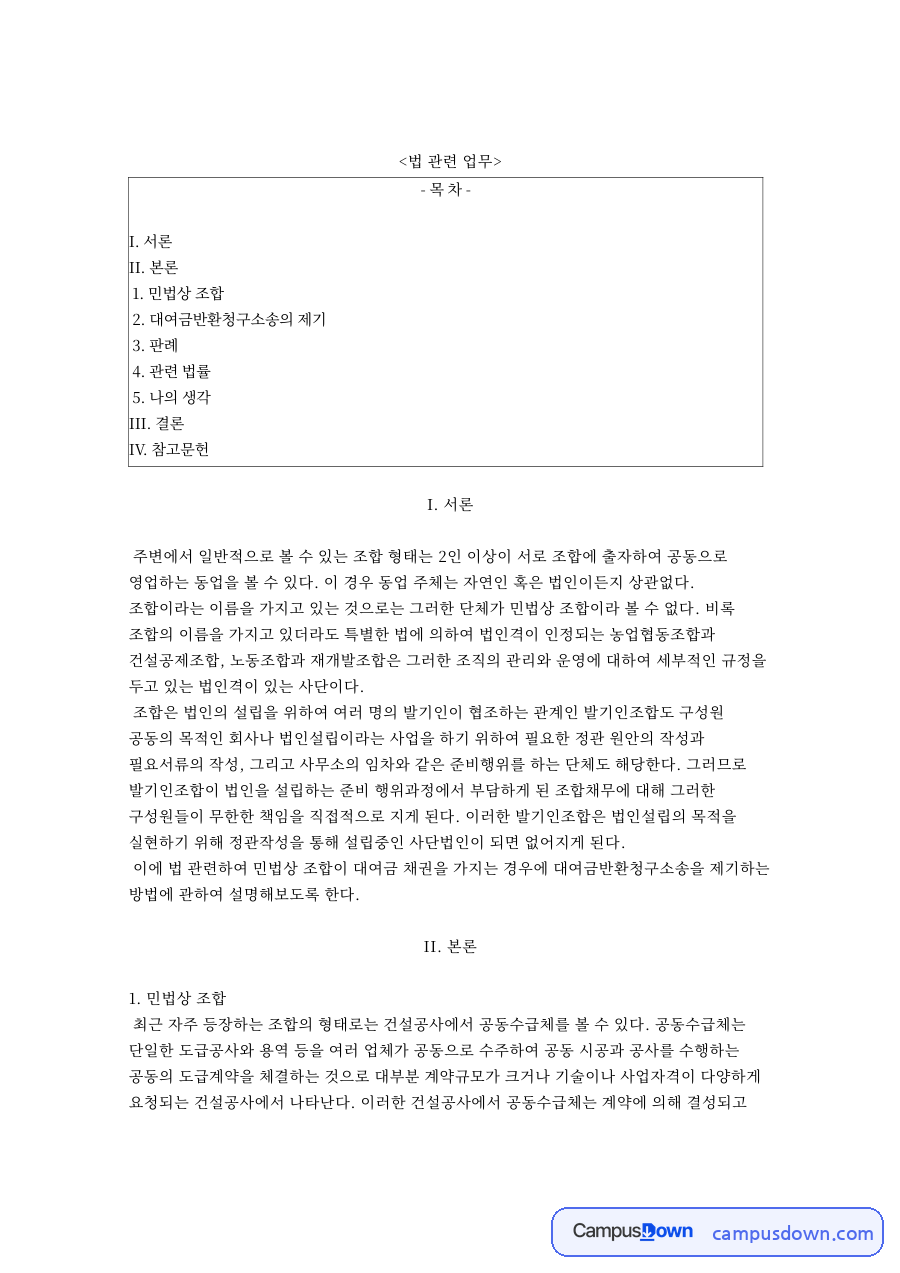
Page 1 is shown as is; from page 2 on, the preview is blurred. Buy it to download the complete original file right away (the file itself is written in Korean).
Packed with real examples and experience. Download it now and save time.
Save your valuable time
Buyer ratings
Fast, accurate and useful.
No ratings yet. Be the first to rate it.


1 / 6
좌우로 밀어서 페이지를 넘겨보세요
과제 개요
| 전체 페이지 수 | 6페이지 |
|---|---|
| 파일 형식 | 한글(HWP) |
| 등록일 | 2025.07.05 |
목차
- 1I. 서론
- 2II. 본론
- 2.11. 민법상 조합
- 2.22. 대여금반환청구소송의 제기
- 2.33. 판례
- 2.44. 관련 법률
- 2.55. 나의 생각
- 3III. 결론
- 4IV. 참고문헌
캠퍼스다운 도움말
해당 자료는 No AI 자료입니다. 인싸이트를 얻고 새롭게 가공해 보세요.
자료를 받아서 이용하면 품질이 확 올라갑니다.
- 민법
- 민사소송법
- 민법상 조합
- 조합재산
- 합유
- 당사자능력
- 임의적 소송신탁
- 업무집행조합원
- 대여금반환청구소송
- 공동수급체
Suing to Recover a Loan Made by a Civil Law Partnership in Korea: Capacity to Be a Party and Voluntary Litigation Trust
※ You can preview page 1 as is. Buy it to download the complete original file right away. The file itself is written in Korean.
■ Suing to Recover a Loan Made by a Civil Law Partnership in Korea: Capacity to Be a Party and Voluntary Litigation Trust — Overview
A 6-page Korean civil law and civil procedure paper. It explains what a civil law partnership (johap) under Articles 703 and following of the Korean Civil Act is, using construction joint ventures as an example, and how partnership property is held jointly (hapyu). It then discusses why Korean courts deny a partnership the capacity to be a party, how they instead allow a managing partner to sue through a voluntary litigation trust, how to file a claim for repayment of a loan, and argues for limited party capacity for partnerships that function like associations, with reference to German law.
■ Suing to Recover a Loan Made by a Civil Law Partnership in Korea: Capacity to Be a Party and Voluntary Litigation Trust — Excerpt from the original document (English translation)
Based on a comparison with German law, it is possible to think that, although a partnership cannot have completely comprehensive legal capacity like a corporation, it may have certain legal capacity under certain conditions, or that a method of interpreting the law through law-making that goes beyond the statute can be considered; but there has not yet been any concrete work on what changes this should bring to the amendment, application and interpretation of our Civil Act. Nevertheless, awareness of the problems and limits of partnerships under the existing Civil Act and Civil Procedure Act is expanding day by day.
Where property is obtained through the partnership's business but acquired in the name of a partner or managing partner, it is considered that there is a duty to transfer that right into the partnership's name. Before that right is transferred, the right held by the partnership and the other partners may be no more than a claim for transfer; but in the case of property obtained through an act carried out on the partnership's account, with the transfer made while indicating that the property is for the partnership, it is considered that the partnership and all of its partners should in fact be regarded as the owners of that property even if no act of transferring the right into the partnership's name exists. This means that, before the contributions to the partnership and the act of transferring partnership property take place, the partners still hold the rights to that partnership property, and the partnership holds only a claim as an obligatory right.
Whether a partnership can be legally recognized as having capacity to be a party under the Civil Procedure Act is, in the end, closely related to how the nature of a partnership is classified. On this point, following the Civil Act system that completely separates partnerships from associations, the Civil Procedure Act has a separate provision recognizing the litigation capacity of unincorporated associations but no provision recognizing litigation capacity for partnerships, thereby excluding partnerships by the wording of the statute. (Go Ju-hyeon, 2019, A Study on the Operation and Improvement of the Claim Execution System under the Civil Execution Act: Focusing on the Collection Order System)
However, this approach of the Civil Procedure Act causes much inconvenience in civil litigation when one considers the forms of partnership that actually exist. A partnership must always make all of its partners plaintiffs or defendants, and litigating this way imposes procedural burdens on both the partnership and its opponent. When the partnership's opponent wants to file suit, it must investigate who all the partners are, which may lead to unfavorable litigation results due to the passage of time.
The case law is also aware of the problems of denying a partnership capacity to be a party under procedural law. It recognizes the problems of allowing only compulsory joint litigation even where, by the partnership agreement and resolutions, the managing partner has in practice been given authority to manage partnership property and the right to represent the partnership and carry out external business, and it exceptionally allows voluntary litigation trusts; so the managing partner of a partnership can be regarded as having been given authority similar or identical to that of an unincorporated association.
Rather than denying partnerships capacity to be a party under procedural law in principle and exceptionally applying voluntary litigation trusts, it is more reasonable to recognize a partnership's capacity to be a party in a limited way.
The changes in German law the material mentions later led to legislation: the German Act to Modernize the Law on Partnerships (MoPeG), in force since January 2024, expressly recognizes legal capacity for civil-law partnerships that act externally. Our case law still regards litigation over partnership property as inherently compulsory joint litigation in which all partners must be parties, while exceptionally allowing a managing partner's voluntary litigation trust. Adding a comparison of this difference lets you write a much more persuasive conclusion for assignments covering both the Civil Act and the Civil Procedure Act.
■ Suing to Recover a Loan Made by a Civil Law Partnership in Korea: Capacity to Be a Party and Voluntary Litigation Trust — Contents and key concepts
Who sues when a partnership is owed money?
✦ At a glance
- The party capacity problem of civil law partnerships
- Structure: partnership → procedural status → how to sue → case law → opinion
- Useful for civil law and civil procedure assignments
☰ What the paper covers
- Partnerships versus statutory cooperatives
- Joint ownership of partnership property
- Denial of party capacity and the litigation trust exception
- Relevant Civil Act and Civil Procedure Act provisions
✎ Partnerships in Korean procedure
Korean courts treat lawsuits over partnership property as requiring all partners as co-plaintiffs.
A managing partner may sue in his own name only through a voluntary litigation trust that courts accept when there is a reasonable need.
Note: the paper itself is written in Korean and discusses Korean law. This page is general study information, not legal advice.
■ Suing to Recover a Loan Made by a Civil Law Partnership in Korea: Capacity to Be a Party and Voluntary Litigation Trust References
- 구성권, 2014, 대여금채권의 회수불능과 비영업대금의 이익에 대한 과세, 한국세법학회 고주현, 2019, 민사집행법상 채권집행제도의 운영 및 개선방안에 관한 연구 :- 추심명령제도를 중심으로 - 황병열, 채권자취소권에 있어서 사해행위에 관한 연구, 계명대학교 대학원
Keyword Prompt
전문가가 만들었어요과제를 직접 쓰는 데 도움이 되는 영어 프롬프트예요.
Tip! Prompt 에 자신의 생각을 추가해서 하면 훨씬 더 ✨ 좋습니다.
캠퍼스다운에서 레포트 받고 잘 쓰는 법 3가지, AI로 참고자료 제대로 재가공하기 →Prompt 1
I'm writing a university assignment on "민법상 조합의 대여금반환청구소송: 조합의 당사자능력, 업무집행조합원의 임의적 소송신탁과 판례". Help me build an outline (introduction, 2-3 body sections, conclusion) that covers 민법, 민사소송법 and 민법상 조합. Don't write the paper for me - give me guiding questions for each section. My own perspective: [자신의 생각 넣는 곳] Please respond in Korean.
Prompt 2
Explain the key concepts "민법" and "민사소송법" in simple terms, then show how they connect to the topic "민법상 조합의 대여금반환청구소송: 조합의 당사자능력, 업무집행조합원의 임의적 소송신탁과 판례". Point out common misunderstandings students have about them. My own perspective: [자신의 생각 넣는 곳] Please respond in Korean.
Prompt 3
Suggest 3 real-world cases or examples I could analyze in an assignment on "민법상 조합의 대여금반환청구소송: 조합의 당사자능력, 업무집행조합원의 임의적 소송신탁과 판례", focusing on "민법상 조합". For each, tell me what I should look up and verify in official or academic sources. My own perspective: [자신의 생각 넣는 곳] Please respond in Korean.
Prompt 4
Review my draft paragraph on "민법상 조합의 대여금반환청구소송: 조합의 당사자능력, 업무집행조합원의 임의적 소송신탁과 판례" (key idea: "조합재산"). Give feedback on logic, evidence and clarity, and mark where I need a citation. My paragraph: [paste here] My own perspective: [자신의 생각 넣는 곳] Please respond in Korean.
Take a break with a quick personality test?
Ranked by actual participation. Results in about a minute.
Loading…
Most-read content
Loading view counts…

Campusdown is a lifelong-learning community in Korea offering study materials, information on government support, student loans and scholarships, and more. Don't miss our free resources.
Go to the Campusdown home page →Refund policy
- Change of mind / refund requested after partial use / more than 7 days after purchase
◆ Exceptions
- File errors / cannot download or open the file
◆ How to request a refund: send a 1:1 inquiry via Customer Service at the top