
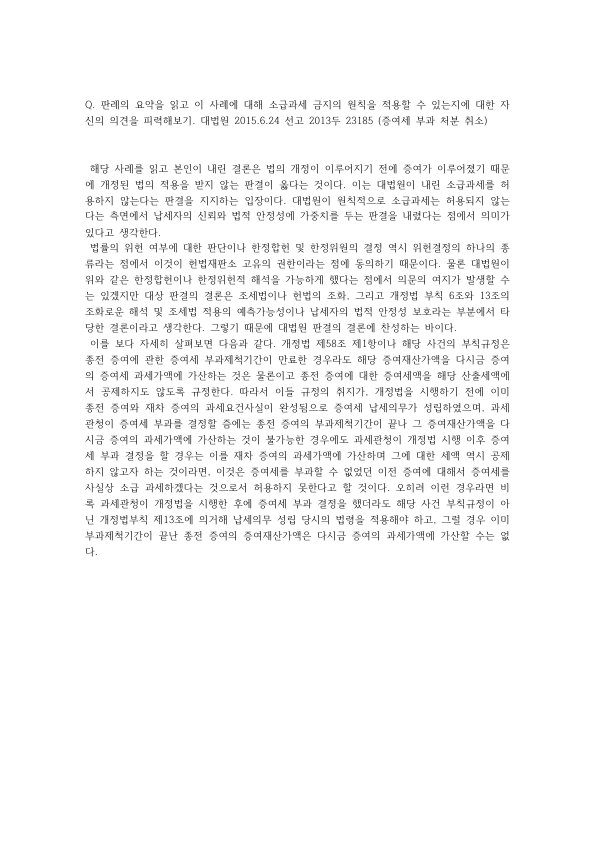
Page 1 is shown as is; from page 2 on, the preview is blurred. Buy it to download the complete original file right away (the file itself is written in Korean).
Packed with real examples and experience. Download it now and save time.
Save your valuable time
Buyer ratings
Fast, accurate and useful.
No ratings yet. Be the first to rate it.
Retroactive Taxation and the Principle of Tax Legality in Korea: An Opinion on Supreme Court Case 2013Du23195 on Aggregating Repeated Gifts
※ You can preview page 1 as is. Buy it to download the complete original file right away. The file itself is written in Korean.
■ Retroactive Taxation and the Principle of Tax Legality in Korea: An Opinion on Supreme Court Case 2013Du23195 on Aggregating Repeated Gifts — Overview
A 1-page Korean tax law opinion on Supreme Court decision 2013Du23195 (June 24, 2015). The 1996 revision of the Inheritance and Gift Tax Act allowed earlier gifts to be added to a later gift's taxable value even after the assessment period for the earlier gift had expired, without crediting the earlier tax. The author supports the Court's holding that applying this to gifts completed before the revision would amount to retroactive taxation, so the law in force when the tax liability arose must apply under Addendum Article 13.
■ Retroactive Taxation and the Principle of Tax Legality in Korea: An Opinion on Supreme Court Case 2013Du23195 on Aggregating Repeated Gifts — Excerpt from the original document (English translation)
This is because I agree that determining whether a statute is unconstitutional, and decisions of limited constitutionality and limited unconstitutionality, are also a kind of decision of unconstitutionality and are the Constitutional Court's own power. Of course, questions may arise in that the Supreme Court made possible the kind of limited-constitutionality or limited-unconstitutionality interpretation described above, but I think the conclusion of the judgment under review is sound in terms of harmonizing tax law with the Constitution, interpreting Articles 6 and 13 of the addenda to the amended act harmoniously, and protecting the predictability of applying tax law and taxpayers' legal stability.
For reference, Article 18(2) of the Framework Act on National Taxes provides that income, profits, property, acts or transactions for which the obligation to pay national tax has been established shall not be taxed retroactively under new tax laws enacted after that establishment. Its roots are the prohibition in Article 13(2) of the Constitution on deprivation of property rights by retroactive legislation and the principle of no taxation without law in Article 59. The case number 2013Du23185 written in the material appears to be a typo for the actual judgment 2013Du23195, so when citing it in an assignment be sure to check the number and date of judgment at the National Law Information Center. It is even better to read it against the original text of the summary of the judgment.
■ Retroactive Taxation and the Principle of Tax Legality in Korea: An Opinion on Supreme Court Case 2013Du23195 on Aggregating Repeated Gifts — Contents and key concepts
Can a new law revive an expired gift for tax purposes?
✦ At a glance
- The ban on retroactive taxation in a gift tax case
- Structure: conclusion → reasons → reading the addenda
- Useful for tax law and administrative law case notes
☰ What the paper covers
- The author's conclusion
- Taxpayer trust and legal stability
- Addendum Articles 6 and 13
- Comment on the Constitutional Court's role
✎ Tax legality and non-retroactivity in Korea
Article 59 of the Korean Constitution requires taxes to be set by statute, and Article 18(2) of the Framework Act on National Taxes bars applying a new tax law to liabilities that already arose.
In the U.S., retroactive tax legislation is judged under due process and has often been upheld for short periods (United States v. Carlton, 1994), so Korea's statutory ban is stricter.
Note: the paper itself is written in Korean and discusses Korean law. This page is general study information, not legal advice.
Take a break with a quick personality test?
Ranked by actual participation. Results in about a minute.
Loading…
Most-read content
Loading view counts…

Campusdown is a lifelong-learning community in Korea offering study materials, information on government support, student loans and scholarships, and more. Don't miss our free resources.
Go to the Campusdown home page →Refund policy
- Change of mind / refund requested after partial use / more than 7 days after purchase
◆ Exceptions
- File errors / cannot download or open the file
◆ How to request a refund: send a 1:1 inquiry via Customer Service at the top