
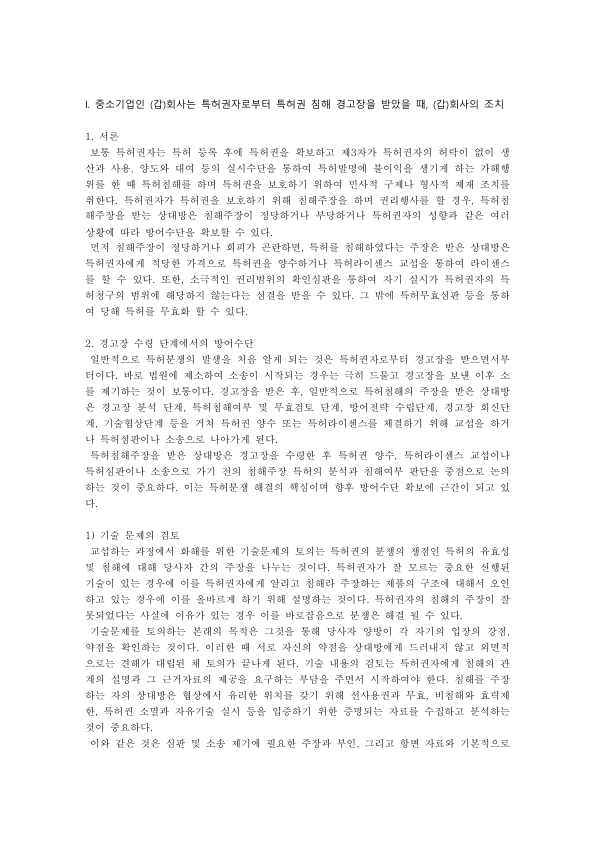
Page 1 is shown as is; from page 2 on, the preview is blurred. Buy it to download the complete original file right away (the file itself is written in Korean).
Packed with real examples and experience. Download it now and save time.
Save your valuable time
Buyer ratings
Fast, accurate and useful.
No ratings yet. Be the first to rate it.

Responding to Patent Troll Demand Letters, Font Copyright Claims and Trademark Infringement: Four IP Disputes Small Korean Companies Face
※ You can preview page 1 as is. Buy it to download the complete original file right away. The file itself is written in Korean.
■ Responding to Patent Troll Demand Letters, Font Copyright Claims and Trademark Infringement: Four IP Disputes Small Korean Companies Face — Overview
A 15-page Korean intellectual property report built around real-world scenarios. It explains how a small company should respond to a patent infringement warning letter, how patent assertion entities operate and how courts and lawmakers can respond, how font files differ from typeface designs in copyright claims over a website, when using a similar mark infringes a registered trademark, and how new forms of IP can be protected.
■ Responding to Patent Troll Demand Letters, Font Copyright Claims and Trademark Infringement: Four IP Disputes Small Korean Companies Face — Excerpt from the original document (English translation)
Just as Korea's top internet portal company also grew on the basis of Hangul, the value that letters hold on the internet and in daily life has a great influence on the nation. Since fonts are works created through the creative efforts of companies and individuals, they should be protected as works. Font files are protected by copyright, but the typeface design itself is not. In other words, font files receive copyright protection against reproduction, transmission, and the like under the Copyright Act, so infringement is recognized, but the typeface itself, which is the result, can be used freely. Therefore, Company A can counter the copyright infringement claim.
In Korea, with the spread of digital devices such as smartphones, tablets, and e-books, the number of consumers who download and use Korean fonts is increasing. However, compared with the rising trend in font consumption, users' lack of copyright awareness, the increase in free fonts from companies, and the price competitiveness problem of fonts for screen use are still acting as factors. In particular, as more fonts have recently been distributed for free and price competition among companies has intensified, actual commercialization opportunities are tending to decrease.
Fonts also belong to copyrighted works under the law, but legal safeguards and a change in users' awareness are required in the domestic font market. Going beyond copyright disputes, the ever-increasing copyright complaints are in the end only deepening unethical practices that exploit typeface and font copyrights, and because of this the copyright holders who should actually enjoy the benefits do not feel the need for change. Above all, to protect font copyright efficiently, in keeping with the fundamental purpose of cultural development, the government should improve the complicated Copyright Act, and a change in the awareness of companies and consumers should come first.
IV. Cases that do not constitute trademark infringement despite using a trademark identical or similar to another person's registered trademark on identical or similar goods
The scope and limits of trademark rights are set out in Article 51 of the Trademark Act. The grounds set out in Article 51 also include grounds recognized as limitations within the Constitution or within the nature of trademark rights, apart from the Trademark Act. In the case of functional trademarks under Article 51(1)(4), this is a limitation recognized from the nature of trademark rights. A trademark serves to supplement distinctiveness, not to supplement function. Function should be supplemented by patents.
If function were supplemented by a trademark, not only would the result be that function is supplemented through examination of distinctiveness alone, without examination of a patent's novelty or inventive step, but also function would be supplemented forever through renewal of trademark registration, rather than for the patent protection period of 20 years from the filing date. Because of this principle, functional trademarks cannot be registered, and even if registered they are invalid. Therefore, the rule in Article 51(1)(4) has a confirmatory meaning.
In the case of a conspicuous geographical indication under Article 51(1)(3), a conspicuous geographical indication itself has no distinctiveness regardless of the goods on which the trademark is used, so it cannot be registered as a trademark. And for the same reason as functional trademarks, it is invalid even if registered. This provision is also given meaning in that it guarantees free use by the public by blocking the right to prohibit, which is the negative right of trademark rights, until the trademark registration is invalidated.
However, as for such grounds of invalidity, when a decision invalidating the trademark registration becomes final, the trademark right is deemed never to have existed from the beginning, so the public can use it freely even without this provision. Therefore, it has no meaning of blocking the right to prohibit. Nevertheless, not recognizing distinctiveness for conspicuous geographical names is based on policy reasons rather than on trademark law principles, and treats them as having no inherent distinctiveness.
Providing that conspicuous geographical names have no distinctiveness regardless of the goods cannot be seen as something recognized under the Trademark Act. Earlier Supreme Court precedent states that a trademark registered under Article 6(2) of the Trademark Act is not subject to the limitations of Article 51, but it does not make the reason for this clear.
For reference, Korean case law does not regard the typeface design itself as a work, but protects font files as computer program works. Thus, using output made with a legitimately installed font and reproducing or distributing the font file are judged differently. The fair use provision is in Article 35-5 of the Copyright Act, and on the patent side, the trial to confirm the scope of rights (Article 135 of the Patent Act) and the invalidation trial (Article 133) before the Intellectual Property Trial and Appeal Board are the representative means of responding to warning letters, so be sure to check the filing requirements and the effects of the decision for each procedure together with the original text of the provisions.
■ Responding to Patent Troll Demand Letters, Font Copyright Claims and Trademark Infringement: Four IP Disputes Small Korean Companies Face — Contents and key concepts
What should a small company do when an IP warning letter arrives?
✦ At a glance
- Handling patent troll letters and IP claims
- Structure: patent letters → trolls → fonts → trademarks → new IP
- Useful for IP and business law
☰ What the paper covers
- Defenses to a patent warning letter
- Patent troll strategies and responses
- Font files vs. typeface designs
- Trademark infringement
- Protecting new forms of IP
✎ Patent trolls and fonts in Korea and the U.S.
Korea protects font files as computer programs but not typeface designs, and offers invalidation and scope-confirmation trials at the Intellectual Property Trial and Appeal Board.
U.S. law also excludes typeface designs from copyright while protecting font software, and eBay Inc. v. MercExchange, 547 U.S. 388 (2006), made injunctions for patent infringement depend on four equitable factors.
Note: the paper itself is written in Korean and discusses Korean law. This page is general study information, not legal advice.
Related wiki: Patent Trolls
Related wiki: Trade Secrets
Take a break with a quick personality test?
Ranked by actual participation. Results in about a minute.
Loading…
Most-read content
Loading view counts…

Campusdown is a lifelong-learning community in Korea offering study materials, information on government support, student loans and scholarships, and more. Don't miss our free resources.
Go to the Campusdown home page →Refund policy
- Change of mind / refund requested after partial use / more than 7 days after purchase
◆ Exceptions
- File errors / cannot download or open the file
◆ How to request a refund: send a 1:1 inquiry via Customer Service at the top