
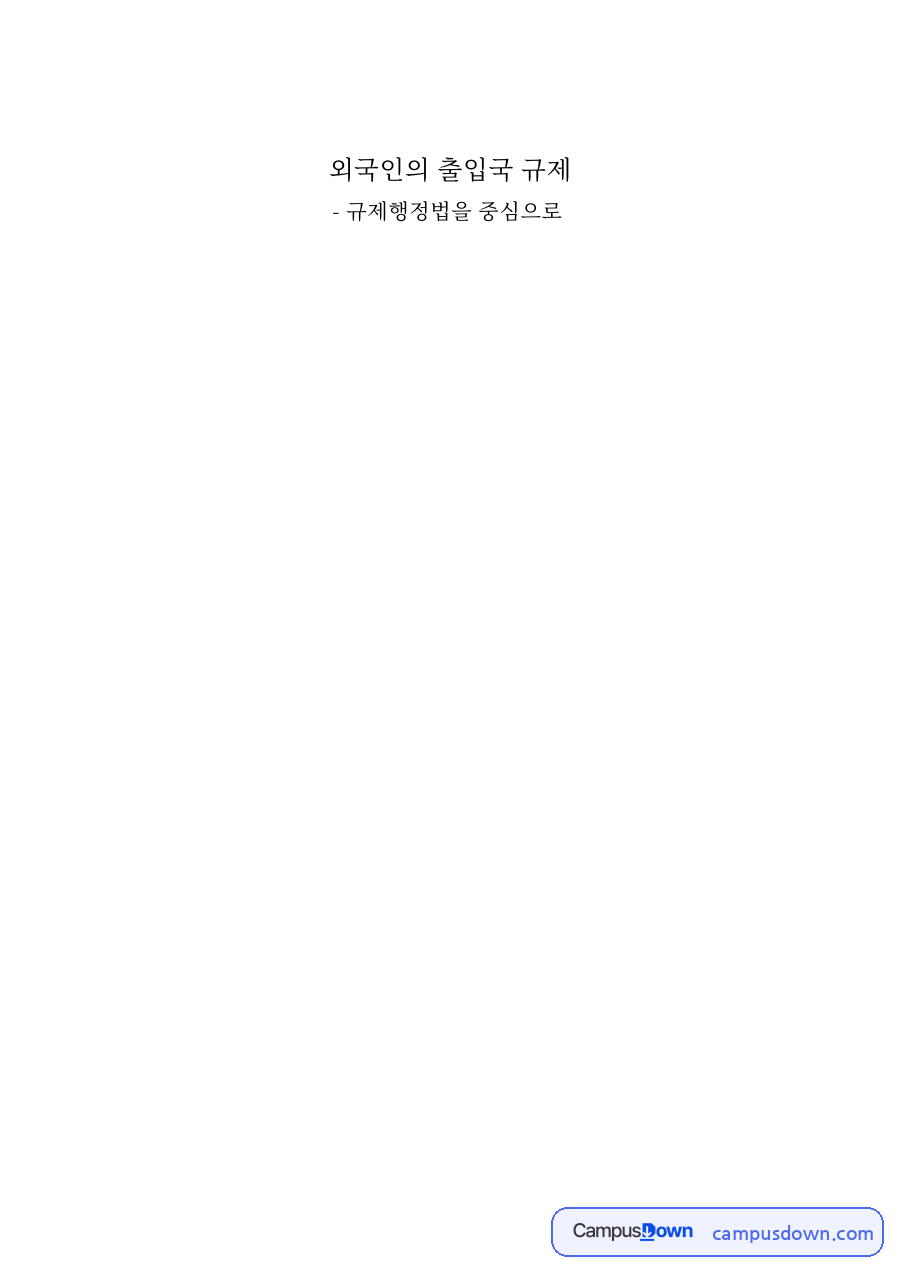
Page 1 is shown as is; from page 2 on, the preview is blurred. Buy it to download the complete original file right away (the file itself is written in Korean).
Packed with real examples and experience. Download it now and save time.
Save your valuable time
Buyer ratings
Fast, accurate and useful.
No ratings yet. Be the first to rate it.


1 / 13
좌우로 밀어서 페이지를 넘겨보세요
과제 개요
| 전체 페이지 수 | 13페이지 |
|---|---|
| 파일 형식 | 한글(HWP) |
| 등록일 | 2025.08.05 |
목차
- 1I. 서론
- 1.11. 연구의 필요성
- 2II. 본론
- 2.11. 외국인의 기본권과 출입국 관련 내용
- 2.21) 외국인의 출입국 관련 판례
- 2.32) 외국인에게 인정되지 않는 기본권
- 2.4(1) 사회권적 기본권
- 2.5(2) 정치적 기본권
- 2.63) 외국인에 대한 출입국 관련 통제
- 2.72. 외국인에 대한 입국 규제
- 2.81) 외국인에 대한 이주통제
- 2.92) 외국인에 대한 입국 통제
- 2.103) 외국인에 대한 입국금지사유
- 2.113. 외국인이 국내 체류 중에 발생하는 생활적 문제
- 2.121) 체류자격외 활동
- 2.132) 근무지의 추가·변경
- 2.143) 활동범위 등의 제한
- 2.154) 정치활동
- 2.164. 개선이 필요한 통제 영역
- 3III. 결론
- 4IV. 참고문헌
캠퍼스다운 도움말
해당 자료는 No AI 자료입니다. 인싸이트를 얻고 새롭게 가공해 보세요.
자료를 받아서 이용하면 품질이 확 올라갑니다.
- 출입국관리법
- 외국인의 기본권
- 입국금지
- 체류자격
- 강제퇴거
- 외국인 보호
- 출국정지
- 규제행정법
- 행정법 과제
- 연구의 필요성
Regulating the Entry and Stay of Foreign Nationals Under Korea's Immigration Control Act: Rights of Foreigners, Entry Bans, Limits on Activities, Departure Suspension and Deportation
※ You can preview page 1 as is. Buy it to download the complete original file right away. The file itself is written in Korean.
■ Regulating the Entry and Stay of Foreign Nationals Under Korea's Immigration Control Act: Rights of Foreigners, Entry Bans, Limits on Activities, Departure Suspension and Deportation — Overview
A 12-page Korean administrative law paper on how the Immigration Control Act regulates foreign nationals. It reviews court rulings on immigration detention and foreigners' rights, which rights foreigners do not fully enjoy, grounds for denying entry, limits on work and activities during a stay, and departure suspension and deportation.
■ Regulating the Entry and Stay of Foreign Nationals Under Korea's Immigration Control Act: Rights of Foreigners, Entry Bans, Limits on Activities, Departure Suspension and Deportation — Excerpt from the original document (English translation)
Among other laws on foreigners' political activities, the Public Official Election Act does not give foreigners the right to vote in presidential or National Assembly elections, but gives the right to vote for local council members and local government heads to "persons aged 19 or older ... who are foreigners for whom three years have passed since acquiring permanent residence status under Article 10 of the Immigration Control Act and who are entered in the foreigner registration ledger of the local government under Article 34 of that act." This difference appears to rest on the premise that participation in the national political community and in a local community differ in nature, for example, choosing those who exercise important sovereign power with nationwide effect versus choosing those who handle local affairs such as residents' welfare. Foreigners are not given the right to run for local council or local government head. Foreigners are also barred from election campaigning, but in the exceptional cases where they have the right to vote, campaigning is allowed. In resident recalls and resident referendums, which are forms of resident participation in local autonomy, qualified foreigners can vote, but the requirements differ. The right to vote in a recall, which removes local council members and heads, covers the same range as voters under the election act, while the right to vote in a referendum, a procedure for deciding a specific issue, extends to "foreigners qualified to reside in Korea continuously under immigration laws and specified by local ordinance," a wider group. Finally, under the Political Parties Act, foreigners cannot become party members (Article 22(2)).
When a foreigner staying in Korea engages in political activity, the Minister of Justice may issue a written order to stop the activity or other necessary orders (Article 17(2) and (3) of the act). When ordering a halt under Article 17(3), the minister must state in the order "1. to stop the activity immediately, 2. that deportation or other measures will be taken if the order is not obeyed, and 3. other necessary matters," and issue it directly or through the head of an immigration office, branch or sub-office. Because it may not always be clear what counts as political activity, this should be improved so that, at the order stage, the agency's judgment that a specific act is prohibited by law is clearly communicated.
The Immigration Control Act was enacted with the purpose of "providing for immigration control of all nationals and foreigners entering or leaving Korea, stay control of foreigners residing in Korea, and refugee recognition procedures." Under Article 94, a person who stays beyond the scope of their status of stay or period of stay in violation of the act, and a person who employs them, may be punished by up to three years in prison or a fine of up to 30 million won, and employers can be restricted even from hiring foreigners legally. Those who arrange or encourage the employment of persons without status of stay can also be punished. Illegal stay generally means a foreigner staying in a country in violation of its immigration laws. Currently, 388,000 foreigners are staying in Korea illegally. In Justice Ministry statistics, illegally staying foreigners are those whose period of stay has expired without an extension. Of these, 125,022 had permission for a long-term stay of more than 90 days but overstayed or had permission revoked, and 263,678 entered visa-free or in transit for a stay of up to three months and overstayed.
To add: on March 23, 2023, the Constitutional Court ruled Article 63(1) of the Immigration Control Act, which allowed people under a deportation order to be detained with no upper time limit, incompatible with the Constitution (2020Hun-Ga1 and others). In response, the act revised in March 2025 and in force since June 1 limits detention in principle to an initial two months and a total of nine months even with extensions approved by a new Foreigner Detention Committee, and allows extensions up to a total of 20 months only in exceptional cases. Objections to detention are now also reviewed by that committee rather than the Minister of Justice. The voting age of 19 in the Public Official Election Act quoted in the paper was lowered to 18 in 2020.
■ Regulating the Entry and Stay of Foreign Nationals Under Korea's Immigration Control Act: Rights of Foreigners, Entry Bans, Limits on Activities, Departure Suspension and Deportation — Contents and key concepts
How far can Korea restrict foreigners' entry and stay?
✦ At a glance
- Korea's immigration controls on foreign nationals
- Structure: rights → entry → stay → departure and deportation
- Useful for administrative law and immigration law courses
☰ What the paper covers
- Court rulings on detention
- Rights foreigners lack
- Entry bans
- Limits during a stay
- Deportation
✎ Immigration detention in Korea and the U.S.
After a 2023 Constitutional Court ruling, Korea capped detention pending deportation at 9 months, or 20 months in exceptional cases, from June 2025.
In the U.S., the Supreme Court in Zadvydas v. Davis (2001) read a presumptive six-month limit into post-removal-order detention when removal is not reasonably foreseeable.
Note: the paper itself is written in Korean and discusses Korean law. This page is general study information, not legal advice.
■ Regulating the Entry and Stay of Foreign Nationals Under Korea's Immigration Control Act: Rights of Foreigners, Entry Bans, Limits on Activities, Departure Suspension and Deportation References
- 서영숙. "다문화 사회에서의 출입국 이민행정 연구." 국내석사학위논문 건국대학교 교육대학원, 2022. 서울, p10-p11. 김의. "외국인의 출입국관리에 관한 비교법적 연구." 국내석사학위논문 연세대학교 대학원, 2019. 서울, p9-p11. 노재호. "國益危害 外國人 관리 정책에 대한 연구." 국내석사학위논문 중앙대학교 행정대학원, 2018. 서울, p6. 옥재희. "외국인 범죄 발생 동향과 대응체계 및 개선방안 연구." 국내석사학위논문 연세대학교 법무대학원, 2021. 서울, p20-p22. 황지홍. "출입국관리법상 비전문취업 체류자격자의 가족결합권." 국내석사학위논문 국민대학교 일반대학원, 2020. 서울, p7-p9. 이지현. "불법체류 외국인노동자의 인권보호에 관한 법적 연구." 국내석사학위논문 한국방송통신대학교, 2020. 서울, p32-p42. 이상목. "국내 외국인의 체류자격 변경에 관한 연구." 국내석사학위논문 공주교육대학교 교육대학원, 2020. 충청남도, p16-p20. 마문품. "제주지역 외국인 불법 체류자의 발생원인 및 실태조사." 국내석사학위논문 제주대학교 대학원, 2021. 제주도, p22-p35.
Keyword Prompt
전문가가 만들었어요과제를 직접 쓰는 데 도움이 되는 영어 프롬프트예요.
Tip! Prompt 에 자신의 생각을 추가해서 하면 훨씬 더 ✨ 좋습니다.
캠퍼스다운에서 레포트 받고 잘 쓰는 법 3가지, AI로 참고자료 제대로 재가공하기 →Prompt 1
I'm writing a university assignment on "외국인의 출입국 규제와 규제행정법: 외국인의 기본권, 입국금지사유, 체류 중 활동 제한, 출국정지와 강제퇴거". Help me build an outline (introduction, 2-3 body sections, conclusion) that covers 출입국관리법, 외국인의 기본권 and 입국금지. Don't write the paper for me - give me guiding questions for each section. My own perspective: [자신의 생각 넣는 곳] Please respond in Korean.
Prompt 2
Explain the key concepts "출입국관리법" and "외국인의 기본권" in simple terms, then show how they connect to the topic "외국인의 출입국 규제와 규제행정법: 외국인의 기본권, 입국금지사유, 체류 중 활동 제한, 출국정지와 강제퇴거". Point out common misunderstandings students have about them. My own perspective: [자신의 생각 넣는 곳] Please respond in Korean.
Prompt 3
Suggest 3 real-world cases or examples I could analyze in an assignment on "외국인의 출입국 규제와 규제행정법: 외국인의 기본권, 입국금지사유, 체류 중 활동 제한, 출국정지와 강제퇴거", focusing on "입국금지". For each, tell me what I should look up and verify in official or academic sources. My own perspective: [자신의 생각 넣는 곳] Please respond in Korean.
Prompt 4
Review my draft paragraph on "외국인의 출입국 규제와 규제행정법: 외국인의 기본권, 입국금지사유, 체류 중 활동 제한, 출국정지와 강제퇴거" (key idea: "체류자격"). Give feedback on logic, evidence and clarity, and mark where I need a citation. My paragraph: [paste here] My own perspective: [자신의 생각 넣는 곳] Please respond in Korean.
Take a break with a quick personality test?
Ranked by actual participation. Results in about a minute.
Loading…
Most-read content
Loading view counts…

Campusdown is a lifelong-learning community in Korea offering study materials, information on government support, student loans and scholarships, and more. Don't miss our free resources.
Go to the Campusdown home page →Refund policy
- Change of mind / refund requested after partial use / more than 7 days after purchase
◆ Exceptions
- File errors / cannot download or open the file
◆ How to request a refund: send a 1:1 inquiry via Customer Service at the top