
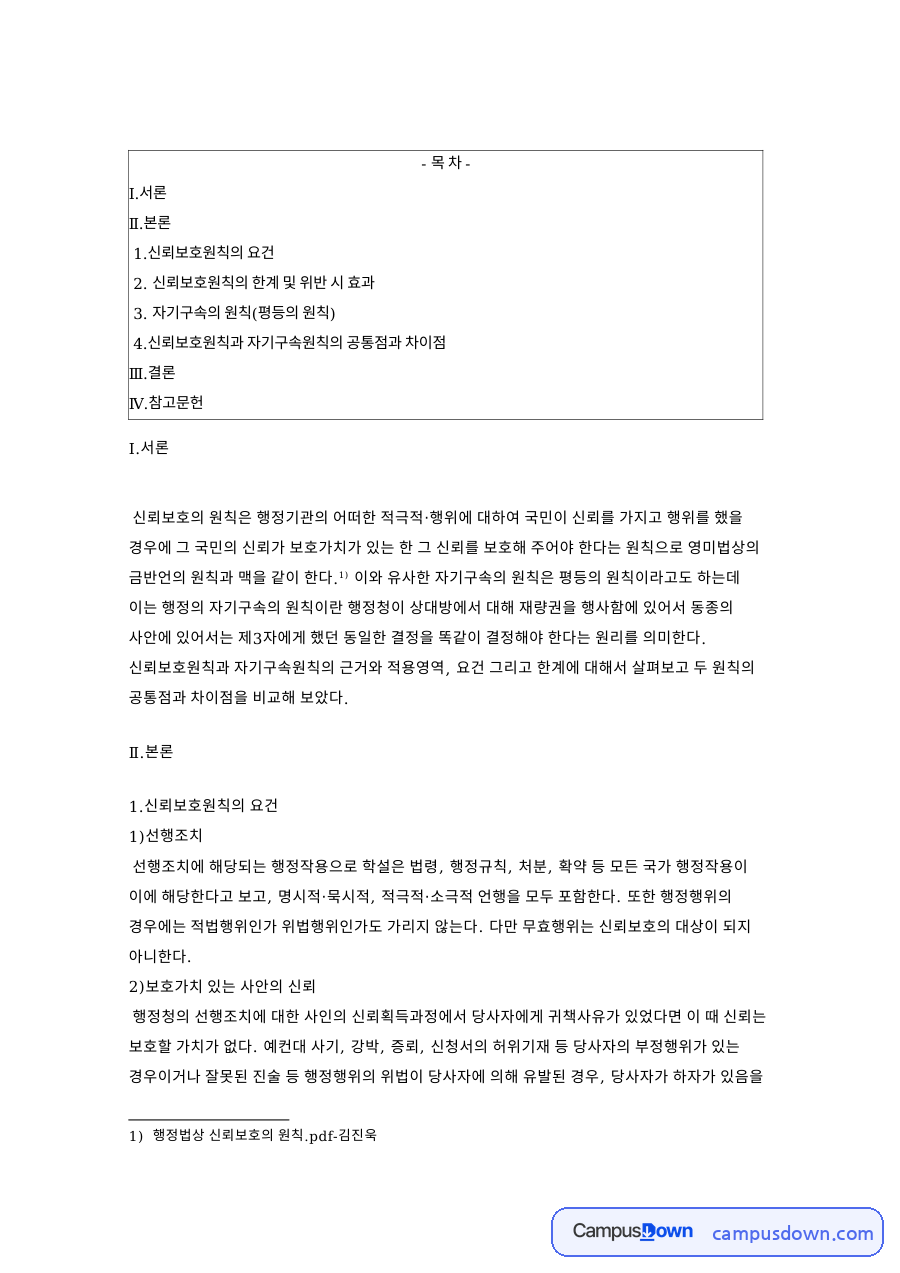
Page 1 is shown as is; from page 2 on, the preview is blurred. Buy it to download the complete original file right away (the file itself is written in Korean).
Packed with real examples and experience. Download it now and save time.
Save your valuable time
Buyer ratings
Fast, accurate and useful.
No ratings yet. Be the first to rate it.


1 / 5
좌우로 밀어서 페이지를 넘겨보세요
과제 개요
| 전체 페이지 수 | 5페이지 |
|---|---|
| 파일 형식 | 한글(HWP) |
| 등록일 | 2025.07.03 |
목차
- 1Ⅰ. 서론
- 2Ⅱ. 본론
- 2.11.신뢰보호원칙의 요건
- 2.22. 신뢰보호원칙의 한계 및 위반 시 효과
- 2.33. 자기구속의 원칙(평등의 원칙)
- 2.44.신뢰보호원칙과 자기구속원칙의 공통점과 차이점
- 3Ⅲ. 결론
- 4Ⅳ. 참고문헌
캠퍼스다운 도움말
해당 자료는 No AI 자료입니다. 인싸이트를 얻고 새롭게 가공해 보세요.
자료를 받아서 이용하면 품질이 확 올라갑니다.
- 신뢰보호원칙
- 자기구속의 원칙
- 행정법 일반원칙
- 평등원칙
- 재량준칙
- 공적 견해표명
- 실효의 원칙
- 행정기본법
- 행정법
- 행정법 과제
Protection of Legitimate Expectations and Administrative Self-Binding in Korean Administrative Law: Requirements, Limits, Similarities and Differences
※ You can preview page 1 as is. Buy it to download the complete original file right away. The file itself is written in Korean.
■ Protection of Legitimate Expectations and Administrative Self-Binding in Korean Administrative Law: Requirements, Limits, Similarities and Differences — Overview
A 4-page Korean administrative law paper comparing two general principles. It sets out the requirements and limits of protecting people who relied on an agency's prior action, explains how agencies are bound by their own past practice under the equality principle, and compares the two on basis, scope and limits.
■ Protection of Legitimate Expectations and Administrative Self-Binding in Korean Administrative Law: Requirements, Limits, Similarities and Differences — Excerpt from the original document (English translation)
First, on the differences: the principle of protecting legitimate expectations means that if people act in reliance on some act of an administrative agency, that reliance should be protected, while the principle of self-binding means that when an agency has repeatedly acted a certain way in a situation and the same situation arises for a third party, the agency must handle it the same way, so the agency itself is bound; the two differ considerably from their basic concepts. Reliance protection arises when a prior measure, trust worthy of protection, causation and the person's action all exist, while self-binding arises when there is a legally comparable situation, the same circumstances, application to the same agency and an administrative precedent, so the requirements also differ clearly. But the two principles also have something in common. Both allow discretion, so when an agency acts against the principle, an unlawful act may come to be recognized as an administrative act at the discretion of the official holding that discretion.
In administrative rules, the doctrine of self-binding matters for discretionary guidelines. Because such guidelines are not binding law, an agency that departs from them does not, in principle, act unlawfully. But if the agency issues a decision contrary to its practice without reasonable grounds, a person harmed by it can argue that it is unlawful for violating the principle of self-binding. One view holds that the administrative rule, combined with self-binding, has turned into binding law, so a contrary decision is unlawful. But the decision is unlawful not because it violated a guideline turned into law but because it violated the principle of self-binding, so that view can be considered wrong.
To add: the General Act on Public Administration, in force since March 2021, writes in the equality principle (Article 9), the principle of protecting legitimate expectations (Article 12) and the doctrine of forfeiture (Article 12(2)). The courts set out five requirements for reliance protection: an official statement of position by the agency, the person's reliance on it without fault, action taken in that reliance, harm to the person's interests from a decision contrary to the statement, and no serious harm to the public interest or third parties. Contrary to the paper, the Supreme Court has also held that an agency is bound by a practice formed under its discretionary guidelines through the equality or reliance principles (Supreme Court decision 2009Du7967, December 24, 2009).
■ Protection of Legitimate Expectations and Administrative Self-Binding in Korean Administrative Law: Requirements, Limits, Similarities and Differences — Contents and key concepts
Can an agency go back on what it told you?
✦ At a glance
- Reliance protection and self-binding in Korean law
- Structure: requirements → limits → self-binding → comparison
- Useful for administrative law courses
☰ What the paper covers
- Requirements for reliance
- Limits and effects
- Basis of self-binding
- Need for precedent
- Comparing the two
✎ Reliance on government in Korea and the U.S.
Korea wrote both principles into its General Act on Public Administration in 2021, and courts apply a five-part test for reliance.
U.S. courts rarely apply equitable estoppel against the federal government, though agencies must explain departures from their own past practice to avoid arbitrary action.
Note: the paper itself is written in Korean and discusses Korean law. This page is general study information, not legal advice.
■ Protection of Legitimate Expectations and Administrative Self-Binding in Korean Administrative Law: Requirements, Limits, Similarities and Differences References
- 행정법상 신뢰보호의 원칙.pdf-김진욱
- 자기구속의 원칙[다음 블로그] http://blog.daum.net/_blog/BlogTypeView.do?blogid=0UbLT&articleno=103&categoryId=11®dt=20120601145252
Keyword Prompt
전문가가 만들었어요과제를 직접 쓰는 데 도움이 되는 영어 프롬프트예요.
Tip! Prompt 에 자신의 생각을 추가해서 하면 훨씬 더 ✨ 좋습니다.
캠퍼스다운에서 레포트 받고 잘 쓰는 법 3가지, AI로 참고자료 제대로 재가공하기 →Prompt 1
I'm writing a university assignment on "신뢰보호원칙과 행정의 자기구속원칙 비교: 신뢰보호의 요건과 한계, 자기구속의 근거·요건·한계와 두 원칙의 공통점·차이점". Help me build an outline (introduction, 2-3 body sections, conclusion) that covers 신뢰보호원칙, 자기구속의 원칙 and 행정법 일반원칙. Don't write the paper for me - give me guiding questions for each section. My own perspective: [자신의 생각 넣는 곳] Please respond in Korean.
Prompt 2
Explain the key concepts "신뢰보호원칙" and "자기구속의 원칙" in simple terms, then show how they connect to the topic "신뢰보호원칙과 행정의 자기구속원칙 비교: 신뢰보호의 요건과 한계, 자기구속의 근거·요건·한계와 두 원칙의 공통점·차이점". Point out common misunderstandings students have about them. My own perspective: [자신의 생각 넣는 곳] Please respond in Korean.
Prompt 3
Suggest 3 real-world cases or examples I could analyze in an assignment on "신뢰보호원칙과 행정의 자기구속원칙 비교: 신뢰보호의 요건과 한계, 자기구속의 근거·요건·한계와 두 원칙의 공통점·차이점", focusing on "행정법 일반원칙". For each, tell me what I should look up and verify in official or academic sources. My own perspective: [자신의 생각 넣는 곳] Please respond in Korean.
Prompt 4
Review my draft paragraph on "신뢰보호원칙과 행정의 자기구속원칙 비교: 신뢰보호의 요건과 한계, 자기구속의 근거·요건·한계와 두 원칙의 공통점·차이점" (key idea: "평등원칙"). Give feedback on logic, evidence and clarity, and mark where I need a citation. My paragraph: [paste here] My own perspective: [자신의 생각 넣는 곳] Please respond in Korean.
Take a break with a quick personality test?
Ranked by actual participation. Results in about a minute.
Loading…
Most-read content
Loading view counts…

Campusdown is a lifelong-learning community in Korea offering study materials, information on government support, student loans and scholarships, and more. Don't miss our free resources.
Go to the Campusdown home page →Refund policy
- Change of mind / refund requested after partial use / more than 7 days after purchase
◆ Exceptions
- File errors / cannot download or open the file
◆ How to request a refund: send a 1:1 inquiry via Customer Service at the top