
Page 1 is shown as is; from page 2 on, the preview is blurred. Buy it to download the complete original file right away (the file itself is written in Korean).
Packed with real examples and experience. Download it now and save time.
Save your valuable time
Buyer ratings
Fast, accurate and useful.
No ratings yet. Be the first to rate it.


1 / 2
좌우로 밀어서 페이지를 넘겨보세요
과제 개요
| 전체 페이지 수 | 2페이지 |
|---|---|
| 파일 형식 | 한글(HWP) |
| 등록일 | 2025.07.20 |
캠퍼스다운 도움말
해당 자료는 No AI 자료입니다. 인싸이트를 얻고 새롭게 가공해 보세요.
자료를 받아서 이용하면 품질이 확 올라갑니다.
- 비례대표제
- 전국구 국회의원
- 1인 2표제
- 정당명부식
- 법률 제정 절차
- 국회 입법과정
- 예산결산특별위원회
- 국회법
- 정치와 법
Proportional Representation in Korea's National Assembly and How Laws and Budgets Are Made: From At-Large Seats to Two-Ballot Voting
※ You can preview page 1 as is. Buy it to download the complete original file right away. The file itself is written in Korean.
■ Proportional Representation in Korea's National Assembly and How Laws and Budgets Are Made: From At-Large Seats to Two-Ballot Voting — Overview
A 2-page Korean politics and law paper. It reviews why Korea added nationwide at-large seats to district elections, how the old system was criticized as a tool for ruling-party majorities and patronage, and how two-ballot party-list voting fixed part of the problem. It then outlines how bills move from introduction to committee review, plenary vote and promulgation, how the budget is reviewed, and where the legislative process falls short.
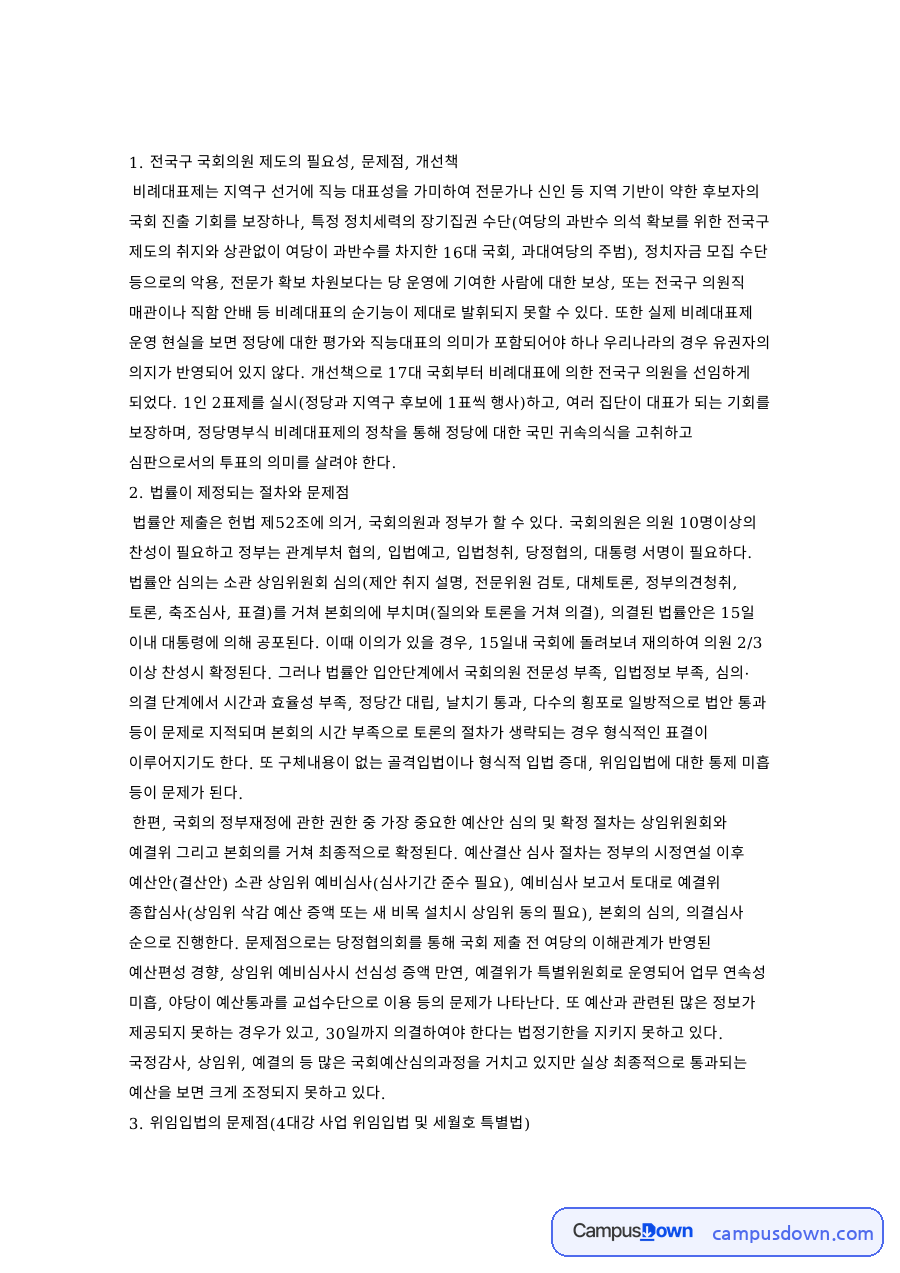
■ Proportional Representation in Korea's National Assembly and How Laws and Budgets Are Made: From At-Large Seats to Two-Ballot Voting — Excerpt from the original document (English translation)
Delegated legislation means the establishment of legal rules by state organs other than the National Assembly, including administrative orders, local government ordinances, and the rules enacted by the Supreme Court and the Constitutional Court. In modern times, as administrative activity has become specialized, information and expertise for legislation have become necessary, so efficiency was increased by allowing administrative agencies to legislate as well.
The Four Major Rivers Project was a project for the government to manage the rivers directly for purposes such as environmental conservation and a stable water supply; issues such as environmental problems (deteriorating water quality), excessive budget spending and a lack of grounds for job creation should have been considered, but the law was enacted through delegated legislation without sufficient discussion (based on Article 23 of the River Act, that is, "providing that establishing a comprehensive plan for rivers is the government's responsibility for the efficient conservation and management of rivers"). In addition, the Grand Canal project and the Four Major Rivers Project were treated as different from each other and handled urgently to produce results within the term of office, facing domestic and international criticism (violations of the Ramsar Convention and the Convention on Biological Diversity). The amendment to the Enforcement Decree of the River Act included a substantial increase in the items for hydrological surveys and the addition of "the state's measures for securing water in response to climate change" to the contents of the long-term comprehensive water resources plan. In the lawsuits over the legality of the Four Major Rivers Project, apart from environmental issues, the problem of the planning procedure set by the River Act was raised, and the government's position prevailed on the ground of members' safety through securing sufficient water.
For reference, the material says a bill returned for reconsideration is finalized with the approval of two-thirds or more of the members, but Article 53(4) of the Constitution requires the attendance of a majority of all members and the approval of two-thirds or more of the members present. The budget bill must be passed no later than 30 days before the start of the fiscal year (Article 54(2) of the Constitution), so the statutory deadline is December 2. The one-person-two-votes system was introduced from the 2004 general election after the Constitutional Court ruled unconstitutional in 2001 the method of allocating proportional representation seats by one vote per person, and a semi-mixed-member proportional system has applied since 2020, so check the current Public Official Election Act.
■ Proportional Representation in Korea's National Assembly and How Laws and Budgets Are Made: From At-Large Seats to Two-Ballot Voting — Contents and key concepts
Why does Korea elect some lawmakers by party vote?
✦ At a glance
- Proportional representation in Korea
- Structure: at-large seats → legislative process → budget review
- Useful for comparative politics and constitutional law
☰ What the paper covers
- Purpose of at-large seats
- Criticism and the two-ballot reform
- How a bill becomes law
- Budget review and its problems
✎ Seats, ballots and lawmaking in Korea
In 2001 Korea's Constitutional Court struck down a system that allocated party-list seats using district votes, and since 2004 voters cast one ballot for a district candidate and one for a party.
The U.S. House uses only single-member districts, so Korea's mixed system is closer to Germany's model; in both Korea and the U.S., most real legislative work happens in committees.
Note: the paper itself is written in Korean and discusses Korean law. This page is general study information, not legal advice.
Keyword Prompt
전문가가 만들었어요과제를 직접 쓰는 데 도움이 되는 영어 프롬프트예요.
Tip! Prompt 에 자신의 생각을 추가해서 하면 훨씬 더 ✨ 좋습니다.
캠퍼스다운에서 레포트 받고 잘 쓰는 법 3가지, AI로 참고자료 제대로 재가공하기 →Prompt 1
I'm writing a university assignment on "비례대표제의 필요성과 문제점, 법률 제정 절차와 예산 심의: 전국구에서 1인 2표 정당명부식으로, 국회 입법 과정의 한계". Help me build an outline (introduction, 2-3 body sections, conclusion) that covers 비례대표제, 전국구 국회의원 and 1인 2표제. Don't write the paper for me - give me guiding questions for each section. My own perspective: [자신의 생각 넣는 곳] Please respond in Korean.
Prompt 2
Explain the key concepts "비례대표제" and "전국구 국회의원" in simple terms, then show how they connect to the topic "비례대표제의 필요성과 문제점, 법률 제정 절차와 예산 심의: 전국구에서 1인 2표 정당명부식으로, 국회 입법 과정의 한계". Point out common misunderstandings students have about them. My own perspective: [자신의 생각 넣는 곳] Please respond in Korean.
Prompt 3
Suggest 3 real-world cases or examples I could analyze in an assignment on "비례대표제의 필요성과 문제점, 법률 제정 절차와 예산 심의: 전국구에서 1인 2표 정당명부식으로, 국회 입법 과정의 한계", focusing on "1인 2표제". For each, tell me what I should look up and verify in official or academic sources. My own perspective: [자신의 생각 넣는 곳] Please respond in Korean.
Prompt 4
Review my draft paragraph on "비례대표제의 필요성과 문제점, 법률 제정 절차와 예산 심의: 전국구에서 1인 2표 정당명부식으로, 국회 입법 과정의 한계" (key idea: "정당명부식"). Give feedback on logic, evidence and clarity, and mark where I need a citation. My paragraph: [paste here] My own perspective: [자신의 생각 넣는 곳] Please respond in Korean.
Take a break with a quick personality test?
Ranked by actual participation. Results in about a minute.
Loading…
Most-read content
Loading view counts…

Campusdown is a lifelong-learning community in Korea offering study materials, information on government support, student loans and scholarships, and more. Don't miss our free resources.
Go to the Campusdown home page →Refund policy
- Change of mind / refund requested after partial use / more than 7 days after purchase
◆ Exceptions
- File errors / cannot download or open the file
◆ How to request a refund: send a 1:1 inquiry via Customer Service at the top