
Page 1 is shown as is; from page 2 on, the preview is blurred. Buy it to download the complete original file right away (the file itself is written in Korean).
Packed with real examples and experience. Download it now and save time.
Save your valuable time
Buyer ratings
Fast, accurate and useful.
No ratings yet. Be the first to rate it.


Preventing Reoffending by Juvenile Offenders in Korea: A Dedicated Agency, High-Risk Area Management, More Probation Officers and Safer Environments
※ You can preview page 1 as is. Buy it to download the complete original file right away. The file itself is written in Korean.
■ Preventing Reoffending by Juvenile Offenders in Korea: A Dedicated Agency, High-Risk Area Management, More Probation Officers and Safer Environments — Overview
A 2-page Korean juvenile justice and youth welfare paper proposing four state measures to prevent reoffending by youths placed on probation or higher dispositions: a dedicated agency modeled on the U.S. OJJDP, focused management of high-crime areas, more juvenile probation officers to reduce caseloads, and blocking harmful environments with community watch programs.
■ Preventing Reoffending by Juvenile Offenders in Korea: A Dedicated Agency, High-Risk Area Management, More Probation Officers and Safer Environments — Excerpt from the original document (English translation)
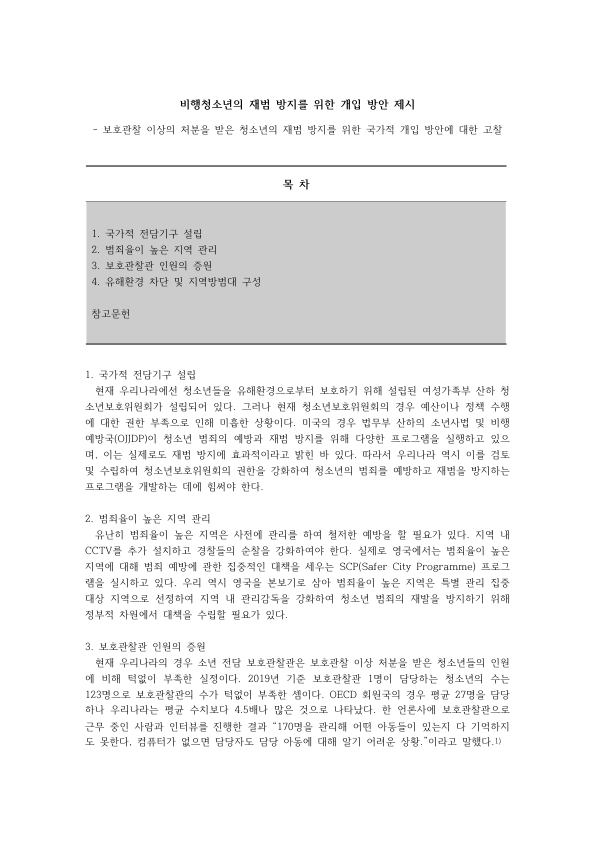
Korea currently has the Youth Protection Committee under the Ministry of Gender Equality and Family, set up to protect young people from harmful environments. But the committee falls short because it lacks budget and authority to carry out policy. In the United States, the Office of Juvenile Justice and Delinquency Prevention (OJJDP) under the Department of Justice runs a range of programs to prevent juvenile crime and reoffending, and these have been reported to be effective in preventing reoffending. Korea should likewise study and adopt this approach, strengthening the committee's authority and working to develop programs that prevent youth crime and reoffending.
Areas with especially high crime rates need to be managed in advance for thorough prevention. More CCTV cameras should be installed and police patrols strengthened in these areas. In fact, the United Kingdom has run the Safer Cities Programme (SCP), which sets intensive crime prevention measures for high-crime areas.
Note: The paper puts the number of youths handled by one probation officer at 123, while its references cite an article headlined '114 juvenile offenders per probation officer,' so the figures do not match. Check the Ministry of Justice's latest statistics before citing them. Article 1 of the Juvenile Act states that it provides for protective dispositions and other measures to adjust the environment and correct the conduct of antisocial juveniles, and probation is carried out under the Act on Probation and Electronic Monitoring, etc. The assessment of foreign programs' effectiveness is the author's own summary.
■ Preventing Reoffending by Juvenile Offenders in Korea: A Dedicated Agency, High-Risk Area Management, More Probation Officers and Safer Environments — Contents and key concepts
After punishment: helping them not fall again
✦ At a glance
- Four ways the state can reduce juvenile reoffending
- Structure: agency → high-risk areas → probation officers → environment
- Useful for youth welfare and criminal policy courses
☰ What the paper covers
- A dedicated agency
- High-risk areas
- Probation caseloads
- Harmful environments
- Community watch
✎ Juvenile justice in Korea and the U.S.
Korea's Juvenile Act favors protective dispositions such as probation over punishment, and caseloads for juvenile probation officers are a long-running concern.
In the U.S., the Office of Juvenile Justice and Delinquency Prevention in the Justice Department funds and studies prevention and reentry programs.
Note: the paper itself is written in Korean and discusses Korean law. This page is general study information, not legal advice.
■ Preventing Reoffending by Juvenile Offenders in Korea: A Dedicated Agency, High-Risk Area Management, More Probation Officers and Safer Environments References
- 국가적 전담기구 설립 현재 우리나라에선 청소년들을 유해환경으로부터 보호하기 위해 설립된 여성가족부 산하 청소년보호위원회가 설립되어 있다. 그러나 현재 청소년보호위원회의 경우 예산이나 정책 수행에 대한 권한 부족으로 인해 미흡한 상황이다. 미국의 경우 법무부 산하의 소년사법 및 비행예방국(OJJDP)이 청소년 범죄의 예방과 재범 방지를 위해 다양한 프로그램을 실행하고 있으며, 이는 실제로도 재범 방지에 효과적이라고 밝힌 바 있다. 따라서 우리나라 역시 이를 검토 및 수립하여 청소년보호위원회의 권한을 강화하여 청소년의 범죄를 예방하고 재범을 방지하는 프로그램을 개발하는 데에 힘써야 한다. 범죄율이 높은 지역 관리 유난히 범죄율이 높은 지역은 사전에 관리를 하여 철저한 예방을 할 필요가 있다. 지역 내 CCTV를 추가 설치하고 경찰들의 순찰을 강화하여야 한다. 실제로 영국에서는 범죄율이 높은 지역에 대해 범죄 예방에 관한 집중적인 대책을 세우는 SCP(Safer City Programme) 프로그램을 실시하고 있다. 우리 역시 영국을 본보기로 삼아 범죄율이 높은 지역은 특별 관리 집중 대상 지역으로 선정하여 지역 내 관리감독을 강화하여 청소년 범죄의 재발을 방지하기 위해 정부적 차원에서 대책을 수립할 필요가 있다. 보호관찰관 인원의 증원 현재 우리나라의 경우 소년 전담 보호관찰관은 보호관찰 이상 처분을 받은 청소년들의 인원에 비해 턱없이 부족한 실정이다. 2019년 기준 보호관찰관 1명이 담당하는 청소년의 수는 123명으로 보호관찰관의 수가 턱없이 부족한 셈이다. OECD 회원국의 경우 평균 27명을 담당하나 우리나라는 평균 수치보다 4.5배나 많은 것으로 나타났다. 한 언론사에 보호관찰관으로 근무 중인 사람과 인터뷰를 진행한 결과 “170명을 관리해 어떤 아동들이 있는지 다 기억하지도 못한다, 컴퓨터가 없으면 담당자도 담당 아동에 대해 알기 어려운 상황.”이라고 말했다. 이는 제대로 된 보호관찰이 이루어지지 않으며, 청소년에게도 교화의 기회가 전혀 마련되지 않음을 상기시킨다. 따라서 보호관찰관을 추가로 채용하여 보호관찰관 한 명이 담당하는 청소년 범죄자들의 수를 줄여 그들 간의 접촉 빈도수를 증시시키고, 건전한 의사소통을 함으로써 제대로 된 보호관찰이 이루어지도록 조치해야 할 것이다. 이는 곧 사회적으로 청소년 범죄의 감소로 직결될 것이라고 본다. 유해환경 차단 및 지역 방범대 구성 청소년들은 지역사회에서 각종 유해환경에 노출될 가능성이 높다. 성인들의 과소비 풍조, 대중매체의 파장, 각종 범죄의 보도와 그에 대한 관용적인 태도는 청소년으로 하여금 모방 심리와 동시에 불신을 고취시킬 위험이 있다. 따라서 국가에서는 청소년에게 유해한 환경인 업소나 장소는 사전에 차단하여 재범이 발생하지 않도록 노력해야 한다. 여기서 차단이라 함은, 지속된 순찰이나 환경을 정화하는 활동을 뜻한다. 청소년에게 불건전한 환경에 대해서는 접촉할 수 없도록 관리를 강화하고, 청소년이 오가는 환경은 정화활동을 하여 사전에 유해환경과의 접촉을 차단하는 것이 필요하다. 또한 지역 주민 방범대를 꾸려 범죄 예방을 할 수 있도록 정부차원에서 실질적인 지원이 필요하다. 미국과 영국의 경우 이웃감시 프로그램을 실시하고 있으며, 이는 상당한 효과가 있는 것으로 밝혀졌다. 따라서 우리나라 역시 지역 주민과 경찰이 협력하여 지역 내 방범대를 꾸려 순찰하는 등 청소년 재범에 적극적으로 임해야 할 것이며, 정부에서도 이를 위해 전폭적인 지원을 해야 할 것이다.
- 참 고 문 헌 이미리, 김춘경, 여종일(2019). <청소년 심리 및 상담>. 학지사.
- 이미경(2015). <청소년 범죄의 재범 예방 위한 대책 연구>. 연세대학교 법무대학원 석사학위논문.
- 최혜순(2003). <청소년 비행 재범 방지에 관한 연구 – 보호관찰 청소년을 중심으로>. 단국대학교 행정법무대학원 석사학위논문.
- 최인섭, 이성식(2010). <미국 OJJDP의 청소년 재범예방을 위한 개별 프로그램의 운영사례 연구> (연구총서 10-04). 한국형사정책연구원.
- 전현진(2019). 보호와 처벌 사이 : 소년사법 보고서(2) 보호관찰관 1명에 소년범 114명...‘사회적응 교육’ 겉핥기에 그친다. <경향신문>.
Take a break with a quick personality test?
Ranked by actual participation. Results in about a minute.
Loading…
Most-read content
Loading view counts…

Campusdown is a lifelong-learning community in Korea offering study materials, information on government support, student loans and scholarships, and more. Don't miss our free resources.
Go to the Campusdown home page →Refund policy
- Change of mind / refund requested after partial use / more than 7 days after purchase
◆ Exceptions
- File errors / cannot download or open the file
◆ How to request a refund: send a 1:1 inquiry via Customer Service at the top