
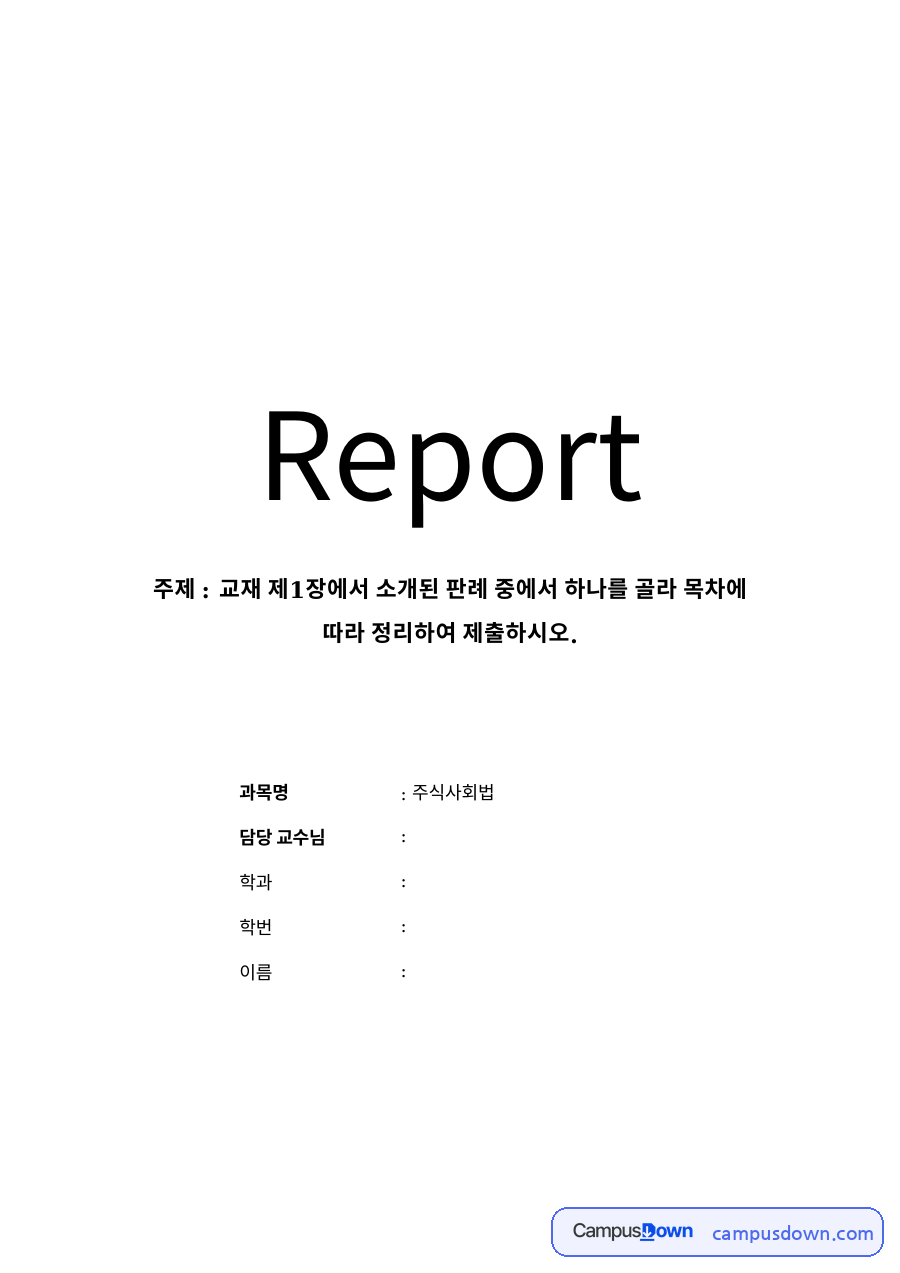
Page 1 is shown as is; from page 2 on, the preview is blurred. Buy it to download the complete original file right away (the file itself is written in Korean).
Packed with real examples and experience. Download it now and save time.
Save your valuable time
Buyer ratings
Fast, accurate and useful.
No ratings yet. Be the first to rate it.


1 / 8
좌우로 밀어서 페이지를 넘겨보세요
과제 개요
| 전체 페이지 수 | 8페이지 |
|---|---|
| 파일 형식 | 한글(HWP) |
| 등록일 | 2025.08.09 |
목차
- 1Ⅰ. 사실 관계
- 1.1(1) 소외 1 주식회사의 주주현황과 운영실태
- 1.2(2) 소외 2 주식회사의 주주현황과 운영실태
- 1.3(3) 소외 6 주식회사의 설립과 운영
- 1.4(4) 소외 1 주식회사와 소외 2 주식회사의 물품대금채무의 청산
- 2Ⅱ. 법적 쟁점
- 2.1(1) 소외 2 주식회사의 실질적 운영자
- 2.2(2) 소외 2 주식회사의 법인격부인과 피고 개인의 책임
- 3Ⅲ. 법원의 판단
- 4Ⅳ. 자신의 의견
- 5Ⅴ. 참고문헌
캠퍼스다운 도움말
해당 자료는 No AI 자료입니다. 인싸이트를 얻고 새롭게 가공해 보세요.
자료를 받아서 이용하면 품질이 확 올라갑니다.
- 법인격부인론
- 법인격 형해화
- 법인격 남용
- 2007다90982
- 회사법
- 주식회사
- 신의성실의 원칙
- 1인 회사
- 상법
- 사실 관계
Piercing the Corporate Veil in Korea: Supreme Court Case 2007Da90982, Facts and Issues, the Tests for Sham and Abuse, and Reversal
※ You can preview page 1 as is. Buy it to download the complete original file right away. The file itself is written in Korean.
■ Piercing the Corporate Veil in Korea: Supreme Court Case 2007Da90982, Facts and Issues, the Tests for Sham and Abuse, and Reversal — Overview
A 7-page Korean corporate law case report on Supreme Court Decision 2007Da90982 (2008). It lays out how the defendant controlled three successive companies, mixed funds and settled suppliers' debts for a fraction, then explains the Court's tests for a company reduced to a sham and for abuse of the corporate form, and the reversal of the lower court's ruling holding the defendant personally liable.
■ Piercing the Corporate Veil in Korea: Supreme Court Case 2007Da90982, Facts and Issues, the Tests for Sham and Abuse, and Reversal — Excerpt from the original document (English translation)
Where a company outwardly has the form of a corporation but merely borrows that form and is in substance entirely the individual business of the person behind it, or where it is recklessly used as a means of evading the application of law to that person, it is not permitted, even if the act is outwardly the company's, to deny the liability of the person behind it by insisting that the company and that person are separate entities so that the legal effects belong only to the company; this is an abuse of corporate personality that violates the principle of good faith and is gravely contrary to justice and equity. Therefore liability for the company's acts can be imposed not only on the company but also on the person behind it. To find that a company is merely the individual business of the person behind it, in principle, as of the time of the legal act or factual act in question, the company must have become a sham to the point that it exists in name only and is in substance no more than an individual business, judged by whether the property and business of the company and that person were so commingled as to be hard to distinguish, whether the decision-making procedures prescribed by law or the articles, such as shareholders' or board meetings, were not followed, the degree of undercapitalization, and the scale of the business and number of employees.
Also, even if the corporate personality has not become a sham to that extent, where the person behind the company abuses its corporate personality, liability for the company's acts can be imposed on both the company and that person; in this case it is required that, as of the time of the abusive act such as evading debts, the person behind the company held a controlling position allowing them to use the company at will and used that position to abuse the corporate system, and whether that person abused the corporate system must be judged individually by considering all circumstances, including the degree to which the corporate personality had become a sham and the other party's perception and reliance.
The lower court's judgment that the plaintiff could also hold the defendant, the person behind Company 2, liable for the fabric payment debt arising from Company 2's transactions misunderstood the law on sham and abuse of corporate personality, and this error clearly affected the judgment.
Therefore, without examining the remaining grounds of appeal, the lower court's judgment is reversed and the case is remanded to the lower court for further proceedings, as decided unanimously by the participating Justices.
The principle of good faith: Article 2 of the Civil Act provides that 'rights shall be exercised and duties performed in accordance with good faith.' This is a fundamental principle of civil law that both parties to rights and duties must act in good faith when exercising rights or performing duties. It is also called the good faith principle for short. It means acting with regard to the other party's legitimate interests, not betraying the other party's trust, and not departing from equity.
Note: Supreme Court Decision 2007Da90982 of September 11, 2008 reversed and remanded the lower court ruling (Daegu High Court Decision 2006Na7366 of November 16, 2007) that had held the defendant personally liable. The Supreme Court held that the defendant's control of the company was not enough, that closing an unprofitable company, settling its debts and setting up a new one is not in itself unlawful, and that given the degree of commingling, neither a sham nor abuse of corporate personality could be found. Note that parts of the facts and issues in the paper's main body restate the lower court's findings, and the author's own opinion differs from the Supreme Court's conclusion.
■ Piercing the Corporate Veil in Korea: Supreme Court Case 2007Da90982, Facts and Issues, the Tests for Sham and Abuse, and Reversal — Contents and key concepts
When the person behind the company can be held liable
✦ At a glance
- A leading Korean veil-piercing case and why the Supreme Court said no
- Structure: facts → issues → the Court's tests → reversal → opinion
- Useful for corporate law and commercial law courses
☰ What the paper covers
- Three companies
- Mixed funds
- The sham test
- The abuse test
- Reversal
✎ Veil piercing in Korea and the U.S.
Korean courts pierce the veil on good-faith grounds only when a company is a sham or its form is abused, and they apply the doctrine strictly.
In the U.S., state courts use alter ego tests looking at commingling, undercapitalization and disregard of formalities, and also reserve piercing for exceptional cases.
Note: the paper itself is written in Korean and discusses Korean law. This page is general study information, not legal advice.
Related wiki: Piercing the Corporate Veil
■ Piercing the Corporate Veil in Korea: Supreme Court Case 2007Da90982, Facts and Issues, the Tests for Sham and Abuse, and Reversal References
- 대법원 종합법률정보 ( glaw.scourt.go.kr ) (출처 : 대법원 2008.09.11.
- 선고 2007다90982 판결[매매대금] > 종합법률정보 판례) 대구고등법원 2007.11.16.
- 선고 2006나7366 판결 대법원 2001. 1. 19.
- 선고 97다21604 판결 대법원 2008.9.11.
- 선고 2007다90982 판결 법인격부인론에 관하여. 김현수 변호사 강의안
Keyword Prompt
전문가가 만들었어요과제를 직접 쓰는 데 도움이 되는 영어 프롬프트예요.
Tip! Prompt 에 자신의 생각을 추가해서 하면 훨씬 더 ✨ 좋습니다.
캠퍼스다운에서 레포트 받고 잘 쓰는 법 3가지, AI로 참고자료 제대로 재가공하기 →Prompt 1
I'm writing a university assignment on "법인격부인론 판례 정리: 대법원 2007다90982 판결의 사실관계와 쟁점, 법인격 형해화와 남용의 요건, 파기환송의 의미". Help me build an outline (introduction, 2-3 body sections, conclusion) that covers 법인격부인론, 법인격 형해화 and 법인격 남용. Don't write the paper for me - give me guiding questions for each section. My own perspective: [자신의 생각 넣는 곳] Please respond in Korean.
Prompt 2
Explain the key concepts "법인격부인론" and "법인격 형해화" in simple terms, then show how they connect to the topic "법인격부인론 판례 정리: 대법원 2007다90982 판결의 사실관계와 쟁점, 법인격 형해화와 남용의 요건, 파기환송의 의미". Point out common misunderstandings students have about them. My own perspective: [자신의 생각 넣는 곳] Please respond in Korean.
Prompt 3
Suggest 3 real-world cases or examples I could analyze in an assignment on "법인격부인론 판례 정리: 대법원 2007다90982 판결의 사실관계와 쟁점, 법인격 형해화와 남용의 요건, 파기환송의 의미", focusing on "법인격 남용". For each, tell me what I should look up and verify in official or academic sources. My own perspective: [자신의 생각 넣는 곳] Please respond in Korean.
Prompt 4
Review my draft paragraph on "법인격부인론 판례 정리: 대법원 2007다90982 판결의 사실관계와 쟁점, 법인격 형해화와 남용의 요건, 파기환송의 의미" (key idea: "2007다90982"). Give feedback on logic, evidence and clarity, and mark where I need a citation. My paragraph: [paste here] My own perspective: [자신의 생각 넣는 곳] Please respond in Korean.
Take a break with a quick personality test?
Ranked by actual participation. Results in about a minute.
Loading…
Most-read content
Loading view counts…

Campusdown is a lifelong-learning community in Korea offering study materials, information on government support, student loans and scholarships, and more. Don't miss our free resources.
Go to the Campusdown home page →Refund policy
- Change of mind / refund requested after partial use / more than 7 days after purchase
◆ Exceptions
- File errors / cannot download or open the file
◆ How to request a refund: send a 1:1 inquiry via Customer Service at the top