
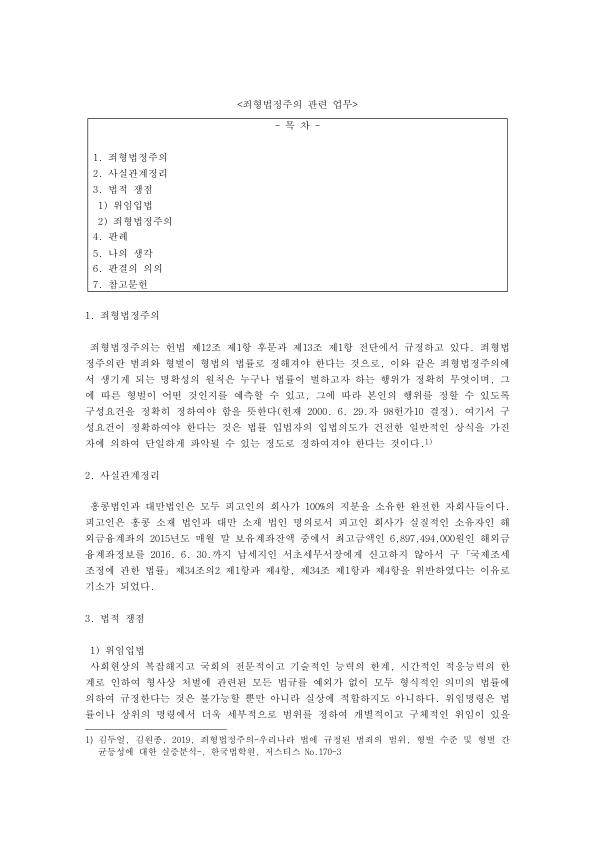
Page 1 is shown as is; from page 2 on, the preview is blurred. Buy it to download the complete original file right away (the file itself is written in Korean).
Packed with real examples and experience. Download it now and save time.
Save your valuable time
Buyer ratings
Fast, accurate and useful.
No ratings yet. Be the first to rate it.


Overseas Financial Account Reporting and the Limits of Delegated Legislation: A Case Note on Korean Supreme Court 2019Do11381
※ You can preview page 1 as is. Buy it to download the complete original file right away. The file itself is written in Korean.
■ Overseas Financial Account Reporting and the Limits of Delegated Legislation: A Case Note on Korean Supreme Court 2019Do11381 — Overview
A Korean criminal and constitutional law case note. A company was prosecuted for failing to report overseas accounts held through a wholly owned subsidiary, under a rule whose key terms were set by presidential decree. The paper explains the principle of legality and the clarity requirement, the requirements and foreseeability test for delegated legislation, the six strands of the Supreme Court's reasoning in 2019Do11381, and the author's evaluation of the lower court's finding.
■ Overseas Financial Account Reporting and the Limits of Delegated Legislation: A Case Note on Korean Supreme Court 2019Do11381 — Excerpt from the original document (English translation)
Under this, a domestic corporation bears the reporting obligation for overseas financial accounts held locally by an overseas branch it establishes, whereas it does not bear the reporting obligation for overseas financial accounts held locally by a wholly owned subsidiary it establishes abroad and of which it directly or indirectly owns 100 percent of the voting shares; a problem was therefore raised that this is contrary to equity. For this reason, in the amendment by Presidential Decree No. 26078 on February 3, 2015, a legal amendment was made adding the parenthetical provision in this case to the main text of Article 50(4) of the Enforcement Decree.
Considering how the parenthetical provision in this case was newly established, it should be regarded as intended to expand the scope of persons obliged to report overseas financial accounts by adding a new criterion for determining reporting obligors to the criterion that had already been set in the main text of Article 50(4) of the Enforcement Decree before the provision was established. Therefore, where a domestic corporation satisfies the reporting-obligor criterion of the parenthetical provision in this case, there is no need to separately examine or decide whether it satisfies the criterion set in the main text of Article 50(4) of the Enforcement Decree before the provision was established; such a domestic corporation bears the reporting obligation for overseas financial accounts in the name of its wholly owned subsidiary.
6) Nevertheless, the lower court, on the premise that the parenthetical provision in this case is void for exceeding the scope of delegation in Article 34(6) of the former Adjustment of International Taxes Act, held that whether the defendant company is the substantive owner of the overseas financial accounts in the names of the Hong Kong and Taiwan corporations cannot be determined by the parenthetical provision. This judgment of the lower court contains an error that affected the judgment by misunderstanding the concept of substantive owner set out in Article 34(4) of the former Adjustment of International Taxes Act and the relevant legal principles on the limits of delegated legislation.
In light of the increased social functions of the modern state and the growing complexity of social phenomena, it should be seen that not all penal provisions can be set by statutes enacted by the legislature, so delegating them to the executive is also permissible (Constitutional Court decision 91Heonga4 of July 8, 1991). Since Article 75 of the Constitution, which sets out the basis and limits of delegated legislation, applies to matters of crimes and punishments as well, where a penal provision delegates part of the elements of the offense to subordinate legislation and the constitutionality of that form of delegation is in question, the limits of delegated legislation and the principle prohibiting blanket delegation also become issues, together with the principle of nulla poena sine lege.
"Specifically defining the scope" in Article 75 of the Constitution means that the basic matters of the content and scope to be prescribed by subordinate norms must be set out in the statute as concretely and precisely as possible, so that the content to be prescribed by subordinate norms can be anticipated from the statute itself.
The limits of delegated legislation are grounded in Article 75 of the Constitution, and nulla poena sine lege in Articles 12 and 13 of the Constitution and Article 1 of the Criminal Act, so cases on delegating penal provisions, where the two principles meet, are a good topic for both constitutional law and criminal law assignments. If, as in this material, you organize the logic of the majority opinion together with the opposing logic, you can clearly state your agreement or disagreement with the conclusion in a case comment while firmly supporting it with Constitutional Court precedents. Practicing examining one by one the arguments in the judgment, such as the special nature of wholly owned parent-subsidiary companies and the expertise of the addressees, can be applied directly when analyzing other delegated-legislation cases.
■ Overseas Financial Account Reporting and the Limits of Delegated Legislation: A Case Note on Korean Supreme Court 2019Do11381 — Contents and key concepts
Overseas Financial Account Reporting and the Limits of Delegated Legislation
✦ At a glance
- When can a criminal rule leave details to a presidential decree?
- Structure: legality principle → facts → issues → Supreme Court → opinion
- Useful for criminal law, constitutional law and tax law case notes
☰ What the paper covers
- Legality and clarity (Constitutional Court 98Hun-Ga10)
- Facts: accounts held via a wholly owned subsidiary
- Foreseeability test for delegation
- Evaluation of the judgment
✎ Background in brief
Korean law allows statutes to delegate details to decrees only with specific, foreseeable limits.
Criminal provisions face a stricter version of this test because punishment is at stake.
Note: the paper itself is written in Korean and discusses Korean law. This page is general study information, not legal advice.
Related wiki: Nulla Poena Sine Lege
■ Overseas Financial Account Reporting and the Limits of Delegated Legislation: A Case Note on Korean Supreme Court 2019Do11381 References
- 김두얼, 김원종, 2019, 죄형법정주의-우리나라 법에 규정된 범죄의 범위, 형벌 수준 및 형벌 간 균등성에 대한 실증분석-, 한국법학원, 저스티스 No.170-3 심승범, 2019, 존 롤즈의 정의론에 입각한 법률 제도 분석 및 죄형법정주의와의 비교 검토, 조선대학교 법학연구원, 法學論叢 Vol.26 No.1
Take a break with a quick personality test?
Ranked by actual participation. Results in about a minute.
Loading…
Most-read content
Loading view counts…

Campusdown is a lifelong-learning community in Korea offering study materials, information on government support, student loans and scholarships, and more. Don't miss our free resources.
Go to the Campusdown home page →Refund policy
- Change of mind / refund requested after partial use / more than 7 days after purchase
◆ Exceptions
- File errors / cannot download or open the file
◆ How to request a refund: send a 1:1 inquiry via Customer Service at the top