
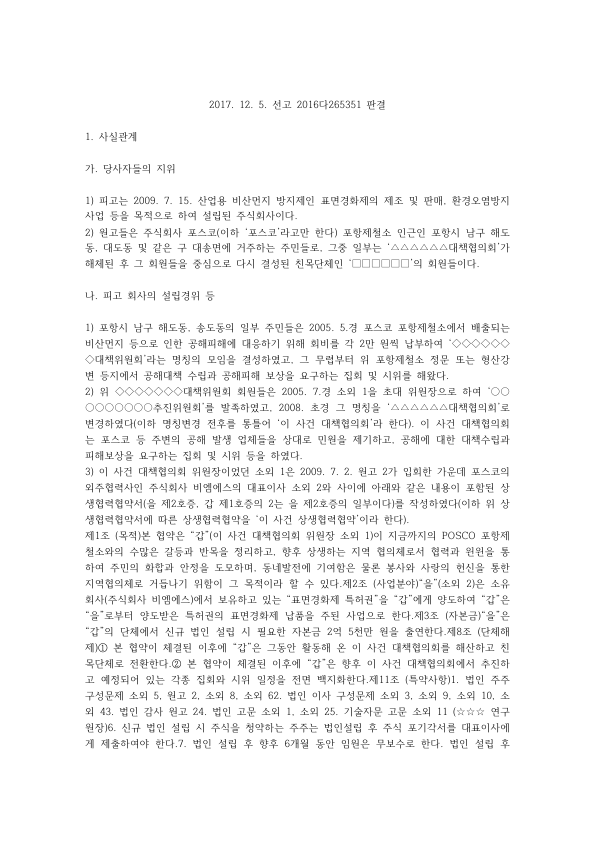
Page 1 is shown as is; from page 2 on, the preview is blurred. Buy it to download the complete original file right away (the file itself is written in Korean).
Packed with real examples and experience. Download it now and save time.
Save your valuable time
Buyer ratings
Fast, accurate and useful.
No ratings yet. Be the first to rate it.


Nominee Shareholders in Korean Corporate Law: Supreme Court Case 2016Da265351 on Subscribing for Shares in Another Person's Name
※ You can preview page 1 as is. Buy it to download the complete original file right away. The file itself is written in Korean.
■ Nominee Shareholders in Korean Corporate Law: Supreme Court Case 2016Da265351 on Subscribing for Shares in Another Person's Name — Overview
A 6-page Korean case comment on Supreme Court Decision 2016Da265351 (December 5, 2017), which asked who becomes the shareholder when shares are subscribed in someone else's name. Using a dispute between residents near a steelworks and a company founded under a cooperation agreement, it explains Article 332 of the Commercial Act and the Court's rule that a consenting named person is ordinarily the subscriber, then links the ruling to Korea's real-name policies.
■ Nominee Shareholders in Korean Corporate Law: Supreme Court Case 2016Da265351 on Subscribing for Shares in Another Person's Name — Excerpt from the original document (English translation)
Where shares are subscribed in another person's name, who the shareholder is must ultimately be decided by whom one regards as the party that subscribed for the shares. In incorporation by promoters, a contract to subscribe for shares is formed among the promoters; when new shares are issued to increase capital, it is formed between the applicant for subscription and the company. Since who the subscriber and shareholder is ultimately is a question of determining the parties to the new-share subscription contract, the legal principles for determining contracting parties should in principle be followed, while taking into account the characteristics of share subscription contracts.
Promoters must subscribe for shares in writing (Commercial Act Article 293). A person who wishes to apply to subscribe for shares must state the class and number of shares to be subscribed and his or her address in two copies of the share subscription form and affix his or her name and seal or signature (Commercial Act Articles 302(1) and 425). The reason the Commercial Act prescribes the method of share subscription in this way is to allow the company to handle legal relationships involving many shareholders by formal and uniform standards, promoting efficiency and legal stability in related administration. These characteristics must be fully reflected when determining the parties to a share subscription contract.
Where shares are subscribed in another's name, the question of determining the parties to the share subscription contract should be examined by dividing it into the following two cases.
First, where an agreement was made to subscribe for shares in the name of a fictitious person or in another's name without that person's consent. A fictitious person cannot be a party to a share subscription contract. Meanwhile, where shares are subscribed in another's name without consent, the question is who, between the named person and the person who actually made the contribution (the "actual contributor"), is the subscriber; the named person in principle cannot be a party to the share subscription contract, because a person who did not consent to shares being subscribed in his or her name has neither the intention to subscribe for shares nor expressed it. Therefore, if the actual contributor agreed to subscribe for shares in a fictitious person's name or in another's name without consent and performed the contribution, he or she should be regarded as acquiring the status of shareholder, unless there are special circumstances such as this clearly being contrary to the intention of the other party to the share subscription contract (the other promoters in incorporation by promoters, and the company in other cases).
Second, where an agreement was made, with another's consent, to subscribe for shares in that person's name. In this case, depending on the contents of the contract, either the named person or the actual contributor may be the subscriber, but in principle the named person should be regarded as the subscriber. Even where the named person and the actual contributor agreed that the actual contributor would be the subscriber, the actual contributor cannot be called the subscriber. This is because, unless there are special circumstances such as the company, as the other party to the share subscription contract, knowing of and consenting to the arrangement that the actual contributor would be the subscriber, it is reasonable to regard that other party as having understood the named person to be the party to the share subscription contract.
Article 332(1) of the Commercial Act provides that a person who subscribes for shares in the name of a fictitious person or in another's name without that person's consent is liable as a subscriber, and paragraph (2) provides that a person who subscribes for shares in another's name with that person's consent is jointly and severally liable with that person for payment.
For reference, the view in the material's opinion section that only the shareholder on the shareholder register can exercise shareholder rights against the company comes from Supreme Court en banc decision 2015Da248342 of March 23, 2017, and Decision 2016Da265351 in this case, building on that line, determined who the subscriber is when shares are subscribed in another's name. Cite the two decisions while distinguishing their issues. The names in the facts are masked as in the judgment, and it is best to confirm the judgment's final conclusion in the original text of the judgment.
■ Nominee Shareholders in Korean Corporate Law: Supreme Court Case 2016Da265351 on Subscribing for Shares in Another Person's Name — Contents and key concepts
Who is the real shareholder when shares are held in another's name?
✦ At a glance
- A case comment on nominee shareholding
- Structure: facts → two issues → holding → commentary
- Useful for corporate law and comparative business law
☰ What the paper covers
- Facts of the cooperation agreement
- Who were the parties
- Who subscribed for the shares
- Article 332 and party identification
- Real-name transaction policy
✎ Nominee shares in Korea and the U.S.
After the 2017 en banc decision 2015Da248342, a company generally deals only with the shareholder of record, and 2016Da265351 applied similar formal logic to subscriptions made with a named person's consent.
U.S. corporate law also lets companies rely on the stock ledger, for example Delaware General Corporation Law Section 219, while beneficial owners holding through nominees must work through the record holder.
Note: the paper itself is written in Korean and discusses Korean law. This page is general study information, not legal advice.
Related wiki: Nominee Shareholders
Take a break with a quick personality test?
Ranked by actual participation. Results in about a minute.
Loading…
Most-read content
Loading view counts…

Campusdown is a lifelong-learning community in Korea offering study materials, information on government support, student loans and scholarships, and more. Don't miss our free resources.
Go to the Campusdown home page →Refund policy
- Change of mind / refund requested after partial use / more than 7 days after purchase
◆ Exceptions
- File errors / cannot download or open the file
◆ How to request a refund: send a 1:1 inquiry via Customer Service at the top