
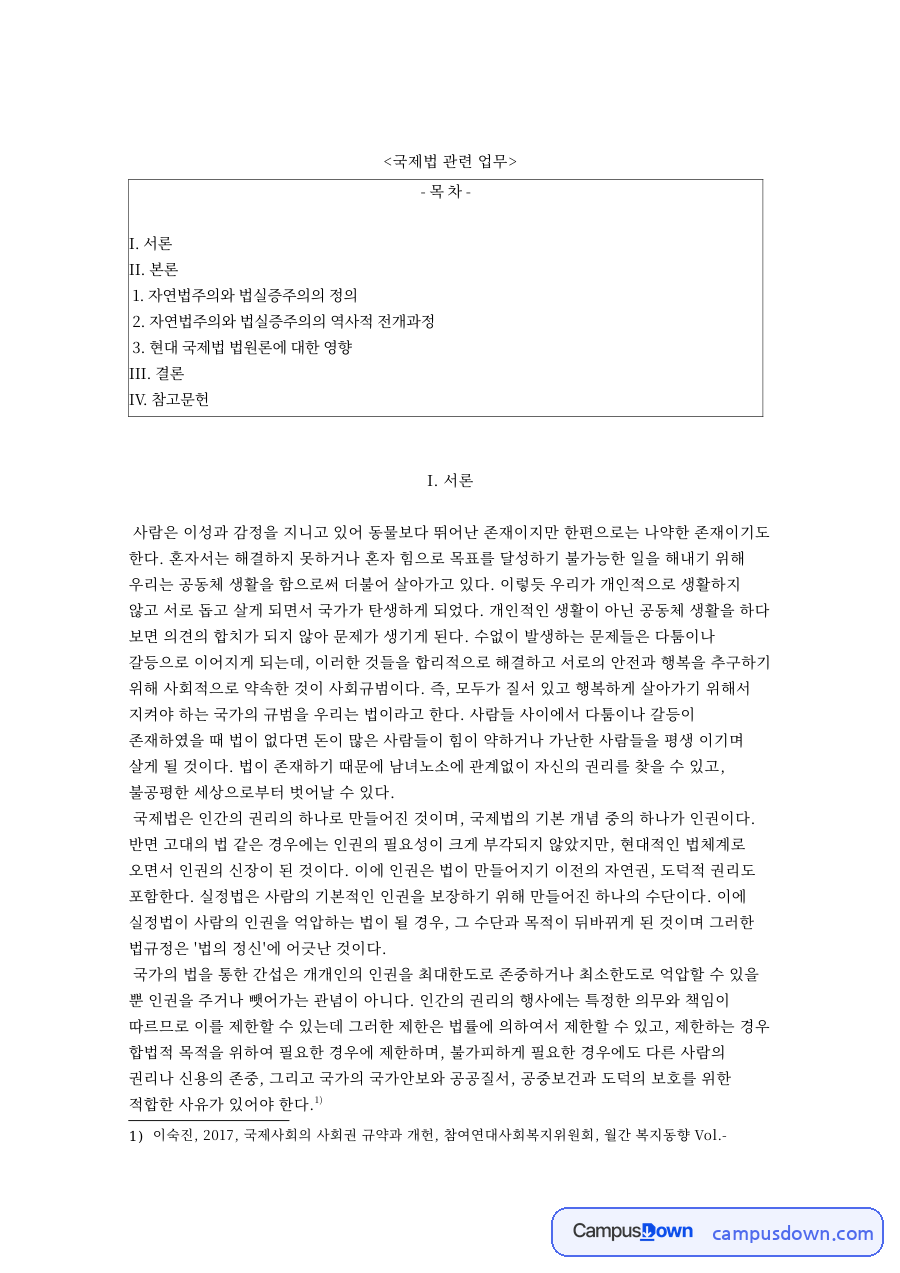
Page 1 is shown as is; from page 2 on, the preview is blurred. Buy it to download the complete original file right away (the file itself is written in Korean).
Packed with real examples and experience. Download it now and save time.
Save your valuable time
Buyer ratings
Fast, accurate and useful.
No ratings yet. Be the first to rate it.


1 / 5
좌우로 밀어서 페이지를 넘겨보세요
무엇이 국제법이 되는가라는 질문 뒤에는, 법을 이성에서 찾을지 합의에서 찾을지에 대한 오래된 논쟁이 있어요.
과제 개요
| 전체 페이지 수 | 5페이지 |
|---|---|
| 파일 형식 | 한글(HWP) |
| 등록일 | 2025.06.30 |
목차
- 1I. 서론
- 2II. 본론
- 2.11. 자연법주의와 법실증주의의 정의
- 2.22. 자연법주의와 법실증주의의 역사적 전개과정
- 2.33. 현대 국제법 법원론에 대한 영향
- 3III. 결론
- 4IV. 참고문헌
캠퍼스다운 도움말
해당 자료는 No AI 자료입니다. 인싸이트를 얻고 새롭게 가공해 보세요.
자료를 받아서 이용하면 품질이 확 올라갑니다.
- 자연법주의 법실증주의
- 국제법 법원론
- ICJ 규정 제38조
- 그로티우스 국제법
- 헌법 제6조 조약
Natural Law and Legal Positivism in International Law: From Grotius to Article 38 of the ICJ Statute and the Domestic Effect of Treaties in Korea
※ You can preview page 1 as is. Buy it to download the complete original file right away. The file itself is written in Korean.
■ Natural Law and Legal Positivism in International Law: From Grotius to Article 38 of the ICJ Statute and the Domestic Effect of Treaties in Korea — Overview
A 5-page Korean international law paper. It defines natural law and legal positivism, traces them from Aquinas and Grotius to Comte, and discusses how both shape the sources of international law today. It closes with Article 6 of Korea's Constitution, the Vienna Convention's rule of treaty interpretation and a ruling that individuals cannot invoke GATT directly.
무엇이 국제법이 되는가라는 질문 뒤에는, 법을 이성에서 찾을지 합의에서 찾을지에 대한 오래된 논쟁이 있어요.
■ Natural Law and Legal Positivism in International Law: From Grotius to Article 38 of the ICJ Statute and the Domestic Effect of Treaties in Korea — Excerpt from the original document (English translation)
Natural law theory can be divided into traditional natural law and early modern natural law. Traditional natural law began in ancient Greek philosophy, passed through Plato, Aristotle and the Stoics, and was completed as a theoretical system by Aquinas, the leading Scholastic thinker, on the basis of theology and religious philosophy. Early modern natural law, by contrast, began with Pufendorf and dominated the philosophy of law until it was challenged by the historical school and legal positivism in the 19th century; in the modern era natural law was freed from the constraints of the Church and came to be explained from the standpoint of modern rationalism. Grotius explained the existence of natural law grounded in human reason, and as modern individualism, rationalism and utilitarianism rose, he separated the theological meaning from traditional natural law and advanced a new early modern natural law based on human reason. In traditional natural law, natural law was a social order for humans ordained by God that existed metaphysically, whereas in early modern natural law it exists by being recognized through human reason.
Legal positivism began in the modern era when Comte's positivist philosophy influenced jurisprudence. It rejects philosophical inquiry into supernatural things that human senses cannot grasp, such as the world of God, and studies only law that the human senses can perceive, that is, existing positive law. Socrates in antiquity is said to have said 'a bad law is still the law' and drunk the hemlock, which can be seen as a strong spirit of obeying the law. Legal positivism can be seen as resting on this attitude. But believing in it too blindly can give rise to a dictator like Hitler.
Natural law and legal positivism have a very important influence as the theoretical foundations of modern jurisprudence. Whether all application of law should follow legal positivism based on objectivity, or natural law based on morality and human conscience, remains a matter of debate. Legal positivism and natural law are major topics in international law. Many scholars have studied whether the two concepts can coexist, how to reconcile them if so, and which one is right if they cannot. The two theories remain contested despite research and conflict continuing since the 20th century because problems often arise in our society that cannot be solved by relying entirely on law.
As in the maxims 'law is the maximum of morality' and 'criminal law is the backbone of morality,' law sets out in written form the minimum morality, ethics and values that members of society must observe and gives them binding force. The problem is that morality, ethics and values take many forms, and individuals differ in which ones they consider important.
To add: Article 38(1) of the Statute of the International Court of Justice lists treaties, international custom and the general principles of law recognized by civilized nations as the bases for decisions, with judicial decisions and the teachings of scholars as subsidiary means. Peremptory norms (jus cogens) under Article 53 of the Vienna Convention on the Law of Treaties are often cited as a concept influenced by natural law thinking. The paper's 'law is the maximum of morality' should read Jellinek's 'law is the minimum of morality,' and early modern natural law is usually traced to Grotius's On the Law of War and Peace (1625). Socrates's 'a bad law is still the law' is known not to appear as such in Plato's writings. The GATT ruling is Supreme Court Decision 2008Du17936 of January 30, 2009.
■ Natural Law and Legal Positivism in International Law: From Grotius to Article 38 of the ICJ Statute and the Domestic Effect of Treaties in Korea — Contents and key concepts
Is international law only what states agree to?
✦ At a glance
- Natural law, positivism and the sources of international law
- Structure: definitions → history → modern influence → Korean practice
- Useful for international law and legal philosophy courses
☰ What the paper covers
- Defining the two schools
- Natural law in court reasoning
- From Aquinas to Comte
- Treaties in Korean law
- The GATT ruling
✎ Treaties in Korean and U.S. law
Korea's Constitution gives ratified treaties and generally recognized international law the same effect as domestic law, though courts limit direct claims by individuals.
Under the U.S. Supremacy Clause treaties are the law of the land, but Medellín v. Texas (2008) held that non-self-executing treaties need legislation before courts enforce them.
Note: the paper itself is written in Korean and discusses Korean law. This page is general study information, not legal advice.
■ Natural Law and Legal Positivism in International Law: From Grotius to Article 38 of the ICJ Statute and the Domestic Effect of Treaties in Korea References
- 전종익, 2019, 헌법재판소의 국제인권조약 적용, 한국법학원, 저스티스 Vol.- No.170-2 장복희, 2018, 제3세대 인권인 국제연대권, 아주대학교 법학연구소, 아주법학 Vol.11 No.4 이숙진, 2017, 국제사회의 사회권 규약과 개헌, 참여연대사회복지위원회, 월간 복지동향 Vol.- No.224
Keyword Prompt
전문가가 만들었어요과제를 직접 쓰는 데 도움이 되는 영어 프롬프트예요.
Tip! Prompt 에 자신의 생각을 추가해서 하면 훨씬 더 ✨ 좋습니다.
캠퍼스다운에서 레포트 받고 잘 쓰는 법 3가지, AI로 참고자료 제대로 재가공하기 →Prompt 1
I'm writing a university assignment on "자연법주의와 법실증주의, 국제법 법원론에 미친 영향: 그로티우스부터 ICJ 규정 제38조, 헌법 제6조와 조약의 국내 효력". Help me build an outline (introduction, 2-3 body sections, conclusion) that covers 자연법주의 법실증주의, 국제법 법원론 and ICJ 규정 제38조. Don't write the paper for me - give me guiding questions for each section. My own perspective: [자신의 생각 넣는 곳] Please respond in Korean.
Prompt 2
Explain the key concepts "자연법주의 법실증주의" and "국제법 법원론" in simple terms, then show how they connect to the topic "자연법주의와 법실증주의, 국제법 법원론에 미친 영향: 그로티우스부터 ICJ 규정 제38조, 헌법 제6조와 조약의 국내 효력". Point out common misunderstandings students have about them. My own perspective: [자신의 생각 넣는 곳] Please respond in Korean.
Prompt 3
Suggest 3 real-world cases or examples I could analyze in an assignment on "자연법주의와 법실증주의, 국제법 법원론에 미친 영향: 그로티우스부터 ICJ 규정 제38조, 헌법 제6조와 조약의 국내 효력", focusing on "ICJ 규정 제38조". For each, tell me what I should look up and verify in official or academic sources. My own perspective: [자신의 생각 넣는 곳] Please respond in Korean.
Prompt 4
Review my draft paragraph on "자연법주의와 법실증주의, 국제법 법원론에 미친 영향: 그로티우스부터 ICJ 규정 제38조, 헌법 제6조와 조약의 국내 효력" (key idea: "그로티우스 국제법"). Give feedback on logic, evidence and clarity, and mark where I need a citation. My paragraph: [paste here] My own perspective: [자신의 생각 넣는 곳] Please respond in Korean.
Take a break with a quick personality test?
Ranked by actual participation. Results in about a minute.
Loading…
Most-read content
Loading view counts…

Campusdown is a lifelong-learning community in Korea offering study materials, information on government support, student loans and scholarships, and more. Don't miss our free resources.
Go to the Campusdown home page →Refund policy
- Change of mind / refund requested after partial use / more than 7 days after purchase
◆ Exceptions
- File errors / cannot download or open the file
◆ How to request a refund: send a 1:1 inquiry via Customer Service at the top