
Page 1 is shown as is; from page 2 on, the preview is blurred. Buy it to download the complete original file right away (the file itself is written in Korean).
Packed with real examples and experience. Download it now and save time.
Save your valuable time
Buyer ratings
Fast, accurate and useful.
No ratings yet. Be the first to rate it.


Legal Duties of Nurses in Korea: Eight Court Cases on Duty of Care, Informed Consent, Confidentiality and the Duty to Verify
※ You can preview page 1 as is. Buy it to download the complete original file right away. The file itself is written in Korean.
■ Legal Duties of Nurses in Korea: Eight Court Cases on Duty of Care, Informed Consent, Confidentiality and the Duty to Verify — Overview
A 5-page Korean nursing law paper that summarizes two court cases for each of four legal duties of nurses: the duty of care (missed vital-sign checks, unverified drug orders), the duty to explain and obtain consent, the duty of confidentiality (which the Supreme Court held survives a patient's death) and the duty to verify, ending with reflections on the principle of trust in team-based care.
■ Legal Duties of Nurses in Korea: Eight Court Cases on Duty of Care, Informed Consent, Confidentiality and the Duty to Verify — Excerpt from the original document (English translation)
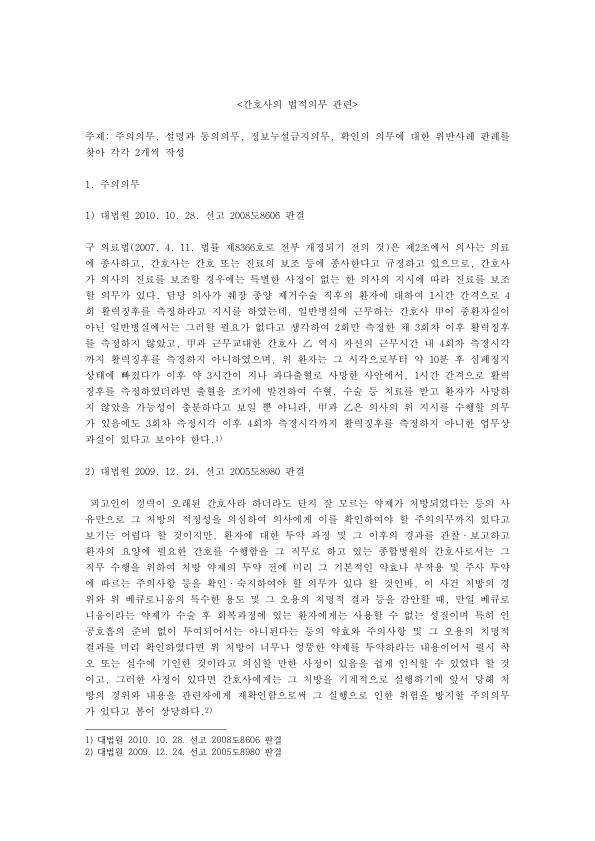
The former Medical Service Act (before its full revision by Act No. 8366 on April 11, 2007) provided in Article 2 that doctors engage in medical care and nurses in nursing or assisting with treatment, so when a nurse assists a doctor's treatment, the nurse must, absent special circumstances, follow the doctor's instructions. In this case the attending doctor ordered vital signs to be checked four times at one-hour intervals for a patient just after surgery to remove a pancreatic tumor. Nurse A, working on a general ward, thought this was unnecessary outside the intensive care unit, checked only twice and skipped the third check onward; Nurse B, who took over the shift, also failed to check by the fourth scheduled time. About ten minutes later the patient went into cardiopulmonary arrest and died some three hours later of excessive bleeding. The court held that hourly checks would very likely have caught the bleeding early enough for transfusion or surgery to save the patient, and that A and B, who were bound to carry out the doctor's order, were professionally negligent in failing to check vital signs between the third and fourth scheduled times.
Even an experienced nurse cannot be said to have a duty to question a prescription and confirm it with the doctor merely because an unfamiliar drug was prescribed. But a nurse at a general hospital, whose job includes observing and reporting on the patient during and after medication and providing the care needed for recovery, must check and understand the basic effects, side effects and injection precautions of a prescribed drug before giving it. Given how the prescription came about, the special use of vecuronium and the fatal results of its misuse, had the nurse checked in advance that vecuronium cannot be used for a patient recovering from surgery and must never be given without preparation for artificial ventilation, she could easily have recognized that the order was so far off that it must have been an error or a mistake. In that situation, before carrying out the order mechanically, the nurse had a duty of care to reconfirm its background and content with those involved to prevent the danger.
Under the personality rights and the right to pursue happiness in Article 10 of the Constitution, a patient has the right to decide how to maintain the functions of life and body and to choose medical treatment.
Note: On May 11, 2018, the Supreme Court held that the 'other person' whose secrets are protected under Article 19 of the Medical Service Act includes people who have died (2018Do2844). Under the current Act, violating Article 19 is punishable by up to three years in prison or a fine of up to 30 million won. A separate Nursing Act setting out nurses' duties, rights and responsibilities was enacted on September 20, 2024 and took effect on June 21, 2025. The paper's phrase 'joint tort in criminal law' is inaccurate; joint tort is a concept of civil liability for damages.
■ Legal Duties of Nurses in Korea: Eight Court Cases on Duty of Care, Informed Consent, Confidentiality and the Duty to Verify — Contents and key concepts
Following orders and exercising judgment
✦ At a glance
- Eight Korean cases on what the law expects of nurses
- Structure: care → consent → confidentiality → verification → reflections
- Useful for nursing management, ethics and health law courses
☰ What the paper covers
- Missed vital-sign checks
- Verifying drug orders
- Informed consent
- Confidentiality after death
- Principle of trust
✎ Nurses' legal duties in Korea and the U.S.
Korea's Supreme Court holds that nurses must check drugs before giving them and query orders that are plainly wrong, and a separate Nursing Act took effect in 2025.
In the U.S., nurses are licensed under state nurse practice acts and can be sued for malpractice, while HIPAA protects patients' health information.
Note: the paper itself is written in Korean and discusses Korean law. This page is general study information, not legal advice.
Related wiki: Medical Malpractice, The Right to Privacy
Take a break with a quick personality test?
Ranked by actual participation. Results in about a minute.
Loading…
Most-read content
Loading view counts…

Campusdown is a lifelong-learning community in Korea offering study materials, information on government support, student loans and scholarships, and more. Don't miss our free resources.
Go to the Campusdown home page →Refund policy
- Change of mind / refund requested after partial use / more than 7 days after purchase
◆ Exceptions
- File errors / cannot download or open the file
◆ How to request a refund: send a 1:1 inquiry via Customer Service at the top