
Page 1 is shown as is; from page 2 on, the preview is blurred. Buy it to download the complete original file right away (the file itself is written in Korean).
Packed with real examples and experience. Download it now and save time.
Save your valuable time
Buyer ratings
Fast, accurate and useful.
No ratings yet. Be the first to rate it.


Legal Basis and Limits of Police Power in Korea: Statutory Reservation, the Passive-Purpose Principle, and a Discussion Paper for Police Studies
※ You can preview page 1 as is. Buy it to download the complete original file right away. The file itself is written in Korean.
■ Legal Basis and Limits of Police Power in Korea: Statutory Reservation, the Passive-Purpose Principle, and a Discussion Paper for Police Studies — Overview
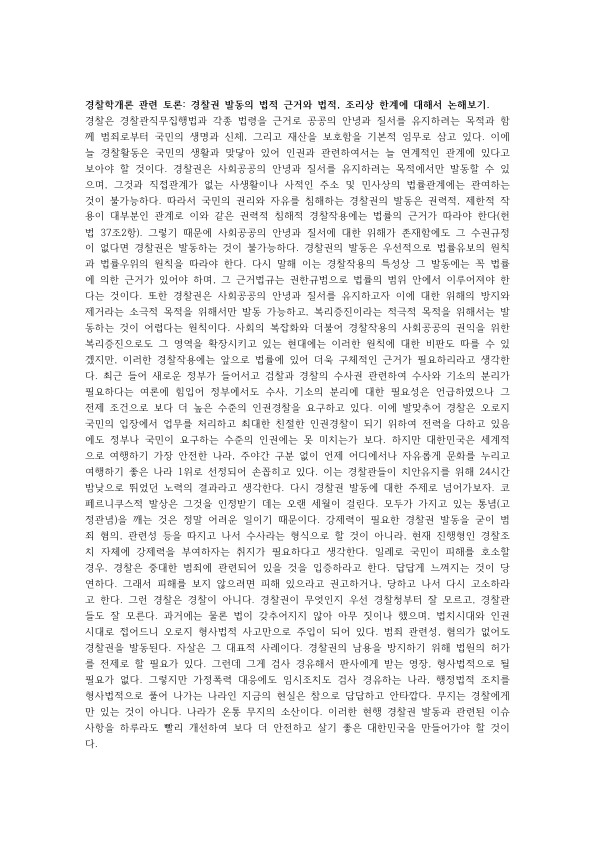
A 1-page Korean police studies discussion paper. It explains that intrusive police measures need a statutory basis under Article 37(2) of the Korean Constitution and the Act on the Performance of Duties by Police Officers, follows the principles of statutory reservation and statutory priority, and describes the traditional rule that police power may be used only to prevent danger. The author then argues for giving ongoing police measures enforceable force subject to court approval, rather than relying only on criminal procedure, citing suicide risk and domestic violence cases.
■ Legal Basis and Limits of Police Power in Korea: Statutory Reservation, the Passive-Purpose Principle, and a Discussion Paper for Police Studies — Excerpt from the original document (English translation)
Based on the Act on the Performance of Duties by Police Officers and various statutes, the police take as their basic mission protecting the lives, bodies and property of citizens from crime, together with the purpose of maintaining public safety and order. Therefore, since police activity always touches citizens' lives, it should be seen as always closely linked to human rights. Police power may be invoked only for the purpose of maintaining public safety and order, and it cannot intervene in private life, private residences or civil legal relationships that are not directly related to that purpose. Accordingly, since the exercise of police power that infringes citizens' rights and freedoms is mostly a coercive and restrictive action, such coercive and infringing police action must have a basis in law (Article 37(2) of the Constitution). Therefore, even where there is a danger to public safety and order, police power cannot be invoked if there is no authorizing provision.
For reference, the limits on police power based on jori (reason) are usually organized as the principle of the passive purpose of police, the principle of police publicness (inviolability of private life and private residence, non-interference in civil relations), the principle of police responsibility, the principle of police proportionality, and the principle of police equality. Among these, the principle of proportionality is expressly stated in Article 1(2) of the Act on the Performance of Duties by Police Officers, which provides that authority must be exercised to the minimum extent necessary. Organizing these five principles in a table together with the material's arguments makes debate preparation easier. Check the sources separately for figures in the material such as safety rankings.
■ Legal Basis and Limits of Police Power in Korea: Statutory Reservation, the Passive-Purpose Principle, and a Discussion Paper for Police Studies — Contents and key concepts
When can Korean police use coercive power without a crime?
✦ At a glance
- The legal basis and limits of police power
- Structure: legal basis → principles → the author's proposal
- Useful for police studies and administrative law discussions
☰ What the paper covers
- Police duties and the governing statute
- Statutory reservation and priority
- The passive-purpose principle
- A proposal for court-approved police measures
✎ Police power in Korean administrative law
Korean law treats police power as an administrative power to prevent danger. It needs a statutory basis and is limited by principles such as proportionality, which the Act on the Performance of Duties by Police Officers states in Article 1(2).
The term differs from the U.S. 'police power,' which refers to states' general authority to regulate for health, safety, and welfare. The Korean concept is narrower and focused on danger prevention by police agencies.
Note: the paper itself is written in Korean and discusses Korean law. This page is general study information, not legal advice.
Take a break with a quick personality test?
Ranked by actual participation. Results in about a minute.
Loading…
Most-read content
Loading view counts…

Campusdown is a lifelong-learning community in Korea offering study materials, information on government support, student loans and scholarships, and more. Don't miss our free resources.
Go to the Campusdown home page →Refund policy
- Change of mind / refund requested after partial use / more than 7 days after purchase
◆ Exceptions
- File errors / cannot download or open the file
◆ How to request a refund: send a 1:1 inquiry via Customer Service at the top