
Page 1 is shown as is; from page 2 on, the preview is blurred. Buy it to download the complete original file right away (the file itself is written in Korean).
Packed with real examples and experience. Download it now and save time.
Save your valuable time
Buyer ratings
Fast, accurate and useful.
No ratings yet. Be the first to rate it.


1 / 3
좌우로 밀어서 페이지를 넘겨보세요
과제 개요
| 전체 페이지 수 | 3페이지 |
|---|---|
| 파일 형식 | 한글(HWP) |
| 등록일 | 2025.07.03 |
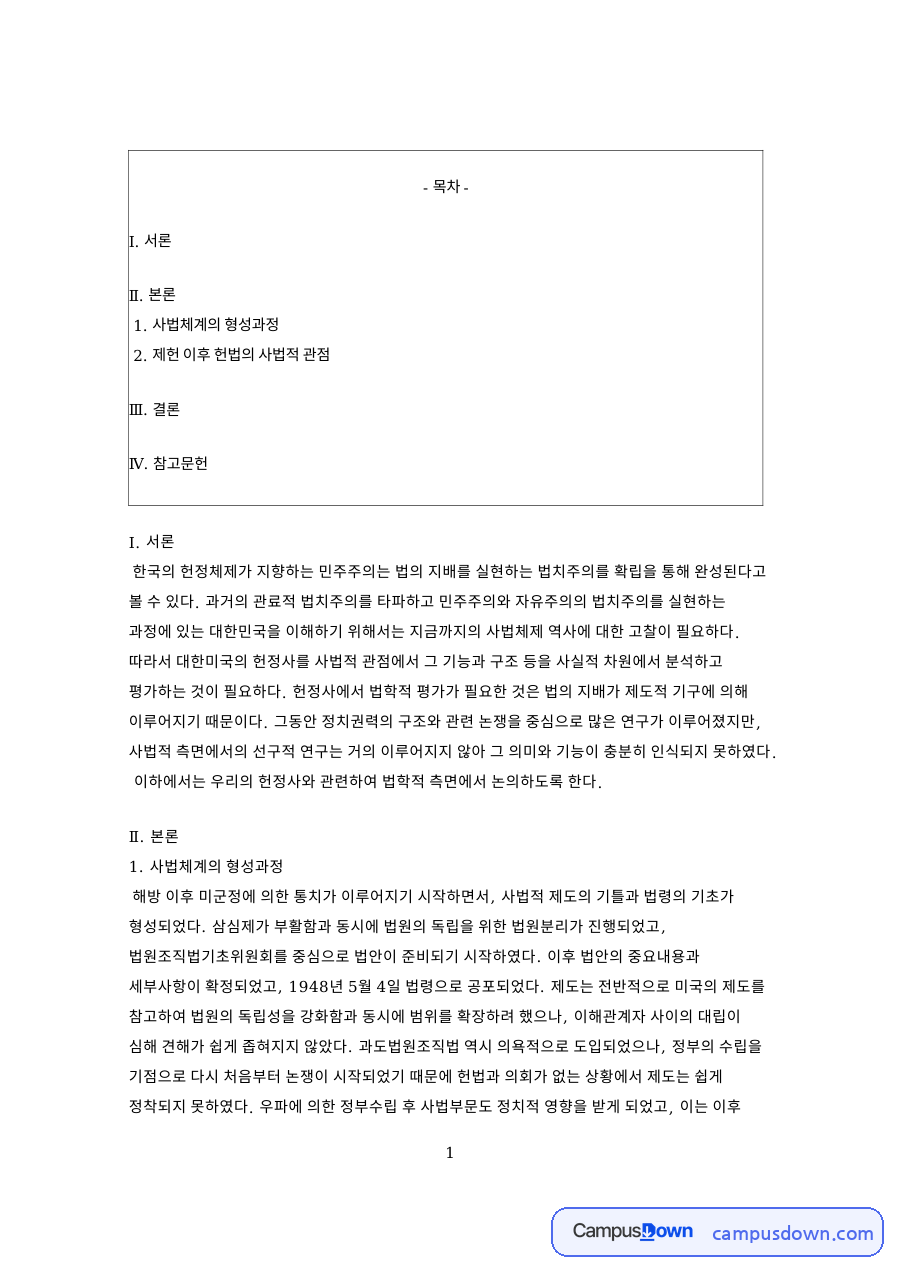
목차
- 1Ⅰ. 서론
- 2Ⅱ. 본론
- 2.11. 사법체계의 형성과정
- 2.22. 제헌 이후 헌법의 사법적 관점
- 3Ⅲ. 결론
- 4Ⅳ. 참고문헌
캠퍼스다운 도움말
해당 자료는 No AI 자료입니다. 인싸이트를 얻고 새롭게 가공해 보세요.
자료를 받아서 이용하면 품질이 확 올라갑니다.
- 헌정사
- 대한민국 헌정사
- 사법체계
- 제헌헌법
- 과도법원조직법
- 탄핵재판소
- 헌법 개정
- 유신헌법
- 1987년 헌법
- 헌법 과제
Korean Constitutional History and the Making of the Courts: The 1948 Interim Court Law, the First Impeachment Court and Nine Amendments
※ You can preview page 1 as is. Buy it to download the complete original file right away. The file itself is written in Korean.
■ Korean Constitutional History and the Making of the Courts: The 1948 Interim Court Law, the First Impeachment Court and Nine Amendments — Overview
A 3-page Korean constitutional law paper that reads Korea's constitutional history through its courts. It covers the U.S. military government's interim court law, the review and impeachment bodies of the 1948 Constitution, the amendments used to extend power, the Yushin Constitution and the 1987 Constitution.
■ Korean Constitutional History and the Making of the Courts: The 1948 Interim Court Law, the First Impeachment Court and Nine Amendments — Excerpt from the original document (English translation)
But with the military coup of May 16, 1961, the constitution was again used as a tool for keeping power. President Park Chung-hee reached a third term through the fifth amendment of 1962 and the sixth amendment, and in this way succeeded in holding power for a long time. Then in 1972 he invoked emergency powers, dissolved the National Assembly, declared martial law and enacted the new Yushin Constitution. The main points of the Yushin Constitution were making it easy to restrict basic rights, shortening National Assembly sessions, giving the president the power to appoint judges, and the Saemaeul project, among others. Because it provided for indirect election of the president, it can be seen as laying the legal foundation for de facto permanent rule. However, the conditions for permanent rule took a new turn after the October 26, 1979 incident, and with the ninth amendment of 1987 as the last, the 1987 Constitution has been maintained for 30 years. Yet although the constitution functions as a norm in people's daily lives, it has not yet become a truly normative constitution. Politicians also use the constitution as a tool for politics, and in administration and the judiciary the constitution is rather neglected, so the normative force of the constitution must be secured, if only to protect the freedoms and rights it guarantees.
The main body discussed, from a legal perspective, Korea's constitutional history: the historical and political background after liberation before the new legal system was put in order, and the history of constitutional amendments that followed. What appears throughout this constitutional history is the attitude and effort toward developing a liberal democratic system.
To add, correct the years as you read. The fifth amendment was made by referendum in December 1962 after the May 16 coup, and the sixth amendment allowing a third presidential term came in 1969. After the October 1972 Yushin declaration, the seventh amendment created the Yushin Constitution, and the current constitution, created by the ninth amendment in October 1987, has remained unamended for nearly 40 years as of 2026. The 1987 Constitution introduced direct presidential elections and a single five-year term, and created a new Constitutional Court to handle review of laws, impeachment, dissolution of political parties, competence disputes and constitutional complaints.
■ Korean Constitutional History and the Making of the Courts: The 1948 Interim Court Law, the First Impeachment Court and Nine Amendments — Contents and key concepts
How did Korea's courts take shape as its constitution changed?
✦ At a glance
- Korean constitutional history through the courts
- Structure: interim courts → three review systems → amendments → 1987
- Useful for constitutional law and Korean legal history
☰ What the paper covers
- Interim court law of 1948
- Judicial review, administrative trials, impeachment
- The 1948 Constitution
- Amendments and the April 1960 revolution
- Yushin and 1987 Constitutions
✎ Constitutional review in Korea and the U.S.
Korea's 1987 Constitution created a separate Constitutional Court in 1988 to review laws, hear constitutional complaints and decide impeachments.
The U.S. has no separate constitutional court: ordinary federal courts review laws under Marbury v. Madison (1803), and the Constitution has been amended only 27 times since 1789.
Note: the paper itself is written in Korean and discusses Korean law. This page is general study information, not legal advice.
■ Korean Constitutional History and the Making of the Courts: The 1948 Interim Court Law, the First Impeachment Court and Nine Amendments References
- 허영(1998). 헌법의 기본정신과 교훈 : 헌정사의 반성적 회고.
- <대한민국 국회> 한국학술진흥재단(2004). 한국 근현대 헌정사연구 : 사법체제의 형성과 민주헌정인문사회분야 지원사업 :2004년도 기초학문육성 결과보고서. <한국연구재단>
Keyword Prompt
전문가가 만들었어요과제를 직접 쓰는 데 도움이 되는 영어 프롬프트예요.
Tip! Prompt 에 자신의 생각을 추가해서 하면 훨씬 더 ✨ 좋습니다.
캠퍼스다운에서 레포트 받고 잘 쓰는 법 3가지, AI로 참고자료 제대로 재가공하기 →Prompt 1
I'm writing a university assignment on "대한민국 헌정사와 사법체계의 형성: 미군정 과도법원조직법, 제헌헌법의 탄핵재판소, 아홉 차례 개헌의 의미". Help me build an outline (introduction, 2-3 body sections, conclusion) that covers 헌정사, 대한민국 헌정사 and 사법체계. Don't write the paper for me - give me guiding questions for each section. My own perspective: [자신의 생각 넣는 곳] Please respond in Korean.
Prompt 2
Explain the key concepts "헌정사" and "대한민국 헌정사" in simple terms, then show how they connect to the topic "대한민국 헌정사와 사법체계의 형성: 미군정 과도법원조직법, 제헌헌법의 탄핵재판소, 아홉 차례 개헌의 의미". Point out common misunderstandings students have about them. My own perspective: [자신의 생각 넣는 곳] Please respond in Korean.
Prompt 3
Suggest 3 real-world cases or examples I could analyze in an assignment on "대한민국 헌정사와 사법체계의 형성: 미군정 과도법원조직법, 제헌헌법의 탄핵재판소, 아홉 차례 개헌의 의미", focusing on "사법체계". For each, tell me what I should look up and verify in official or academic sources. My own perspective: [자신의 생각 넣는 곳] Please respond in Korean.
Prompt 4
Review my draft paragraph on "대한민국 헌정사와 사법체계의 형성: 미군정 과도법원조직법, 제헌헌법의 탄핵재판소, 아홉 차례 개헌의 의미" (key idea: "제헌헌법"). Give feedback on logic, evidence and clarity, and mark where I need a citation. My paragraph: [paste here] My own perspective: [자신의 생각 넣는 곳] Please respond in Korean.
Take a break with a quick personality test?
Ranked by actual participation. Results in about a minute.
Loading…
Most-read content
Loading view counts…

Campusdown is a lifelong-learning community in Korea offering study materials, information on government support, student loans and scholarships, and more. Don't miss our free resources.
Go to the Campusdown home page →Refund policy
- Change of mind / refund requested after partial use / more than 7 days after purchase
◆ Exceptions
- File errors / cannot download or open the file
◆ How to request a refund: send a 1:1 inquiry via Customer Service at the top