
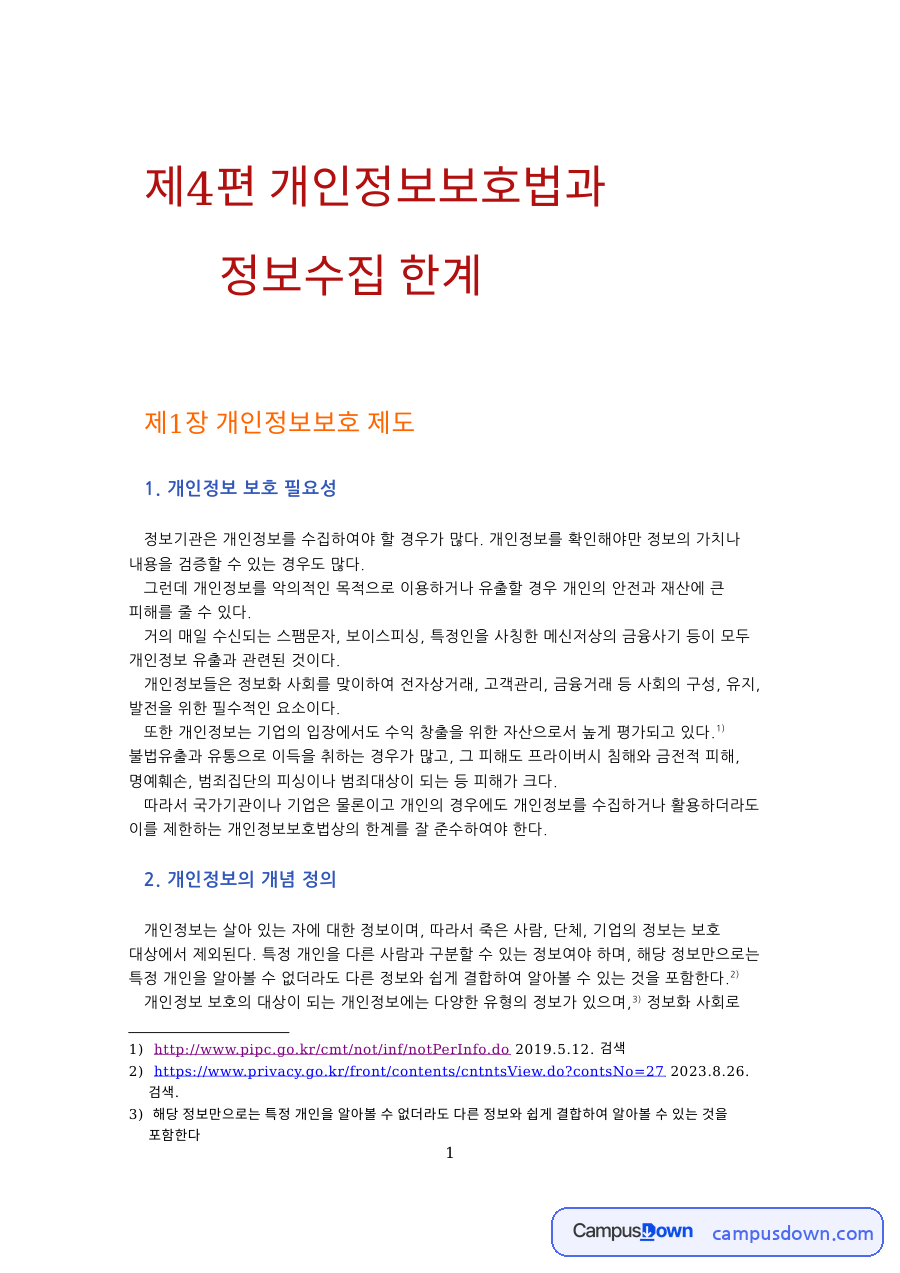
Page 1 is shown as is; from page 2 on, the preview is blurred. Buy it to download the complete original file right away (the file itself is written in Korean).
Packed with real examples and experience. Download it now and save time.
Save your valuable time
Buyer ratings
Fast, accurate and useful.
No ratings yet. Be the first to rate it.


1 / 22
좌우로 밀어서 페이지를 넘겨보세요
과제 개요
| 전체 페이지 수 | 22페이지 |
|---|---|
| 파일 형식 | 한글(HWP) |
| 등록일 | 2025.08.13 |
캠퍼스다운 도움말
해당 자료는 No AI 자료입니다. 인싸이트를 얻고 새롭게 가공해 보세요.
자료를 받아서 이용하면 품질이 확 올라갑니다.
- 개인정보 보호법
- 개인정보
- 가명정보
- 개인정보보호위원회
- 개인정보 분쟁조정
- 신용정보법
- 정보주체의 권리
- 공개정보 수집
- 정보보호
Korea's Personal Information Protection Act and the Limits of Information Gathering: Definitions, Pseudonymized Data, Processing Principles and Dispute Mediation
※ You can preview page 1 as is. Buy it to download the complete original file right away. The file itself is written in Korean.
■ Korea's Personal Information Protection Act and the Limits of Information Gathering: Definitions, Pseudonymized Data, Processing Principles and Dispute Mediation — Overview
A 20-page Korean information law text. It explains why personal data must be protected, how Korea's Personal Information Protection Act defines personal and pseudonymized information, the work of the Personal Information Protection Commission, dispute mediation, breach response and removal requests to search engines, and the credit information rules.
■ Korea's Personal Information Protection Act and the Limits of Information Gathering: Definitions, Pseudonymized Data, Processing Principles and Dispute Mediation — Excerpt from the original document (English translation)
The Personal Information Protection Act protects personal information and also sets certain limits on collecting and processing it for intelligence agencies that collect personal information and for companies or individuals that collect customer information.
In particular, Article 58 (partial exclusion from application) in Chapter 8 (supplementary provisions) is an important legal basis under which personal information collected or requested for analysis related to national security is excluded from the act. Under Article 58(1), 'personal information collected or requested to be provided for the purpose of analyzing information related to national security' is excluded from the act and can be lawfully collected and analyzed.
To protect personal information from illegal collection, misuse and leaks, the act sets out prohibited acts. They also apply to people who process or have processed personal information while working at state agencies, intelligence agencies or investigative agencies, who are subject to criminal punishment.
People who process or have processed personal information are prohibited from the following acts (Article 59 of the act).
1) Obtaining personal information or consent to its processing by deception or other unfair means or methods.
2) Disclosing personal information learned in the course of duty or providing it for use by others without authority.
3) Using, damaging, destroying, altering, forging or leaking another person's personal information without lawful authority or beyond the authority granted.
The Personal Information Protection Act falls under the Personal Information Protection Commission and is administered by its policy division. The following provisions are the most important ones relating to the collection of open-source information.
Article 1 (Purpose): This act aims to protect the freedom and rights of individuals and further to realize the dignity and value of individuals by setting out matters concerning the processing and protection of personal information.
Article 2 (Definitions): The terms used in this act are defined as follows.
1. 'Personal information' means information relating to a living individual that falls under any of the following items.
(b) Information that, even if it cannot by itself identify a particular individual, can easily be combined with other information to identify one. In this case, whether it can easily be combined must be judged by reasonably considering the time, cost and technology needed to identify the individual, such as the availability of the other information.
(c) Information produced by pseudonymizing information under item (a) or (b) under subparagraph 1-2 so that a particular individual cannot be identified without using or combining additional information to restore it to its original state (hereinafter 'pseudonymized information').
1-2. 'Pseudonymization' means processing personal information, by deleting part of it or replacing part or all of it, so that a particular individual cannot be identified without additional information.
2. 'Processing' means collecting, generating, linking, interlocking, recording, storing, retaining, processing, editing, searching, outputting, correcting, restoring, using, providing, disclosing or destroying personal information, and other similar acts.
3. 'Data subject' means a person who can be identified by the information processed and who is the subject of that information.
4. 'Personal information file' means a set of personal information arranged or organized systematically according to certain rules so that it can easily be searched.
5. 'Personal information controller' means a public institution, corporation, organization or individual that processes personal information, directly or through others, to operate a personal information file for business purposes.
6. 'Public institution' means the following.
(a) Bodies handling the administrative affairs of the National Assembly, the courts, the Constitutional Court and the National Election Commission, central administrative agencies (including agencies under the President and the Prime Minister) and their affiliated agencies, and local governments.
7. 'Fixed visual data processing device' means a device, prescribed by presidential decree, that is installed in a certain space and continuously or periodically films people or objects or transmits such images over wired or wireless networks.
7-2. 'Mobile visual data processing device' means a device, prescribed by presidential decree, that is worn or carried by a person or attached to or mounted on a movable object and films people or objects or transmits such images over wired or wireless networks.
8. 'Scientific research' means research applying scientific methods, such as technology development and demonstration, basic research, applied research and privately funded research.
To add: the concept of pseudonymized information was introduced by the so-called three data laws amendment that took effect in August 2020, when the Personal Information Protection Commission was also upgraded to a central administrative agency. A March 2023 amendment (mostly in force from September that year) folded the special rules for information and communications service providers into the general provisions and created the right to request transmission of personal information, the right to refuse or seek an explanation of automated decisions, and rules on mobile visual data devices. The agency contact details, web screens and search engine removal procedures in the paper are as of the time of writing, so current guidance should be checked before use. A personal information dispute mediation, once accepted, has the same effect as a judicial settlement.
■ Korea's Personal Information Protection Act and the Limits of Information Gathering: Definitions, Pseudonymized Data, Processing Principles and Dispute Mediation — Contents and key concepts
What counts as personal information and how far can you collect it?
✦ At a glance
- Korea's personal information law and limits on collection
- Structure: need → definitions → mediation → breach response → statute → credit information
- Useful for data protection, information law and OSINT courses
☰ What the paper covers
- Why protection matters
- Personal and pseudonymized data
- Dispute mediation
- Removal requests
- Credit information rules
✎ Data protection law in Korea and the U.S.
Korea's 2011 act is a single comprehensive data protection law for public and private sectors, enforced by an independent commission.
The U.S. has no comprehensive federal privacy law and relies on sector laws such as HIPAA and state laws such as the California Consumer Privacy Act.
Note: the paper itself is written in Korean and discusses Korean law. This page is general study information, not legal advice.
Related wiki: The Right to Privacy
Keyword Prompt
전문가가 만들었어요과제를 직접 쓰는 데 도움이 되는 영어 프롬프트예요.
Tip! Prompt 에 자신의 생각을 추가해서 하면 훨씬 더 ✨ 좋습니다.
캠퍼스다운에서 레포트 받고 잘 쓰는 법 3가지, AI로 참고자료 제대로 재가공하기 →Prompt 1
I'm writing a university assignment on "개인정보 보호법의 개념과 정보수집의 한계: 개인정보·가명정보 정의, 처리 원칙, 분쟁조정 절차와 신용정보법". Help me build an outline (introduction, 2-3 body sections, conclusion) that covers 개인정보 보호법, 개인정보 and 가명정보. Don't write the paper for me - give me guiding questions for each section. My own perspective: [자신의 생각 넣는 곳] Please respond in Korean.
Prompt 2
Explain the key concepts "개인정보 보호법" and "개인정보" in simple terms, then show how they connect to the topic "개인정보 보호법의 개념과 정보수집의 한계: 개인정보·가명정보 정의, 처리 원칙, 분쟁조정 절차와 신용정보법". Point out common misunderstandings students have about them. My own perspective: [자신의 생각 넣는 곳] Please respond in Korean.
Prompt 3
Suggest 3 real-world cases or examples I could analyze in an assignment on "개인정보 보호법의 개념과 정보수집의 한계: 개인정보·가명정보 정의, 처리 원칙, 분쟁조정 절차와 신용정보법", focusing on "가명정보". For each, tell me what I should look up and verify in official or academic sources. My own perspective: [자신의 생각 넣는 곳] Please respond in Korean.
Prompt 4
Review my draft paragraph on "개인정보 보호법의 개념과 정보수집의 한계: 개인정보·가명정보 정의, 처리 원칙, 분쟁조정 절차와 신용정보법" (key idea: "개인정보보호위원회"). Give feedback on logic, evidence and clarity, and mark where I need a citation. My paragraph: [paste here] My own perspective: [자신의 생각 넣는 곳] Please respond in Korean.
Take a break with a quick personality test?
Ranked by actual participation. Results in about a minute.
Loading…
Most-read content
Loading view counts…

Campusdown is a lifelong-learning community in Korea offering study materials, information on government support, student loans and scholarships, and more. Don't miss our free resources.
Go to the Campusdown home page →Refund policy
- Change of mind / refund requested after partial use / more than 7 days after purchase
◆ Exceptions
- File errors / cannot download or open the file
◆ How to request a refund: send a 1:1 inquiry via Customer Service at the top