
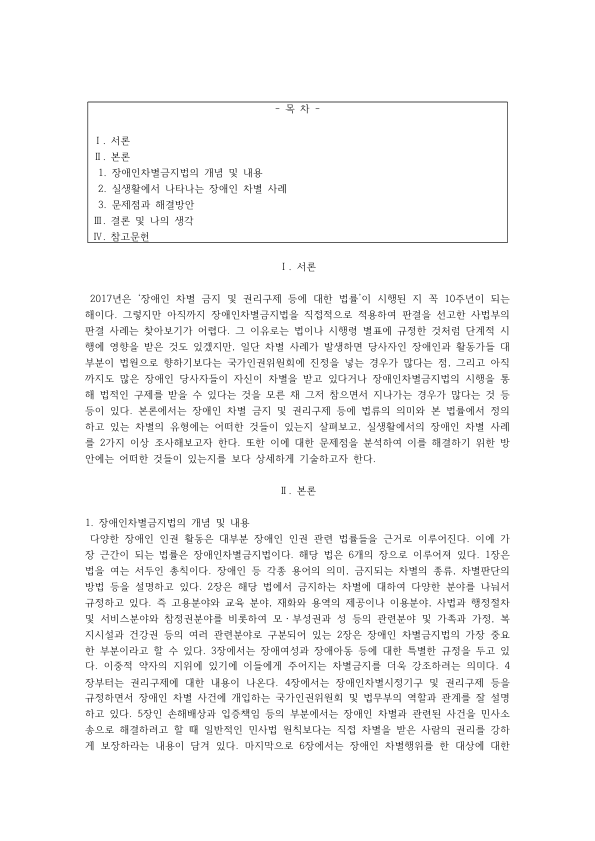
Page 1 is shown as is; from page 2 on, the preview is blurred. Buy it to download the complete original file right away (the file itself is written in Korean).
Packed with real examples and experience. Download it now and save time.
Save your valuable time
Buyer ratings
Fast, accurate and useful.
No ratings yet. Be the first to rate it.


Korea's Anti-Discrimination Act for Persons with Disabilities: Structure, Everyday Discrimination in Transit and Access, and Weak Enforcement
※ You can preview page 1 as is. Buy it to download the complete original file right away. The file itself is written in Korean.
■ Korea's Anti-Discrimination Act for Persons with Disabilities: Structure, Everyday Discrimination in Transit and Access, and Weak Enforcement — Overview
A 4-page Korean disability law paper. It explains the six chapters of the Anti-Discrimination Against and Remedies for Persons with Disabilities Act, gives examples of everyday discrimination such as few low-floor buses, small shops without access duties and inaccessible mobile apps, and examines why remedies from the human rights commission and courts remain weak.
■ Korea's Anti-Discrimination Act for Persons with Disabilities: Structure, Everyday Discrimination in Transit and Access, and Weak Enforcement — Excerpt from the original document (English translation)
Most facilities used by the public also have no duty to install accessibility features for disabled people, so their accessibility is poor. According to Statistics Korea data (2014), 96% of restaurants, 95% of supermarkets and 99% of hair salons nationwide were small businesses and therefore not subject to the Disability Discrimination Act. In addition, current law limits the duty to guarantee access to information to 'websites,' so there is no adequate provision to remedy discrimination encountered when using mobile apps or smartphones. The UN Convention on the Rights of Persons with Disabilities makes 'ensuring access for persons with disabilities to tourism sites' an obligation of state parties, but the Disability Discrimination Act does not reflect this.
Everyday discrimination that disabled people living in the community experience when visiting a theater, attending a performance, or traveling to another region and using lodging or call taxis can also be cited. Most provisions on disabled people's right to enjoy culture are non-mandatory, so reasonable accommodation for disabled people is not provided as a duty, and the law says almost nothing about tourism, so disabled people must bear all the resulting inconvenience themselves.
However loudly people call for laws against disability discrimination, I want to raise the concern that if such laws are not properly designed and enforced, they may remain merely declaratory without real effect. The Disability Discrimination Act was enacted in April 2007 and marks its 10th anniversary this year, and I believe it has achieved visible results as a law that protects disabled people's human rights in many areas and serves as a basis for remedying unreasonable discrimination. Still, large and small problems have been raised: its scope is narrow, it has not kept up with the changing information and communications environment, and it does not fully reflect the UN Convention on the Rights of Persons with Disabilities.
One of the biggest reasons the law lacks effectiveness is its weak penalty provisions. Violations can be sanctioned by recommendations from the National Human Rights Commission, damages or criminal punishment, but even the commission's recommendations, the remedy victims use most often, do not sufficiently satisfy disabled people. Last year 2,433 complaints related to disabled people, including under the Disability Discrimination Act, were filed, and 1,600 to about 2,600 cases are filed every year. About 23% of these complaints were upheld. Even when a correction recommendation is hard won from the commission, its effect is hard to guarantee.
To add: the Disability Discrimination Act was enacted in April 2007 and took effect in April 2008, so as of 2017 it was the 10th anniversary of its enactment rather than of its entry into force. If a National Human Rights Commission recommendation is not followed, the Minister of Justice can issue a corrective order, and violating it brings an administrative fine of up to 30 million won (Articles 43 and 50). Malicious discrimination is punishable by up to three years in prison or a fine of up to 30 million won (Article 49). The disability grading system was abolished in July 2019, and an amendment to the Act on Promotion of the Transportation Convenience of Mobility Disadvantaged Persons (Article 14(7)), promulgated in January 2022 and in force since January 19, 2023, in principle requires low-floor buses when route buses other than intercity buses are replaced (seated-type buses from 2027). The paper's statistics are from 2016 to 2017.
■ Korea's Anti-Discrimination Act for Persons with Disabilities: Structure, Everyday Discrimination in Transit and Access, and Weak Enforcement — Contents and key concepts
Why does disability discrimination persist despite the law?
✦ At a glance
- How Korea's disability anti-discrimination law works and falls short
- Structure: the act → everyday cases → enforcement gaps → solutions
- Useful for disability rights and social welfare law courses
☰ What the paper covers
- Six chapters of the act
- Protected areas of life
- Low-floor buses and mobility
- Shops and mobile access
- Weak remedies
✎ Disability discrimination law in Korea and the U.S.
Korea's 2007 act bans direct and indirect discrimination and refusal of reasonable accommodation, but most victims rely on non-binding commission recommendations.
The Americans with Disabilities Act of 1990 covers employment, public services and public accommodations, and private lawsuits and Justice Department enforcement give it stronger teeth.
Note: the paper itself is written in Korean and discusses Korean law. This page is general study information, not legal advice.
Related wiki: Americans with Disabilities Act (ADA)
Related wiki: Affirmative Action
■ Korea's Anti-Discrimination Act for Persons with Disabilities: Structure, Everyday Discrimination in Transit and Access, and Weak Enforcement References
- 법제처 - 국가법령센터. 장애인 차별 금지 및 권리구제 등에 대한 법률. 보건복지부 연구보고서(2015). “2015년 장애인차별금지법 이행 실태 모니터링”
Take a break with a quick personality test?
Ranked by actual participation. Results in about a minute.
Loading…
Most-read content
Loading view counts…

Campusdown is a lifelong-learning community in Korea offering study materials, information on government support, student loans and scholarships, and more. Don't miss our free resources.
Go to the Campusdown home page →Refund policy
- Change of mind / refund requested after partial use / more than 7 days after purchase
◆ Exceptions
- File errors / cannot download or open the file
◆ How to request a refund: send a 1:1 inquiry via Customer Service at the top