
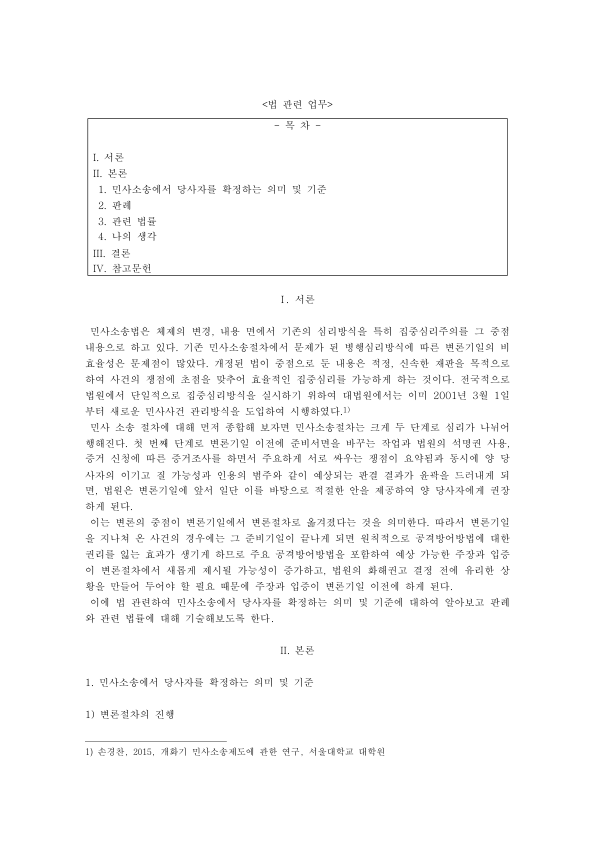
Page 1 is shown as is; from page 2 on, the preview is blurred. Buy it to download the complete original file right away (the file itself is written in Korean).
Packed with real examples and experience. Download it now and save time.
Save your valuable time
Buyer ratings
Fast, accurate and useful.
No ratings yet. Be the first to rate it.


Identifying the Parties in Korean Civil Litigation: Distinction from Standing, the Indication Theory, Case Law and Third-Party Litigation
※ You can preview page 1 as is. Buy it to download the complete original file right away. The file itself is written in Korean.
■ Identifying the Parties in Korean Civil Litigation: Distinction from Standing, the Indication Theory, Case Law and Third-Party Litigation — Overview
A Korean civil procedure paper distinguishing the identification of parties (who the parties are) from standing (who should be a party). It explains the need for standing and the risk of actio popularis, the meaning and standards for identifying parties including third-party litigation, case law based on the modified indication theory, and Articles 51 to 53 of the Civil Procedure Act.
■ Identifying the Parties in Korean Civil Litigation: Distinction from Standing, the Indication Theory, Case Law and Third-Party Litigation — Excerpt from the original document (English translation)
Then, in the case law holding that the person who asserts his or her own claim to performance is the plaintiff and the person alleged to be obliged under the claim is the defendant, the meaning of "the plaintiff's claim itself" is as follows: given that the required entries in the complaint are the indication of the parties, the purport of the claim and the grounds of the claim, "the plaintiff's claim itself" means identifying the parties with a focus on these three required entries.
In Chapter 2 (Parties), the Civil Procedure Act has Section 1 on capacity to be a party and litigation capacity. Article 51 of the Civil Procedure Act, as the principle on capacity to be a party, litigation capacity and the like, provides that capacity to be a party, litigation capacity, legal representation of persons without litigation capacity, and the grant of authority necessary for litigation acts are governed by the Civil Act and other statutes unless this Act provides otherwise. Article 52, on the capacity to be a party of unincorporated associations and the like, provides that an unincorporated association or foundation may be a party in its own name if it has a representative or administrator. Article 53, on appointed parties, provides in paragraph (1) that where several persons with common interests do not fall under Article 52, they may appoint, or change, one or more persons from among them to be a party for all of them, and in paragraph (2) that where the parties are changed under paragraph (1) after the suit is pending before the court, the former parties are deemed to have withdrawn from the suit as a matter of course.
Since the determination of the parties first becomes an issue from the service of the complaint on the parties, before serving the parties the court must judge whether the indication of the parties in the civil suit filed is made accurately as the holders of substantive rights or legal relationships, or as a third party conducting litigation on another's behalf. To do this, it is considered to be linked first to the question of to what level the required entries in a civil complaint must be stated in order to conform to the spirit of the Civil Procedure Act that requires them.
When determining the parties, the principle is that the relationship between the holder of the substantive right or legal relationship and a third party is indicated. However, such a statement is not necessarily required unconditionally. Accordingly, a method of handling is needed where the relationship between the holder of the substantive right or legal relationship and a third party does not appear. In the indication of the parties in a civil suit so filed, whether the holder of the substantive right or legal relationship filed the suit, or whether a third party filed it in the position of a person conducting litigation on another's behalf, can be judged from the purport and grounds of the claim. Therefore, where, by such a method, it is unclear whether the person indicated as a party is the holder of the substantive right or legal relationship, one may or may not take the view that such a relationship must be indicated in cases of third-party litigation on another's behalf. If one takes the view that it must be indicated, then, by interpretation, where it is not indicated, the person stated as a party should be interpreted as a party to the suit as the person with the power to manage and dispose of the substantive right or legal relationship. It cannot be legally presumed that every suit in which the complaint does not indicate whether it is third-party litigation is filed by the person with the power to manage and dispose of the substantive right or legal relationship.
Determination of the parties and standing to be a party are first-step issues that almost always appear in case-type questions on civil procedure. Organizing together the method of determining the parties by reading the complaint as a whole under the modified indication theory, the difference between correcting the indication of a party and substituting the defendant, and examples of third-party litigation such as creditor's subrogation suits and collection suits gives you the ability to start the first paragraph of an answer accurately. Studying them bundled with provisions that often appear in practice, such as appointed parties and the capacity to be a party of unincorporated associations, lets you organize the whole unit on parties at once.
■ Identifying the Parties in Korean Civil Litigation: Distinction from Standing, the Indication Theory, Case Law and Third-Party Litigation — Contents and key concepts
Identifying the Parties in Korean Civil Litigation
✦ At a glance
- Separating who the parties are from who should be
- Structure: introduction → standing → identification → case law → statutes
- Useful for civil procedure assignments and problem answers
☰ What the paper covers
- Meaning and purpose of standing
- Standards for identifying parties
- Modified indication theory in case law
- Civil Procedure Act Articles 51 to 53
✎ Background in brief
Identification asks who is actually suing or being sued, judged mainly from the complaint.
Standing asks whether that person is the right one to bring or defend the claim.
Note: the paper itself is written in Korean and discusses Korean law. This page is general study information, not legal advice.
Related wiki: Civil Procedure Steps
■ Identifying the Parties in Korean Civil Litigation: Distinction from Standing, the Indication Theory, Case Law and Third-Party Litigation References
- 오영경, 2016, 소송당사자의 경제적 조건과 사법불신의 상관성 연구, 동국대학교 손경찬, 2015, 개화기 민사소송제도에 관한 연구, 서울대학교 대학원 김효정, 2017, 주주대표소송에 관한 연구 :국내 및 국제소송상의 쟁점을 중심으로, 연세대학교 대학원
Take a break with a quick personality test?
Ranked by actual participation. Results in about a minute.
Loading…
Most-read content
Loading view counts…

Campusdown is a lifelong-learning community in Korea offering study materials, information on government support, student loans and scholarships, and more. Don't miss our free resources.
Go to the Campusdown home page →Refund policy
- Change of mind / refund requested after partial use / more than 7 days after purchase
◆ Exceptions
- File errors / cannot download or open the file
◆ How to request a refund: send a 1:1 inquiry via Customer Service at the top