
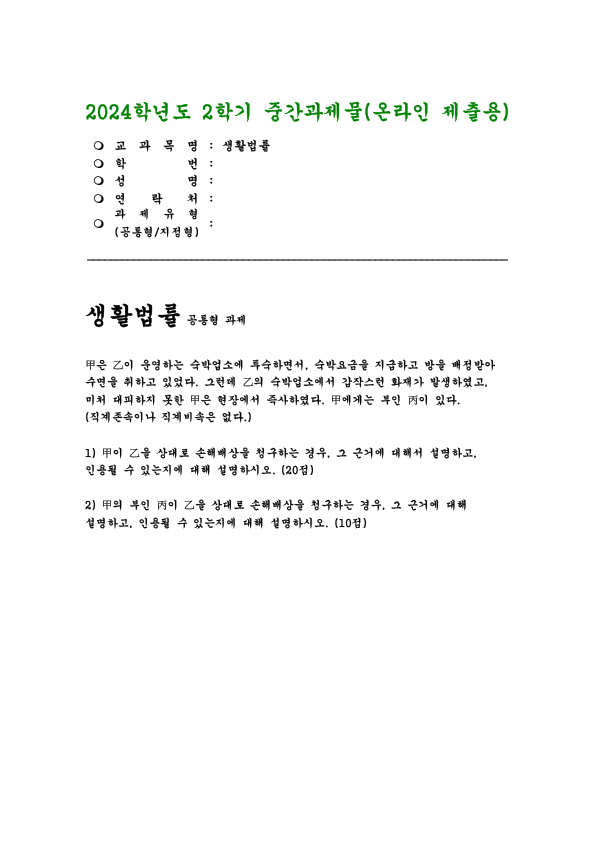
Page 1 is shown as is; from page 2 on, the preview is blurred. Buy it to download the complete original file right away (the file itself is written in Korean).
Packed with real examples and experience. Download it now and save time.
Save your valuable time
Buyer ratings
Fast, accurate and useful.
No ratings yet. Be the first to rate it.


Hotel Fire Death and Damages in Korea: Innkeeper Liability, Tort and Contract Claims, and a Surviving Spouse's Compensation
※ You can preview page 1 as is. Buy it to download the complete original file right away. The file itself is written in Korean.
■ Hotel Fire Death and Damages in Korea: Innkeeper Liability, Tort and Contract Claims, and a Surviving Spouse's Compensation — Overview
An 8-page Korean everyday law paper built on a case: a guest dies in a fire at a lodging business and his wife sues the owner. It compares fires caused by the business, by a guest and by outside events, explains tort and contract claims under the Korean Civil Code, and breaks down funeral costs, lost earnings and damages for emotional distress.
■ Hotel Fire Death and Damages in Korea: Innkeeper Liability, Tort and Contract Claims, and a Surviving Spouse's Compensation — Excerpt from the original document (English translation)
If such measures were not properly taken, the lodging business may bear part of the responsibility apart from the guest's own fault.
The lodging business's response when a fire breaks out: even if the fire was caused by a guest's fault, the lodging business must respond quickly and appropriately as soon as the fire starts. For example, whether the alarm sounded in time and whether guests were given directions to evacuate quickly through emergency exits are important criteria.
The guest's fault and the lodging business's responsibility: even if a guest started the fire, the lodging business must make active efforts to minimize the danger and reduce the damage. For example, if the fire alarm system did not work properly, this may be regarded as the lodging business's negligence, and the lodging business may have to answer for the additional damage it caused.
Comparative negligence: the court can compare the guest's fault with the lodging business's fault and adjust liability for damages. Even if the guest's fault is substantial, if the lodging business neglected safety measures, the faults may be offset and liability shared.
Whether the lodging business breached its duties: even if a fire was caused by a guest's mistake, the lodging business may still be liable if it did not properly maintain and give guidance on emergency evacuation routes and fire equipment. Whether it fulfilled these duties is an important criterion in judging legal liability.
In the end, even when a fire is caused by a guest's fault, the lodging business is not free from responsibility for safety management. If preventive measures were inadequate or the response to the fire was inadequate, the lodging business must bear part of the liability for damages.
When a fire breaks out at a lodging business due to outside causes, the lodging business's liability depends on how controllable and foreseeable the outside cause was and on how the business responded. Examples include a fire that spreads from a nearby building to the lodging business, or a fire caused by a natural disaster.
Fires from outside causes arise from events the lodging business cannot directly control. Examples are flames spreading to the lodging business from a fire in an adjacent building, or a fire caused by lightning. Damage to a lodging business from sparks at a construction site is also classed as an outside cause.
Duty of prevention: a lodging business has a duty to take preventive measures to protect guests from outside dangers. Examples include whether equipment such as fire detectors works properly and whether emergency evacuation routes are secured. Whether these basic measures were taken can determine the lodging business's legal liability.
Adequacy of the response: when a fire breaks out from outside causes, whether the lodging business carried out an appropriate emergency evacuation plan is an important factor in the legal judgment. If guests were not alerted so they could quickly evacuate through emergency exits, or if evacuation routes were blocked, the lodging business will find it hard to escape liability.
Efforts to minimize damage: whether active efforts were made to minimize the damage after the fire also affects legal liability. Whether the lodging business had appropriate firefighting equipment, and whether it promptly reported the damage and carried out recovery work, are considered.
To add: the Supreme Court holds that a lodging operator owes guests a duty to protect their safety under the lodging contract and is liable for breach of contract if it violates that duty (Supreme Court Decision 93Da43590, January 28, 1994). As in the case, when there are no lineal ascendants or descendants, the spouse 丙 is the sole heir and inherits 甲's damages claim, and 丙's own damages for emotional distress are claimed under Article 752 of the Civil Code, which covers cases of loss of life. Where the owner's negligence is disputed, fire inspection records and the condition of alarm equipment are key evidence.
■ Hotel Fire Death and Damages in Korea: Innkeeper Liability, Tort and Contract Claims, and a Surviving Spouse's Compensation — Contents and key concepts
Who pays when a guest dies in a hotel fire?
✦ At a glance
- Innkeeper liability for fire deaths in Korea
- Structure: three fire scenarios → spouse's claim
- Useful for civil law and everyday law courses
☰ What the paper covers
- Fire caused by the business
- Fire caused by a guest
- Fire from outside causes
- Legal basis for the spouse
- Damages and likely outcome
✎ Innkeeper duties in Korea and the U.S.
Korea's Supreme Court treats a lodging operator's duty to protect guests' safety as part of the lodging contract, so a breach supports a contract claim alongside a tort claim.
U.S. states also hold innkeepers to a duty of reasonable care for guest safety, and wrongful death statutes let close family members recover damages.
Note: the paper itself is written in Korean and discusses Korean law. This page is general study information, not legal advice.
Related wiki: Product Liability
■ Hotel Fire Death and Damages in Korea: Innkeeper Liability, Tort and Contract Claims, and a Surviving Spouse's Compensation References
- 김엘림, 최용근 2020 [생활법률] 방송통신대학교출판문화원 민법 [시행 2024. 5. 17] [법률 제19409호]
Take a break with a quick personality test?
Ranked by actual participation. Results in about a minute.
Loading…
Most-read content
Loading view counts…

Campusdown is a lifelong-learning community in Korea offering study materials, information on government support, student loans and scholarships, and more. Don't miss our free resources.
Go to the Campusdown home page →Refund policy
- Change of mind / refund requested after partial use / more than 7 days after purchase
◆ Exceptions
- File errors / cannot download or open the file
◆ How to request a refund: send a 1:1 inquiry via Customer Service at the top