
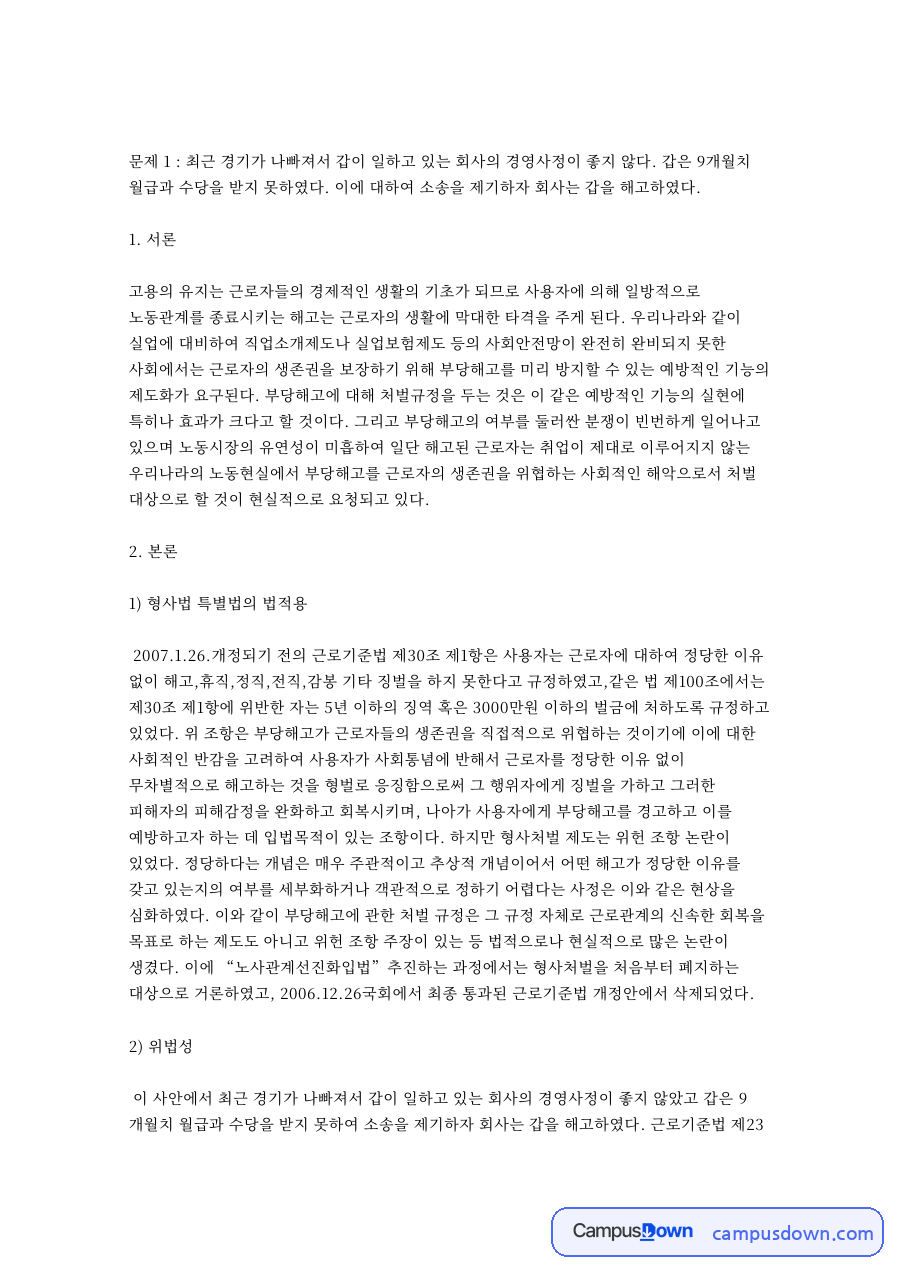
Page 1 is shown as is; from page 2 on, the preview is blurred. Buy it to download the complete original file right away (the file itself is written in Korean).
Packed with real examples and experience. Download it now and save time.
Save your valuable time
Buyer ratings
Fast, accurate and useful.
No ratings yet. Be the first to rate it.


1 / 5
좌우로 밀어서 페이지를 넘겨보세요
과제 개요
| 전체 페이지 수 | 5페이지 |
|---|---|
| 파일 형식 | 한글(HWP) |
| 등록일 | 2025.07.17 |
캠퍼스다운 도움말
해당 자료는 No AI 자료입니다. 인싸이트를 얻고 새롭게 가공해 보세요.
자료를 받아서 이용하면 품질이 확 올라갑니다.
- 임금체불
- 부당해고
- 정리해고 요건
- 근로기준법 제24조
- 이해상반행위
- 특별대리인
- 친권자
- 민법 제921조
- 노동법
Fired After Suing for Unpaid Wages, and a Parent's Conflict of Interest: Korean Labor Standards Act Articles 23-24 and Civil Code Article 921
※ You can preview page 1 as is. Buy it to download the complete original file right away. The file itself is written in Korean.
■ Fired After Suing for Unpaid Wages, and a Parent's Conflict of Interest: Korean Labor Standards Act Articles 23-24 and Civil Code Article 921 — Overview
A 5-page Korean law paper solving two cases. In the first, a worker who sued over nine months of unpaid wages is fired; the paper covers the end of criminal penalties for unfair dismissal and the four conditions for layoffs for business reasons. In the second, a father wants to pledge his 13-year-old son's inherited property for his own loan, which requires a court-appointed special representative.
■ Fired After Suing for Unpaid Wages, and a Parent's Conflict of Interest: Korean Labor Standards Act Articles 23-24 and Civil Code Article 921 — Excerpt from the original document (English translation)
The case law takes the formal judgment theory. That is, “an 'act of conflicting interests' under Article 921 of the Civil Code refers to an act that, by its objective nature, carries a risk of a conflict of interests between the person with parental authority and the child, or among several children under that parental authority, regardless of the intent of the person with parental authority or whether a conflict of interests actually resulted.” Following this position, the court held that it was not an act of conflicting interests where the legal mother, as the person with parental authority over a minor child born outside marriage, jointly inherited from her husband together with that minor child and an adult child born in the marriage, then renounced her own inheritance and at the same time renounced the inheritance on behalf of the minor child born outside marriage, so that the adult child born in the marriage became the sole heir.
In this case, Cheol-su, who is 13, received real estate worth 2 billion won by will from his grandfather Gap. Cheol-su's father Man-su, in the course of taking out a loan from Kookmin Bank for his business, wants to take out the loan using Cheol-su's real estate as collateral. Cheol-su's mother Young-ja and Man-su finished filing for divorce by agreement yesterday. An act of conflicting interests means “an act that benefits the person with parental authority and disadvantages the minor” or “an act that benefits one of the children under parental authority and disadvantages another.” It does not matter whether it is a contract or a unilateral act, whether it concerns property interests or status interests, and litigation acts are included. The Civil Code has no express provision on the effect when a legal representative performs an act of conflicting interests without appointing a special representative, but it is generally regarded as unauthorized agency, since the person with parental authority acted as agent in a matter outside the scope of their power of representation. Therefore it can be treated as valid if the minor ratifies it after reaching adulthood.
Legal acts with a minor require the consent of the legal representative (Civil Code Article 5(1)). A unilateral act with a minor without consent can be cancelled by the minor or the legal representative. Parents exercising parental authority must give consent jointly (Civil Code Article 909(2)). If the parents are divorced, the consent of the parent designated by agreement as the person with parental authority is needed, and if no agreement is reached, the consent of the person with parental authority decided by the family court is needed (Civil Code Article 909(4)). If one parent cannot exercise parental authority for specific reasons such as serious illness, long absence or mental incapacity, the consent of the other parent is enough (Civil Code Article 909(3)). If there is no person with parental authority or parental authority cannot be used, a guardian is appointed and the guardian can consent or act as agent. However, the guardian's acts require the consent of the family council (Civil Code Article 950).
To add: firing a worker merely for demanding wages or filing a lawsuit is an unfair dismissal without just cause under Article 23 of the Labor Standards Act, and the worker can apply for relief to the Labor Relations Commission within three months of the dismissal. Nonpayment of wages itself is subject to imprisonment of up to three years or a fine of up to 30 million won under Article 109 of the Labor Standards Act. In the second case, the statement that a guardian's acts require the consent of the family council is outdated: the July 2013 Civil Code amendment abolished the family council and replaced it with the guardianship supervisor system, so update it to current law.
■ Fired After Suing for Unpaid Wages, and a Parent's Conflict of Interest: Korean Labor Standards Act Articles 23-24 and Civil Code Article 921 — Contents and key concepts
Can a company fire a worker for suing over unpaid wages?
✦ At a glance
- Unfair dismissal and a parent's conflict of interest
- Structure: case 1 labor law → case 2 family law
- Useful for labor law and civil law case practice
☰ What the paper covers
- Criminal penalty for unfair dismissal and its repeal
- Articles 23 and 24 of the Labor Standards Act
- Urgent business need and efforts to avoid layoffs
- Civil Code Article 921 conflicts of interest
- Special representatives and parental consent
✎ How Korea and the U.S. handle these issues
In Korea, a dismissal without just cause can be challenged before the Labor Relations Commission within three months, and unpaid wages can lead to criminal fines or prison.
Most U.S. jobs are at-will, but firing a worker for complaining about unpaid wages is illegal retaliation under the Fair Labor Standards Act.
Note: the paper itself is written in Korean and discusses Korean law. This page is general study information, not legal advice.
■ Fired After Suing for Unpaid Wages, and a Parent's Conflict of Interest: Korean Labor Standards Act Articles 23-24 and Civil Code Article 921 References
- 김은아. "프랑스법에서의 친권남용에 관한 연구 - 프랑스의 친권남용에 대한 해결방법과 우리법과의 비교 및 개선방향에 관하여 -." 경희법학 54.4 (2019): 147-181.
- 김은아(Kim Eun-Ah).
- "미성년자녀의 재산에 대한 친권자의 대리권 행사범위와 그 한계 : 독일, 프랑스, 일본법과의 법제 비교를 중심으로." 가족법연구 34.3 (2020): 25-58.
Keyword Prompt
전문가가 만들었어요과제를 직접 쓰는 데 도움이 되는 영어 프롬프트예요.
Tip! Prompt 에 자신의 생각을 추가해서 하면 훨씬 더 ✨ 좋습니다.
캠퍼스다운에서 레포트 받고 잘 쓰는 법 3가지, AI로 참고자료 제대로 재가공하기 →Prompt 1
I'm writing a university assignment on "임금체불 소송 뒤 해고와 정리해고 요건, 친권자 이해상반행위: 근로기준법 제23조·제24조와 민법 제921조". Help me build an outline (introduction, 2-3 body sections, conclusion) that covers 임금체불, 부당해고 and 정리해고 요건. Don't write the paper for me - give me guiding questions for each section. My own perspective: [자신의 생각 넣는 곳] Please respond in Korean.
Prompt 2
Explain the key concepts "임금체불" and "부당해고" in simple terms, then show how they connect to the topic "임금체불 소송 뒤 해고와 정리해고 요건, 친권자 이해상반행위: 근로기준법 제23조·제24조와 민법 제921조". Point out common misunderstandings students have about them. My own perspective: [자신의 생각 넣는 곳] Please respond in Korean.
Prompt 3
Suggest 3 real-world cases or examples I could analyze in an assignment on "임금체불 소송 뒤 해고와 정리해고 요건, 친권자 이해상반행위: 근로기준법 제23조·제24조와 민법 제921조", focusing on "정리해고 요건". For each, tell me what I should look up and verify in official or academic sources. My own perspective: [자신의 생각 넣는 곳] Please respond in Korean.
Prompt 4
Review my draft paragraph on "임금체불 소송 뒤 해고와 정리해고 요건, 친권자 이해상반행위: 근로기준법 제23조·제24조와 민법 제921조" (key idea: "근로기준법 제24조"). Give feedback on logic, evidence and clarity, and mark where I need a citation. My paragraph: [paste here] My own perspective: [자신의 생각 넣는 곳] Please respond in Korean.
Take a break with a quick personality test?
Ranked by actual participation. Results in about a minute.
Loading…
Most-read content
Loading view counts…

Campusdown is a lifelong-learning community in Korea offering study materials, information on government support, student loans and scholarships, and more. Don't miss our free resources.
Go to the Campusdown home page →Refund policy
- Change of mind / refund requested after partial use / more than 7 days after purchase
◆ Exceptions
- File errors / cannot download or open the file
◆ How to request a refund: send a 1:1 inquiry via Customer Service at the top