
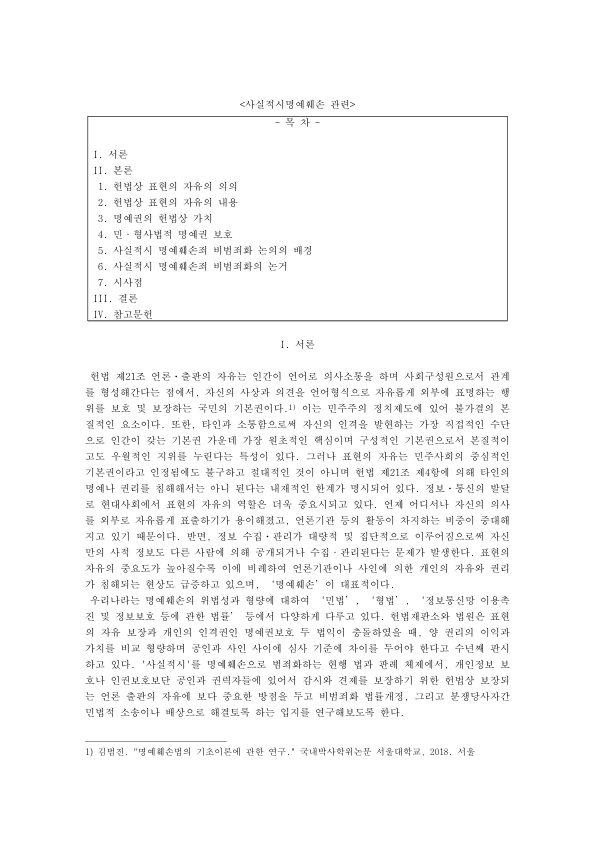
Page 1 is shown as is; from page 2 on, the preview is blurred. Buy it to download the complete original file right away (the file itself is written in Korean).
Packed with real examples and experience. Download it now and save time.
Save your valuable time
Buyer ratings
Fast, accurate and useful.
No ratings yet. Be the first to rate it.


Decriminalizing Truthful Defamation in Korea: Freedom of Expression, the Right to Reputation and Article 307(1) of the Criminal Act
※ You can preview page 1 as is. Buy it to download the complete original file right away. The file itself is written in Korean.
■ Decriminalizing Truthful Defamation in Korea: Freedom of Expression, the Right to Reputation and Article 307(1) of the Criminal Act — Overview
A Korean constitutional and criminal law paper on whether Article 307(1) of the Criminal Act, which punishes defamation even by stating true facts, should be abolished. It covers the meaning and scope of freedom of expression, the constitutional basis of the right to reputation (Articles 10, 17 and 21(4)), civil and criminal protection of reputation, and the arguments and implications of decriminalization.
■ Decriminalizing Truthful Defamation in Korea: Freedom of Expression, the Right to Reputation and Article 307(1) of the Criminal Act — Excerpt from the original document (English translation)
For example, consider an employer who has failed to pay wages, where the workers inform the press of the unpaid wages. If the fact of unpaid wages were protected as privacy, then, since criminal acts are carried out away from others' eyes and are not voluntarily disclosed, all of them would have to be protected as privacy. Yet in Korea, disclosing the fact of unpaid wages is also subject to criminal punishment as defamation by stating facts. Of course, where, while disclosing the unpaid wages, separate personal information such as the employer's address or family relations is disclosed, a separate sanction for infringing privacy would be needed. But the existence of defamation by stating facts, even though it lies outside the scope of privacy protection, suppresses freedom of expression by preventing the fact of unpaid wages itself from being revealed.
Since Korea does not yet clearly have separate civil or criminal provisions protecting privacy, Article 307(1) of the Criminal Act can be used. For example, there was a case in which a person who violated the Public Official Election Act identified the informant who had reported him to the election commission and disclosed it to his fellow party members, and he was punished under Article 307(1) of the Criminal Act. In such a case, where there is no separate criminal provision punishing invasion of privacy, applying that provision to protect an informant's identity, which should be protected as a secret, is considered appropriate. However, applying Article 307(1) on the ground of defamation rather than invasion of privacy can create the problem of "false reputation." Therefore, if Article 307(1) of the Criminal Act is to be maintained with the aim of protecting privacy, there is a need to narrow the provision's scope of application, either by legislation or by an accurate interpretation by the Supreme Court.
The system of punishing defamation by stating facts collapses the basis for the free existence of individual thought by punishing the utterance of facts. If a claim that has emerged as fact through competition in the free marketplace of ideas is restricted because it lowers another's reputation, that competition becomes useless and the free marketplace of ideas loses its reason to exist.
In Korea, discussion continues on whether defamation by stating facts must be punished criminally even though civil remedies such as damages are available.
In 2006, the European Court of Human Rights reviewed cases in which journalists who criticized the government or politicians were criminally punished for defamation, and decided that imposing prison sentences for defamation is an excessive penalty because it restricts the public's right to know and freedom of the press. The reason the abolition of the crime of defamation by stating facts under criminal law continues to be discussed is probably that, in most countries, criminal defamation is abused to maintain the government regime. Thanks to it, those in power can suppress criticism from the press or the public with taxpayers' money rather than their own. Therefore, in defamation-by-stating-facts suits concerning public officials, constitutional freedom of expression should be emphasized more, so that even where public interest has not been proven as a ground for excluding unlawfulness, if the content concerns a fact related to the public interest and there was a justifiable reason to believe the stated fact was true, unlawfulness should be excluded, emphasizing the role of public officials as a public duty.
The core of freedom of expression is not "the freedom to say what others like to hear," but "the freedom to say even what others do not want to hear."
Whether to keep or abolish the crime of defamation by stating facts is a representative constitutional issue in which freedom of expression and personality rights collide head-on, so it is regularly covered in constitutional law, criminal law and media law assignments and debate classes. Comparing the Constitutional Court's 2021 decision upholding constitutionality and its dissenting opinion, and the public-interest standard of Article 310 of the Criminal Act, with this material's arguments for decriminalization lets you complete a well-grounded paper from either side. In particular, the logic distinguishing privacy protection from reputation protection can be applied to various cases such as celebrity reporting, online reviews and whistleblowing, which is also useful for broadening the issues in a debate presentation.
■ Decriminalizing Truthful Defamation in Korea: Freedom of Expression, the Right to Reputation and Article 307(1) of the Criminal Act — Contents and key concepts
Decriminalizing Truthful Defamation in Korea
✦ At a glance
- Should stating true facts be a crime?
- Structure: free speech → reputation → protection → decriminalization debate
- Useful for constitutional rights and criminal law debates
☰ What the paper covers
- Freedom of expression and the right to know
- Constitutional basis of reputation
- Civil and criminal protection
- Arguments for decriminalization
✎ Background in brief
Korean law can punish defamation by true facts, subject to a public interest defense in Article 310.
The Constitutional Court upheld Article 307(1) in 2021, but the debate continues.
Note: the paper itself is written in Korean and discusses Korean law. This page is general study information, not legal advice.
Related wiki: Truth as a Defense to Defamation
■ Decriminalizing Truthful Defamation in Korea: Freedom of Expression, the Right to Reputation and Article 307(1) of the Criminal Act References
- 김범진. "명예훼손법의 기초이론에 관한 연구." 국내박사학위논문 서울대학교, 2018.
- 서울 이예찬. "명예훼손 보도에 대한 제삼자 효과 연구." 국내석사학위논문 고려대학교 언론대학원, 2020.
- 서울 박경원. "헌법상 인터넷 명예훼손과 해결방안에 관한 연구." 국내석사학위논문 부경대학교, 2021.
- 부산 임슬기. "명예에 관한 죄의 신종 행위유형 연구." 국내석사학위논문 이화여자대학교 대학원, 2019.
- 서울 최란. "형법이 보호해야 하는 명예." 국내박사학위논문 고려대학교 대학원, 2020.
- 서울 최해강. "표현의 자유와 공인의 명예권 보호에 관한 연구." 국내석사학위논문 동국대학교 일반대학원, 2023.
- 서울 이흔양. "중국 인터넷에서 공인 명예권 침해 사건에 대한 판결분석." 국내석사학위논문 한양대학교 대학원, 2020.
- 서울 이문한. "가짜뉴스 등 허위사실 표현에 대한 형사적 규제와 그 헌법적 한계." 국내박사학위논문 한양대학교 대학원, 2020.
- 서울 이준석. "SNS상의 표현의 자유와 보호 법익에 관한 연구." 국내박사학위논문 강원대학교 대학원, 2020.
- 강원도 하영록. "언론에 의한 인격권 침해에 대한 사법적 구제에 관한 연구." 국내석사학위논문 숭실대학교, 2019.
- 서울 김민주. "표현의 자유와 인격권 보장에 관한 연구." 국내박사학위논문 동국대학교 일반대학원, 2022.
- 서울 송상현. "가짜뉴스에 대한 규범적·기술적 규제방안 연구." 국내박사학위논문 성균관대학교 일반대학원, 2020.
- 서울 송채은. "강력범죄 피의자의 신상 정보는 어떻게 사회적으로 소통되는가?." 국내석사학위논문 서울대학교 대학원, 2022.
- 서울 윤경호. "언론보도로 인한 연예인의 프라이버시권 침해와 보호 방안에 관한 연구." 국내박사학위논문 동국대학교, 2018.
- 서울 강정민. "가짜뉴스 규제에 관한 헌법적 연구." 국내석사학위논문 서울대학교 대학원, 2020. 서울
Take a break with a quick personality test?
Ranked by actual participation. Results in about a minute.
Loading…
Most-read content
Loading view counts…

Campusdown is a lifelong-learning community in Korea offering study materials, information on government support, student loans and scholarships, and more. Don't miss our free resources.
Go to the Campusdown home page →Refund policy
- Change of mind / refund requested after partial use / more than 7 days after purchase
◆ Exceptions
- File errors / cannot download or open the file
◆ How to request a refund: send a 1:1 inquiry via Customer Service at the top