
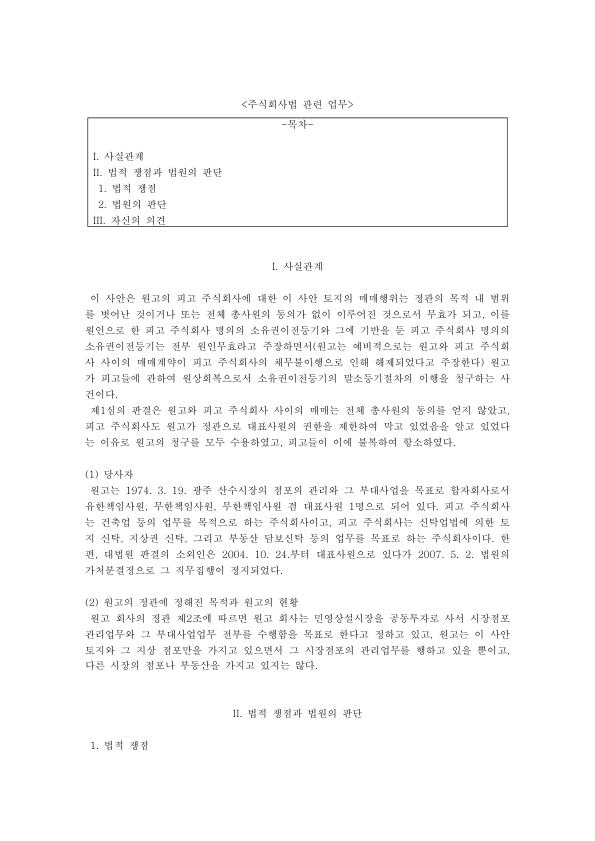
Page 1 is shown as is; from page 2 on, the preview is blurred. Buy it to download the complete original file right away (the file itself is written in Korean).
Packed with real examples and experience. Download it now and save time.
Save your valuable time
Buyer ratings
Fast, accurate and useful.
No ratings yet. Be the first to rate it.


Corporate Capacity and the Objects Clause: A Korean Supreme Court Case on a Limited Partnership Company Selling Its Only Land (2009Da63236)
※ You can preview page 1 as is. Buy it to download the complete original file right away. The file itself is written in Korean.
■ Corporate Capacity and the Objects Clause: A Korean Supreme Court Case on a Limited Partnership Company Selling Its Only Land (2009Da63236) — Overview
A 6-page Korean company law case study. A limited partnership company (hapja hoesa) that managed a market building in Gwangju sold its only land while it was already in auction proceedings. The company argued the sale was outside the objects in its articles and lacked the consent of all members. The paper sets out the facts, the issues, the appellate court reasoning that the sale was void, and the Supreme Court's broader test (acts directly or indirectly necessary to pursue the objects, judged by their objective nature).
It also covers Article 35 of the Civil Act on tort liability of juristic persons.
■ Corporate Capacity and the Objects Clause: A Korean Supreme Court Case on a Limited Partnership Company Selling Its Only Land (2009Da63236) — Excerpt from the original document (English translation)
A company has rights and bears obligations within the scope of the purpose stated in its articles of incorporation; accordingly, its capacity to act and its representative's power of representation are necessarily limited to that scope, and an act performed by its organ outside the scope of the purpose does not belong to the company and is void. Under the plaintiff company's articles of incorporation, where the company has no choice but to dissolve, it must dissolve with the consent of all members and proceed to liquidation.
Moreover, the act of the plaintiff's representative in disposing of the land in this case, which is the very basis of the company's existence, would make it impossible for the plaintiff to carry out the market-store management business that is the purpose in its articles, or would deny the company's existence, producing in substance the same result as dissolving the plaintiff. In light of this, the sale of the land in this case between the plaintiff's representative member (a non-party) and the defendant company cannot be regarded, even judging by the statement of purpose in the plaintiff's articles, as an act objectively and abstractly necessary for the articles' purposes of market-store management and ancillary business. It is therefore proper to hold that the sale falls outside the scope of the plaintiff's purpose and has no effect.
The defendants argue that the plaintiff cannot assert, against the defendants as bona fide third parties, the restriction it placed on its representative member's authority in its articles. However, the defendants' argument holds only where the legal act of the plaintiff's representative falls within the scope of the plaintiff's legal capacity; where the representative goes beyond the company's purpose and performs an act for which it has no legal capacity, the act is entirely without effect regardless of whether the other party knew of those circumstances.
Article 13 of the plaintiff company's articles of incorporation does provide as if the plaintiff's organs could perform acts outside the scope of the purpose if they obtain the consent of all members. But interpreting it that way would violate Article 34 of the Civil Act, so it is appropriate to read the provision not as setting requirements under which an act outside the scope of the purpose becomes valid, but as meaning that, where the company's organ has performed such an act, the consent of all members can ratify an act that is void for lack of legal capacity. Therefore, the ownership transfer registration in the defendant company's name made on this basis, and the ownership transfer registration to the defendant company based on it, are both registrations void for lack of a valid cause.
As to the scope in which the defendant company's defense of simultaneous performance holds: where a bilateral contract becomes void and the parties must return what each has obtained, compelling only one party to perform its duty of restitution first would be contrary to fairness and the principle of good faith, so the parties' duties of restitution stand in a relationship of simultaneous performance. The defendant company raises a defense on whether its defense of simultaneous performance is established.
The defendant argues, to the effect of simultaneous performance, that it need not respond to the plaintiff's claim until the plaintiff returns to the defendant company the purchase price the defendant company paid to the non-party company and others. However, the defendant company's duty to the plaintiff to carry out the procedure for cancelling the ownership transfer registration of the land in this case and the plaintiff's duty to the defendant company to return the purchase price cannot be said to be obligations in a relationship of simultaneous performance.
For reference, the Commercial Act has no express provision like Article 34 of the Civil Act, so there has long been a split between the view that a company's legal capacity is limited by the purpose in its articles and the view that it is not. The courts recognize the limitation but interpret the scope of the purpose very broadly, in effect leaning toward protecting the security of transactions. If you organize the reasons the Supreme Court reversed the lower court in Decision 2009Da63236 in connection with this doctrinal split, you can easily build the framework of a company-law assignment or a case-comment presentation. It is even better to read it alongside the lower court's judgment.
■ Corporate Capacity and the Objects Clause: A Korean Supreme Court Case on a Limited Partnership Company Selling Its Only Land (2009Da63236) — Contents and key concepts
Is selling a company's only land within the objects of its articles?
✦ At a glance
- The scope of corporate capacity under the objects clause
- Structure: facts → issues and rulings → author's opinion
- Useful for company law and civil law general part assignments
☰ What the paper covers
- Facts: market management company and a land sale during auction
- Appellate court: sale void as a de facto dissolution
- Supreme Court: broad test based on the objective nature of the act
- Representative authority limits and protection of third parties
✎ Capacity of juristic persons in Korean law
Article 34 of the Korean Civil Act limits a juristic person's capacity to the objects in its articles. Acts outside that scope are void even if the other party acted in good faith.
Korean courts apply this to companies but read the objects very broadly to protect transactions, which is why the Supreme Court reversed the lower court here.
Note: the paper itself is written in Korean and discusses Korean law. This page is general study information, not legal advice.
Related wiki: Piercing the Corporate Veil
Take a break with a quick personality test?
Ranked by actual participation. Results in about a minute.
Loading…
Most-read content
Loading view counts…

Campusdown is a lifelong-learning community in Korea offering study materials, information on government support, student loans and scholarships, and more. Don't miss our free resources.
Go to the Campusdown home page →Refund policy
- Change of mind / refund requested after partial use / more than 7 days after purchase
◆ Exceptions
- File errors / cannot download or open the file
◆ How to request a refund: send a 1:1 inquiry via Customer Service at the top