
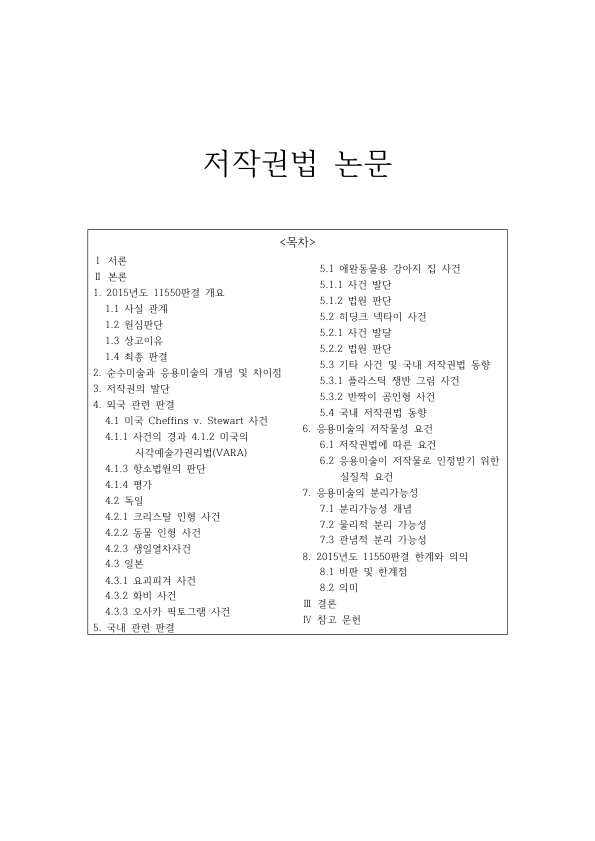
Page 1 is shown as is; from page 2 on, the preview is blurred. Buy it to download the complete original file right away (the file itself is written in Korean).
Packed with real examples and experience. Download it now and save time.
Save your valuable time
Buyer ratings
Fast, accurate and useful.
No ratings yet. Be the first to rate it.


Copyright for Applied Art and Characters in Korea: Supreme Court Case 2015Do11550, Separability, and U.S., German and Japanese Comparisons
※ You can preview page 1 as is. Buy it to download the complete original file right away. The file itself is written in Korean.
■ Copyright for Applied Art and Characters in Korea: Supreme Court Case 2015Do11550, Separability, and U.S., German and Japanese Comparisons — Overview
A 20-page Korean copyright paper on when designs used on products count as protected works. It analyzes Supreme Court Decision 2015Do11550 (December 10, 2015) on imported knockoff dolls of a Japanese rabbit character, contrasts fine art and applied art, compares U.S., German and Japanese cases, reviews Korean rulings on a dog house, a necktie pattern, a tray and a teddy bear, and explains the separability requirement in Article 2(15) of the Copyright Act.
■ Copyright for Applied Art and Characters in Korea: Supreme Court Case 2015Do11550, Separability, and U.S., German and Japanese Comparisons — Excerpt from the original document (English translation)
In 2000, the plaintiff and the defendant information center concluded a contract for the use of the pictograms in this case, with a term of one year starting March 31, 2000, extended for one year if neither party objected by one month before the contract ended, and the same method applying thereafter. Meanwhile, the defendant information center's purpose in concluding the contract to use the pictograms was to display them on tourist information signs installed by the City of Osaka on August 31, 2000. Later, in May 2011, the plaintiff and the defendant information center disagreed over the use of the pictograms and failed to reach an agreement, so the defendant information center decided to stop using the pictograms. The plaintiff then demanded, on the basis of the duty to restore the original state, the removal of the pictograms as well as payment of damages.
The court held that, under Article 2(1)(ii) of the Japanese Copyright Act, a work is a creative expression of thoughts or sentiments, and further stated that the pictograms in this case belong to the category of applied art because they function to make it easy for people to understand the target facilities through their visual sense. It also acknowledged that, because a pictogram is a sign that visualizes a concept based on the shape of the object it depicts, it cannot depart from the shape of the target facility, so the scope for creativity is limited. Considering these points comprehensively, the court held that the pictograms were copyrightable, on the ground that they expressed the plaintiff's individuality and creativity and were also excellent functionally, and so qualified as applied art.
Park Yun-jeong, [2016-08 Japan] Osaka District Court recognizes the copyrightability of "pictograms" for the first time in Japan, Copyright Trends, Korea Copyright Commission, 2016.
This case concerns whether the shape of a pet dog house is protected by copyright. The original creator created a pet dog house (the "work in this case") resembling the shape of the character Mickey Mouse or a panda. It is spherical overall, its bottom is flat and round, and at the front is a large round opening that can be used as an entrance. Seen as a whole, decorations shaped like ears are attached to the top. A band wraps around the middle of the exterior, excluding the entrance. The original creator registered it with the Korea Copyright Commission under the title "Showy."
Later, the plaintiff transferred the economic rights in the work to the defendant in this case and completed registration of the copyright transfer. Meanwhile, the plaintiff made and sold dog houses with shapes similar or identical to the work. The defendant then, on the basis of being the holder of the economic rights in the work, demanded that the plaintiff stop producing and selling products identical or similar to the work. In addition, it applied for a payment order for damages, demanding that the plaintiff and those who bought the similar or identical dog houses stop infringing the copyright in the work.
The plaintiff filed a lawsuit claiming that no copyright existed, arguing that the work does not qualify under the Copyright Act. Its arguments were that the work lacks originality because it simply imitated and gave shape to "Mickey Mouse," the signature character of the world-famous Walt Disney company, and that it cannot be recognized as a work because the independence from the article used is not recognized, so it cannot be regarded as a work of applied art. Accordingly, whether the work in this case is copyrightable emerged as the main issue.
Article 4(11)(4) of the Copyright Act sets out works of applied art as one area of works. In addition, Article 2(15) of the Act defines a work of applied art as "a work of art, including a design, that can be reproduced in identical form on articles and whose independence can be recognized as distinct from the article in which it is used." In other words, to be recognized as a work of applied art protected by the Copyright Act, the requirements of reproducibility and separability must be met. The details of this will be covered next.
On this basis, the court considered that the work in this case can be said to belong to works of applied art, and that, considering its shape, components, arrangement and form, it cannot be said to lack aesthetic elements entirely, but it is difficult to regard it as conceptually departing from a utilitarian article so as to be applied to other utilitarian articles, or as a means of artistic appreciation in itself.
For reference, where part of the material says Article 4(11)(4) of the Copyright Act, it refers to Article 4(1)(4) (works of art, including works of applied art). It is also good to check the number of the wholly amended act mentioned in the introduction in the legislative history at the National Law Information Center. In its 2017 decision Star Athletica v. Varsity Brands, the U.S. Supreme Court set out the separability test under which the design of a useful article is protected if it can be perceived as an independent work of art separate from the article, so try citing it in the comparison section as well.
■ Copyright for Applied Art and Characters in Korea: Supreme Court Case 2015Do11550, Separability, and U.S., German and Japanese Comparisons — Contents and key concepts
When is a design on a product protected by copyright?
✦ At a glance
- Copyright for applied art and characters
- Structure: key case → concepts → foreign law → Korean cases → separability
- Useful for IP and copyright coursework
☰ What the paper covers
- The 2015Do11550 rabbit character case
- Fine art vs. applied art
- U.S., German and Japanese approaches
- Four Korean cases
- Separability and the case's limits
✎ Separability in Korea and the U.S.
Korea's Copyright Act protects applied art only when it can be recognized as independent from the article it appears on, which courts test through physical or conceptual separability.
The U.S. Supreme Court set a similar test in Star Athletica, L.L.C. v. Varsity Brands, Inc., 580 U.S. 405 (2017): a design feature is protectable if it can be perceived as a work of art separate from the useful article.
Note: the paper itself is written in Korean and discusses Korean law. This page is general study information, not legal advice.
Related wiki: Patent Trolls
Related wiki: Fair Use
■ Copyright for Applied Art and Characters in Korea: Supreme Court Case 2015Do11550, Separability, and U.S., German and Japanese Comparisons References
- 두산백과, 저작권법, URL : http://terms.naver.com/entry.nhn?docId=1139063&cid=40942&categoryId=31707 박윤정, 국내 2015년 12월 주요 저작권 판례, pp.1-2, 저작권 동향, 한국저작권위원회, 2016.
- 순수미술, 한문명백과 : 예술체육, URL:http://terms.naver.com/entry.nhn?docId=2055345&cid=44415&categoryId=44415 차상육, 응용미술의 저작권법상 보호에 관한 연구, pp.5-7, 한양대학교 박사 학위논문, 2010.
- 장용길, 韓國 美術 저작권의 효율적 이용 제도 硏究 : 韓國 미술 저작물 등록 ∙ 저작권 신탁제도 설립 제안을 중심으로, pp.10, pp.31, 계명대학교 석사 학위논문, 2010.
- 박경신, 법원, 스페인 대형 범선으로 변형된 버스는 VARA의 보호대상인 시각예술저작물에 해당하지 않는다. 저작권 동향 2016년 제 12호, 2016.
- 차상육, 판례상 수수미술과 응용미술의 구별 -대법원 2015. 12. 10.
- 선고 2015도 11550 판결을 중심으로, pp.12 박윤정, [2016-08 일본] 오사카 지방법원, 일본 최초로‘픽토그램’의 저작물성을 인정함, 저작권동향, 한국저작권위원회, 2016.
- 히딩크 넥타이’ 도안의 저작물성(긍정), 한국저작권위원회, URL : http://www.copyright.or.kr/customer/counsel/copyright-information/copyright-case-law/detail.do?pageIndex=4&precedentSeq=73&searchTarget=&searchText= 이종민, 진종일, 응용미술품의 저작물성 판단 기준에 대한 소고 : 서울중앙지방법원 2014. 1. 29.
- 선고 2012가합543317 판결에 대한 평석을 중심으로, pp.246-247, 서강법률논총 서강법률논총 제3권 제2호 239p ~ 260p, 2014.
- 이동기, 응용미술과 디자인의 권리 보호 체계 : 저작권법과 디자인보호법의 적용 문제, pp.451-452, 원광법학 제24권 제3호 (2008년 9월) pp.443-468, 2008.
- 차상육, 동물 캐릭터의 저작물성 판단 기준, 사건과 판례, 공감·동감·묻다·듣다 생생 뉴스, URL:http://copyright.ecatalog.kr/src/viewer/main.php?host=main&site=20160513_003144_9&category=1&page=1
- 법률신문 뉴스(2016.07.28.), [2015년 분야별 중요판례분석] (22) 지식재산법, URL : https://www.lawtimes.co.kr/Legal-News/Legal-News-View?Serial=102197&kind=AK&key=
Take a break with a quick personality test?
Ranked by actual participation. Results in about a minute.
Loading…
Most-read content
Loading view counts…

Campusdown is a lifelong-learning community in Korea offering study materials, information on government support, student loans and scholarships, and more. Don't miss our free resources.
Go to the Campusdown home page →Refund policy
- Change of mind / refund requested after partial use / more than 7 days after purchase
◆ Exceptions
- File errors / cannot download or open the file
◆ How to request a refund: send a 1:1 inquiry via Customer Service at the top