
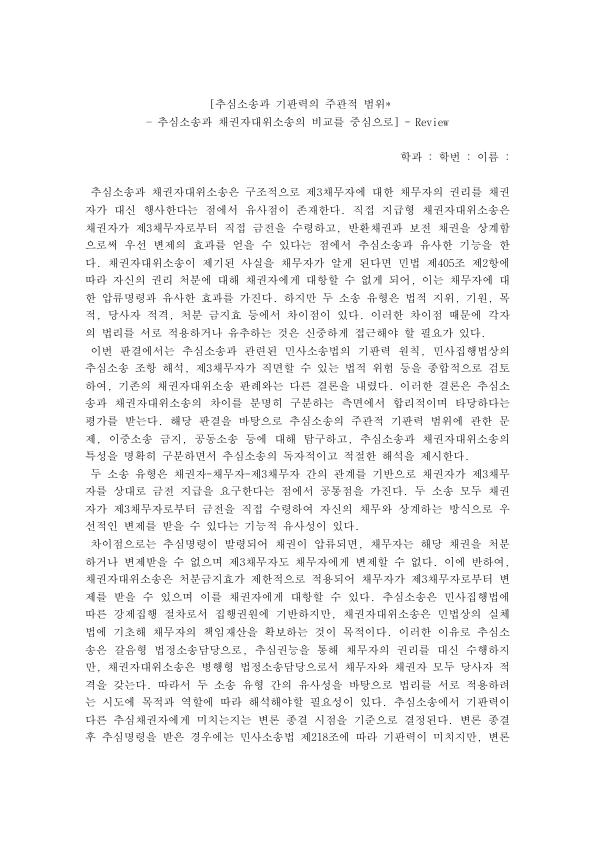
Page 1 is shown as is; from page 2 on, the preview is blurred. Buy it to download the complete original file right away (the file itself is written in Korean).
Packed with real examples and experience. Download it now and save time.
Save your valuable time
Buyer ratings
Fast, accurate and useful.
No ratings yet. Be the first to rate it.


Collection Suits and the Subjective Scope of Res Judicata in Korea: Comparison with Creditor Subrogation Suits
※ You can preview page 1 as is. Buy it to download the complete original file right away. The file itself is written in Korean.
■ Collection Suits and the Subjective Scope of Res Judicata in Korea: Comparison with Creditor Subrogation Suits — Overview
A Korean civil procedure case review comparing a collection suit by a creditor holding a collection order with a creditor subrogation suit. It sets out their structural similarities and differences (enforcement title, prohibition on disposal, substitution versus parallel litigation) and explains how those differences lead to different results on res judicata, bar on re-filing, duplicate suits and joinder, with a critical evaluation of the Supreme Court judgment.
■ Collection Suits and the Subjective Scope of Res Judicata in Korea: Comparison with Creditor Subrogation Suits — Excerpt from the original document (English translation)
Next is the problem of duplicate suits. Where the debtor has already filed suit against the third-party debtor and the collecting creditor files a collection suit against the same third-party debtor, whether it is a duplicate suit is disputed. The Supreme Court held that, because the debtor's suit becomes improper under the collection order, the collection suit does not constitute a duplicate suit. Since it is a special relationship in which the debtor loses the authority to conduct the litigation, a suit filed by the collecting creditor after the suit filed by the debtor is not a duplicate suit.
Finally, there is the problem of joint litigation and intervention. Where several collecting creditors file collection suits against the third-party debtor over the same seized claim, or another collecting creditor intervenes in an existing suit, the question is how to define their litigation relationship. Article 249(2) of the Civil Execution Act expressly provides that all creditors may join the plaintiff's side as co-litigants, allowing all creditors to participate in the collection suit. This provision presupposes that the effects of the judgment, such as res judicata, will extend to the participants.
The case law held that the res judicata of a collection suit does not extend to other creditors who received collection orders before the close of pleadings, but where several collecting creditors jointly file suit over the same seized claim, it is reasonable to regard it as quasi-compulsory joint litigation. This is an interpretation consistent with Article 249 of the Civil Execution Act.
The difference between collection suits and creditor's subrogation suits is where the Civil Execution Act and the Civil Act meet, so it frequently appears on exams and assignments. Reading Article 218 of the Civil Procedure Act, which sets the subjective scope of res judicata, together with Article 249 of the Civil Execution Act, which provides for collection suits and orders to participate, makes it clearer why the case law used the close of pleadings as the reference point, and lets you build arguments for and against in a balanced way in a case-comment assignment. In particular, the distinction between substitutive and parallel litigation on another's behalf connects directly to the issue of standing, so studying it together with the unit on parties in civil procedure deepens your understanding considerably.
■ Collection Suits and the Subjective Scope of Res Judicata in Korea: Comparison with Creditor Subrogation Suits — Contents and key concepts
Collection Suits and the Subjective Scope of Res Judicata in Korea
✦ At a glance
- How far res judicata reaches in collection suits
- Structure: similarities → differences → re-filing → duplicate suits → evaluation
- Useful for civil procedure and civil execution assignments
☰ What the paper covers
- Triangular structure of both suits
- Key differences in effect and authority
- Bar on re-filing by other collecting creditors
- Joinder and intervention under the Civil Execution Act
✎ Background in brief
A collection order lets a creditor sue the debtor's debtor directly, while a subrogation suit exercises the debtor's right on the creditor's own initiative.
Because they start from different legal bases, the binding effect of the judgment on others differs.
Note: the paper itself is written in Korean and discusses Korean law. This page is general study information, not legal advice.
Related wiki: Res Judicata
Take a break with a quick personality test?
Ranked by actual participation. Results in about a minute.
Loading…
Most-read content
Loading view counts…

Campusdown is a lifelong-learning community in Korea offering study materials, information on government support, student loans and scholarships, and more. Don't miss our free resources.
Go to the Campusdown home page →Refund policy
- Change of mind / refund requested after partial use / more than 7 days after purchase
◆ Exceptions
- File errors / cannot download or open the file
◆ How to request a refund: send a 1:1 inquiry via Customer Service at the top