
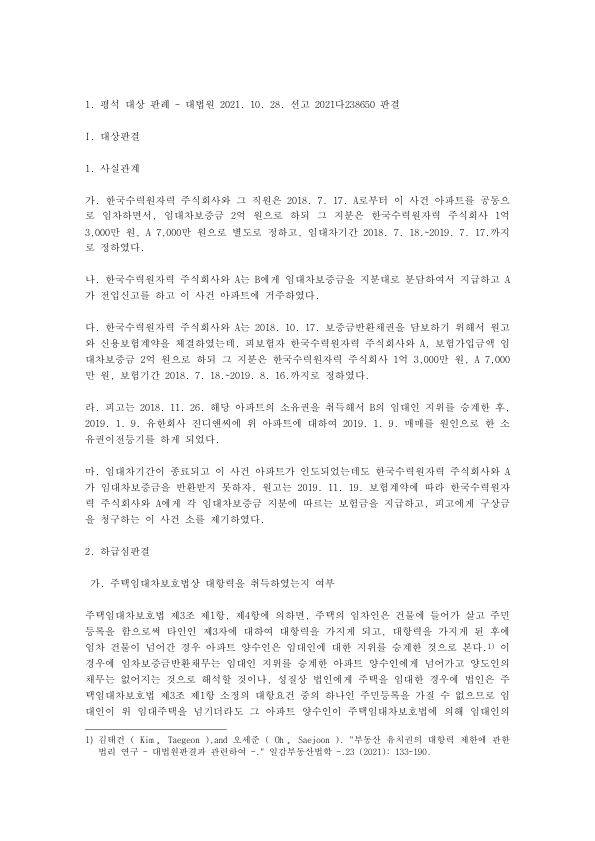
Page 1 is shown as is; from page 2 on, the preview is blurred. Buy it to download the complete original file right away (the file itself is written in Korean).
Packed with real examples and experience. Download it now and save time.
Save your valuable time
Buyer ratings
Fast, accurate and useful.
No ratings yet. Be the first to rate it.


Co-Tenant Rights Under Korea's Housing Lease Protection Act: Supreme Court Case 2021Da238650 on a Company and Employee Leasing Together
※ You can preview page 1 as is. Buy it to download the complete original file right away. The file itself is written in Korean.
■ Co-Tenant Rights Under Korea's Housing Lease Protection Act: Supreme Court Case 2021Da238650 on a Company and Employee Leasing Together — Overview
A 10-page Korean case comment on Supreme Court Decision 2021Da238650 (October 28, 2021). A company and its employee leased an apartment together with split deposit shares, but only the employee moved in and registered residence. The Court held that one co-tenant's perfected lease protection covers the whole lease, so the buyer of the apartment took over the entire deposit obligation, and remanded on whether the sale was a sham.
■ Co-Tenant Rights Under Korea's Housing Lease Protection Act: Supreme Court Case 2021Da238650 on a Company and Employee Leasing Together — Excerpt from the original document (English translation)
A lease deposit and the jeonse money of an obligatory jeonse automatically pass to the buyer regardless of registration. A deposit is basically money the tenant provides to the landlord on the condition that, when the tenant returns the leased property, the full deposit is returned if there has been no non-performance by the tenant, and if there has been non-performance, the balance after deducting the corresponding amount is returned. Therefore, the deposit secures the tenant's overdue rent and the tenant's obligations for damages due to loss of or damage to the leased property until the tenant returns it, and where the tenant has obligations between the expiry of the lease and the return of the leased property, they are naturally deducted from the deposit. In addition, where obligations for damages due to loss of or damage to the leased property already existed when the buyer acquired ownership, that amount of damages must also be deducted from the deposit. Once the leased house has been sold at auction after the tenant acquired opposability and the buyer has come to bear the obligation to return the lease deposit, the buyer's obligation does not disappear even if the tenant later moves their resident registration elsewhere, so the tenant can claim return of the lease deposit from the buyer.
Shin Bong-Geun, "Trends in Case Law under the Housing Lease Protection Act regarding Real Estate Auctions," Real Estate Auction Studies 2.2 (2021): 83-105.
Under the Housing Lease Protection Act, a lease acquires opposability when the tenant has completed delivery of the house and resident registration. In this regard, where two or more people conclude a housing lease contract as co-tenants and only one of them meets the requirements for opposability, the question is whether the other co-tenants cannot be protected. The Act has no provision on this. This can be said to be a question of whether opposability arises personally for the tenant or arises in rem and objectively for the lease relationship itself.
Since, by the wording of Article 3(1) of the Act, the subject for which opposability arises is stated to be the "lease," and since, in connection with delivery of the house, another requirement of opposability, each co-tenant must receive delivery of the entire house subject to the lease contract in order to meet the requirements for opposability even where each one's share of the lease is specified, opposability is regarded as arising for the lease relationship itself.
The co-tenants' claim against the landlord for return of the lease deposit cannot be regarded as an indivisible claim, but their claim against the landlord for delivery of the house appears to be an indivisible claim; in this respect, it appears that opposability of the lease arises for all co-tenants from the time any one of them completes resident registration and receives delivery of the entire house.
Park Tae-sin, "A Review of the Transfer of Leased Housing and the Right to Demand Renewal of a Lease Contract," Comparative Private Law 29.3 (2022): 1-21.
The Supreme Court clarified this legal principle and held that, if even one of the co-tenants of a house meets the requirements for opposability, that opposability extends to the entire lease contract, so when the leased building is transferred, the entire obligation to return the deposit to the co-tenants passes to the apartment transferee who succeeded to the landlord's position, and the transferor's obligation is extinguished. The same principle applies even where the co-tenants' shares of the lease deposit are set differently.
Even if the opposability obtained by one of the co-tenants extends to the entire lease, it cannot be said that third parties' rights are infringed in light of the purpose of public notice under the Act and transaction practice, and it appears sound in that the co-tenants can be protected.
The Supreme Court held that "if even one of the co-tenants of a house meets the requirements for opposability set out in Article 3(1) of the Housing Lease Protection Act, that opposability extends to the entire lease contract, so when the leased building is transferred, the entire obligation to return the deposit to the co-tenants passes to the apartment transferee who succeeded to the landlord's position, and the obligation of the transferor of the house is extinguished."
For reference, Article 3(3) of the Housing Lease Protection Act recognizes opposability for a corporation as well where a corporation that is a small or medium enterprise under the Framework Act on Small and Medium Enterprises leases a house for employee housing and an employee selected by the corporation completes delivery and resident registration. The corporation in this case was not treated as a case to which that provision applies, so the co-lease structure, in which it became a tenant together with the employee, became the issue. The citations of papers throughout the material's text are source attributions, so when using them in an assignment, check the judgment and each paper's original text directly. It is also good to note that the Supreme Court did not accept the lower court's indivisible-claim reasoning.
■ Co-Tenant Rights Under Korea's Housing Lease Protection Act: Supreme Court Case 2021Da238650 on a Company and Employee Leasing Together — Contents and key concepts
Does one co-tenant's move-in protect the whole lease in Korea?
✦ At a glance
- A case comment on co-tenant protection
- Structure: facts → lower court → Supreme Court → analysis
- Useful for property and housing law coursework
☰ What the paper covers
- Facts of the joint lease
- The lower court's reasoning
- The Supreme Court's holding
- Requirements for lease protection
- Why it matters for corporate tenants
✎ Lease protection in Korea and the U.S.
Under Article 3 of the Housing Lease Protection Act, a tenant who takes possession and registers residence gains protection against later buyers from 0:00 the next day, and the buyer steps into the landlord's shoes, including the duty to return the deposit.
Many U.S. states similarly provide that a sale does not end an existing lease and that the buyer takes the property subject to the tenant's rights, though large lump-sum deposits like Korea's jeonse are unusual.
Note: the paper itself is written in Korean and discusses Korean law. This page is general study information, not legal advice.
Related wiki: Tenant Rights Basics
■ Co-Tenant Rights Under Korea's Housing Lease Protection Act: Supreme Court Case 2021Da238650 on a Company and Employee Leasing Together References
- 김태건 ( Kim¸ Taegeon ),and 오세준 ( Oh¸ Saejoon ).
- "부동산 유치권의 대항력 제한에 관한 법리 연구 - 대법원판결과 관련하여 -." 일감부동산법학 -.23 (2021): 133-190.
- 김상현. "주택임대차보호법상 대항력에 관한 고찰." 일감부동산법학 -.19 (2019): 149-173.
- 장명(Myung Jang).
- "신탁과 주택임대차보호법상 대항력 - 대법원 2019. 3. 28.
- 선고 2018다44879(본소), 2018다44886(반소) 판결을 중심으로 -." 法學論叢 51.- (2021): 373-412.
- 유제민. "부동산 경매절차에서의 임대차와 관련된 각종 쟁점 - 대항력, 배당과 관련한 최신 판례와 실무 경향을 중심으로 -." 民事執行法硏究 : 韓國民事執行法學會誌 14.- (2018): 102-173.
- 김서기. "주택임대차보호법상 대항력을 갖춘 임차권의 존재와 해당 주택 매도인의 담보책임에 관한 일고*." 집합건물법학 41.- (2022): 177-205.
- 권주일(Kwon Ju Il).
- "아파트에 대한 부동산 경매의 소고 : 임대차의 대항력과 전입세대열람을 중심으로." 부동산경매연구 2.1 (2021): 139-166.
- 정병호 ( Byoung-ho Jung ).
- "대항력 있는 임대차 목적물 양도와 연체차임 등 공제 - 대법원 2017. 3. 22.
- 선고 2016다218874 판결 -." 최신판례분석 67.2 (2018): 479-509.
- 사동천. "임대인 지위승계 시의 기 발생된 채권의 승계 여부- 대법원 2017.10.12.
- 선고 2016다277880 판결 -." 홍익법학 19.4 (2018): 699-729.
- 김태건 ( Kim Taegeon ),and 오세준 ( Oh Saejoon ).
- "임차보증금반환채권의 가압류와 임대인의 지위 승계에 관한 연구 - 대법원 2013. 1. 17.
- 선고 2011다49523[추심금] 전원합의체 판결을 중심으로 -." 일감부동산법학 -.22 (2021): 43-92.
- 한승수. "임대인 지위의 공동상속과 보증금반환의무." 民事法學 97.- (2021): 161-196.
- 신봉근(Shin Bong-Geun).
- "부동산 경매에 관한 주택임대차보호법의 판례 동향." 부동산경매연구 2.2 (2021): 83-105.
- 박태신. "임대주택 양도와 임대차계약 갱신요구권에 관한 검토." 比較私法 29.3 (2022): 1-21.
- 여미숙. "임대차에서의 연체차임의 공제." 법학논총 36.1 (2019): 315-344.
Take a break with a quick personality test?
Ranked by actual participation. Results in about a minute.
Loading…
Most-read content
Loading view counts…

Campusdown is a lifelong-learning community in Korea offering study materials, information on government support, student loans and scholarships, and more. Don't miss our free resources.
Go to the Campusdown home page →Refund policy
- Change of mind / refund requested after partial use / more than 7 days after purchase
◆ Exceptions
- File errors / cannot download or open the file
◆ How to request a refund: send a 1:1 inquiry via Customer Service at the top