
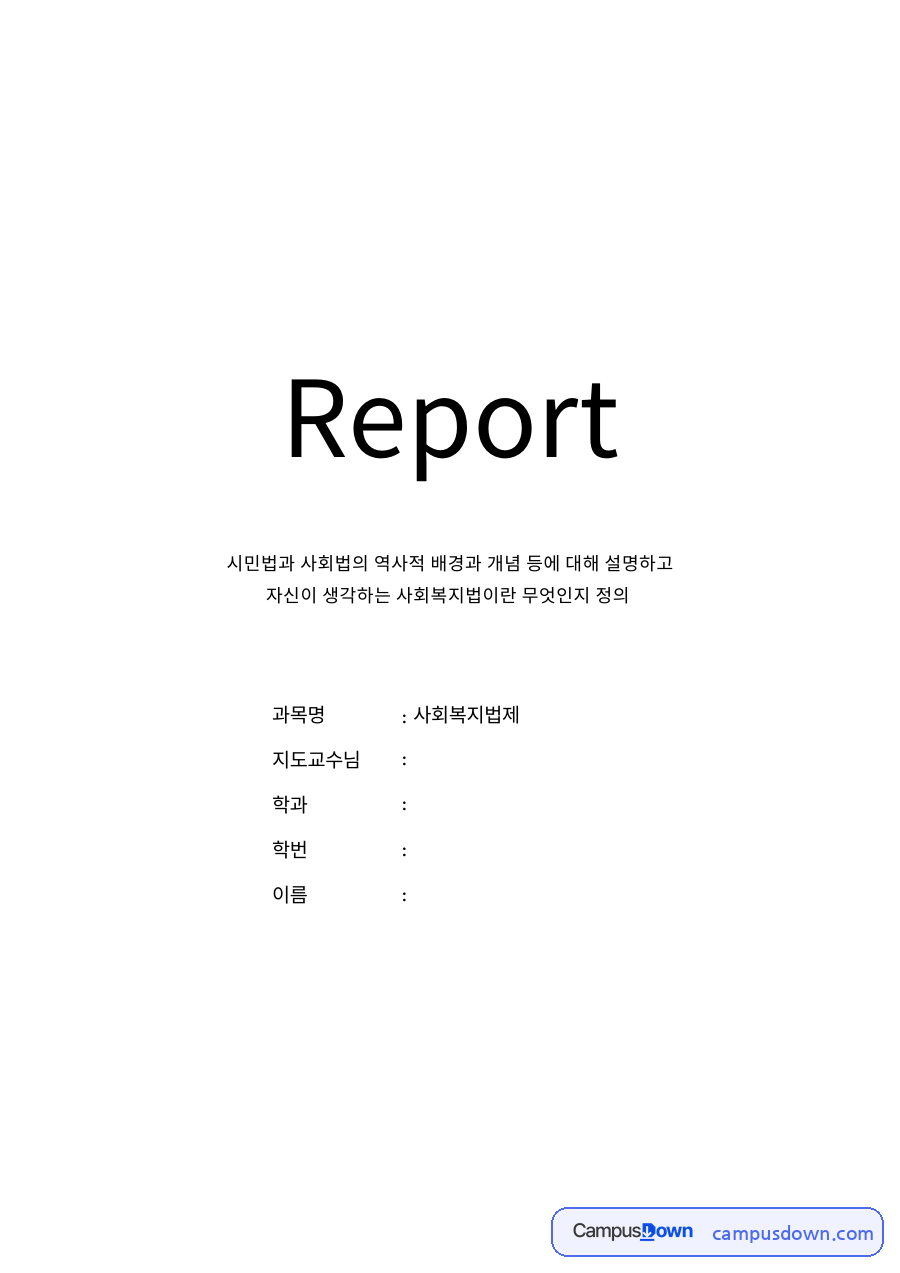
Page 1 is shown as is; from page 2 on, the preview is blurred. Buy it to download the complete original file right away (the file itself is written in Korean).
Packed with real examples and experience. Download it now and save time.
Save your valuable time
Buyer ratings
Fast, accurate and useful.
No ratings yet. Be the first to rate it.


1 / 6
좌우로 밀어서 페이지를 넘겨보세요
과제 개요
| 전체 페이지 수 | 6페이지 |
|---|---|
| 파일 형식 | 한글(HWP) |
| 등록일 | 2025.08.06 |
목차
- 1Ⅰ. 서론
- 2Ⅱ. 본론
- 2.11) 시민법의 개념 및 역사적 배경
- 2.22) 사회법의 개념 및 역사적 배경
- 3Ⅲ. 결론
- 4Ⅳ. 참고문헌
캠퍼스다운 도움말
해당 자료는 No AI 자료입니다. 인싸이트를 얻고 새롭게 가공해 보세요.
자료를 받아서 이용하면 품질이 확 올라갑니다.
- 시민법
- 사회법
- 사회복지법
- 소유권 절대의 원칙
- 계약 자유의 원칙
- 과실책임의 원칙
- 무과실책임
- 소유권의 사회성
- 사회복지법제
Civil Law and Social Law: The Three Principles of Classical Private Law, Why They Were Modified, and the Origins of Social Welfare Law in Korea
※ You can preview page 1 as is. Buy it to download the complete original file right away. The file itself is written in Korean.
■ Civil Law and Social Law: The Three Principles of Classical Private Law, Why They Were Modified, and the Origins of Social Welfare Law in Korea — Overview
A 5-page Korean social welfare law paper. It explains how civil law grew out of the bourgeois revolutions with three principles: absolute ownership, freedom of contract and fault-based liability. It then shows how capitalism exposed their limits and how social law answered with fair contracts, social limits on property and no-fault liability.
■ Civil Law and Social Law: The Three Principles of Classical Private Law, Why They Were Modified, and the Origins of Social Welfare Law in Korea — Excerpt from the original document (English translation)
The basic principles of social law fall into three: fairness of contract, the social nature of ownership and no-fault liability. First, fairness of contract: labor law emerged as social law to secure fair contracts by modifying the principle of freedom of contract, which had deepened inequality between capital and labor. Second, the social nature of ownership modifies civil law's principle of absolute ownership and means that the exercise of ownership is not an absolute freedom but must be subject to necessary limits and restraints from a social and national standpoint. Third, no-fault liability reflects a shift from the employer's fault-based liability to collective liability as the structural contradictions of capitalism and the resulting social problems deepened. Social law, which seeks to modify the principle of individual responsibility into a principle of collective responsibility, has developed mainly around social security law and social welfare services law. With the appearance of industrial accident compensation insurance law, collective liability in which employers jointly bear the burden of industrial accidents was recognized. Such collective liability means that the causes of accidents and illness lie not in individual failings but in the structure of society itself, so society must bear responsibility jointly.
In short, social law emerged by modifying the principles of civil law. One can debate whether social law is a continuation of civil law or an entirely new form of law that breaks with it. This is directly connected to the issue of how capitalist market relations and social policy relate to each other. People gradually realized that human beings who were formally equal before the law were in reality not equal at all. A capitalist who owns the means of production and a worker who has nothing but labor power can never be equal. Social law thus emerged as a modification and supplement of civil law principles. Civil law was made for freedom and equality, but with the passage of time it did not work out as its ideals intended.
To add: Bismarck's social insurance legislation in Germany in the 1880s is regarded as a leading starting point of social law modifying civil law principles, and the 1919 Weimar Constitution was the first to put social rights into a constitution. In Korea, the Labor Standards Act was enacted in 1953 and the Industrial Accident Compensation Insurance Act in 1963, and the Framework Act on Social Security set the basic principles of the social security system in 1995. Besides industrial accident insurance, no-fault liability appears in the Product Liability Act, in force since 2002, and in the operator's liability under the Compulsory Motor Vehicle Liability Security Act. The principles of good faith and prohibition of abuse of rights in Article 2 of the Civil Act also reflect the social nature of ownership.
■ Civil Law and Social Law: The Three Principles of Classical Private Law, Why They Were Modified, and the Origins of Social Welfare Law in Korea — Contents and key concepts
Why did classical civil law need social law?
✦ At a glance
- The three principles of civil law and their modification
- Structure: civil law → its limits → social law → definition
- Useful for social welfare law and intro law courses
☰ What the paper covers
- Broad and narrow welfare law
- Rise of civil law
- Three classical principles
- Limits under monopoly capitalism
- Three principles of social law
✎ From classical private law to the welfare state
Korea's Constitution protects property but lets the law limit it for the public welfare, and labor and social insurance laws modify freedom of contract.
In the U.S., the Supreme Court's Lochner era (1905) struck down labor laws under freedom of contract until West Coast Hotel v. Parrish (1937) upheld a minimum wage.
Note: the paper itself is written in Korean and discusses Korean law. This page is general study information, not legal advice.
Related wiki: Public Assistance Programs
■ Civil Law and Social Law: The Three Principles of Classical Private Law, Why They Were Modified, and the Origins of Social Welfare Law in Korea References
- 사회복지법제 (한국HRD 원격 평생 교육원)
- 노동법의 원리와 체계 (한울노동문제 연구소장, 하종강)
Keyword Prompt
전문가가 만들었어요과제를 직접 쓰는 데 도움이 되는 영어 프롬프트예요.
Tip! Prompt 에 자신의 생각을 추가해서 하면 훨씬 더 ✨ 좋습니다.
캠퍼스다운에서 레포트 받고 잘 쓰는 법 3가지, AI로 참고자료 제대로 재가공하기 →Prompt 1
I'm writing a university assignment on "시민법과 사회법의 역사적 배경과 원리: 소유권 절대·계약 자유·과실책임의 원칙과 수정, 사회복지법의 정의". Help me build an outline (introduction, 2-3 body sections, conclusion) that covers 시민법, 사회법 and 사회복지법. Don't write the paper for me - give me guiding questions for each section. My own perspective: [자신의 생각 넣는 곳] Please respond in Korean.
Prompt 2
Explain the key concepts "시민법" and "사회법" in simple terms, then show how they connect to the topic "시민법과 사회법의 역사적 배경과 원리: 소유권 절대·계약 자유·과실책임의 원칙과 수정, 사회복지법의 정의". Point out common misunderstandings students have about them. My own perspective: [자신의 생각 넣는 곳] Please respond in Korean.
Prompt 3
Suggest 3 real-world cases or examples I could analyze in an assignment on "시민법과 사회법의 역사적 배경과 원리: 소유권 절대·계약 자유·과실책임의 원칙과 수정, 사회복지법의 정의", focusing on "사회복지법". For each, tell me what I should look up and verify in official or academic sources. My own perspective: [자신의 생각 넣는 곳] Please respond in Korean.
Prompt 4
Review my draft paragraph on "시민법과 사회법의 역사적 배경과 원리: 소유권 절대·계약 자유·과실책임의 원칙과 수정, 사회복지법의 정의" (key idea: "소유권 절대의 원칙"). Give feedback on logic, evidence and clarity, and mark where I need a citation. My paragraph: [paste here] My own perspective: [자신의 생각 넣는 곳] Please respond in Korean.
Take a break with a quick personality test?
Ranked by actual participation. Results in about a minute.
Loading…
Most-read content
Loading view counts…

Campusdown is a lifelong-learning community in Korea offering study materials, information on government support, student loans and scholarships, and more. Don't miss our free resources.
Go to the Campusdown home page →Refund policy
- Change of mind / refund requested after partial use / more than 7 days after purchase
◆ Exceptions
- File errors / cannot download or open the file
◆ How to request a refund: send a 1:1 inquiry via Customer Service at the top