
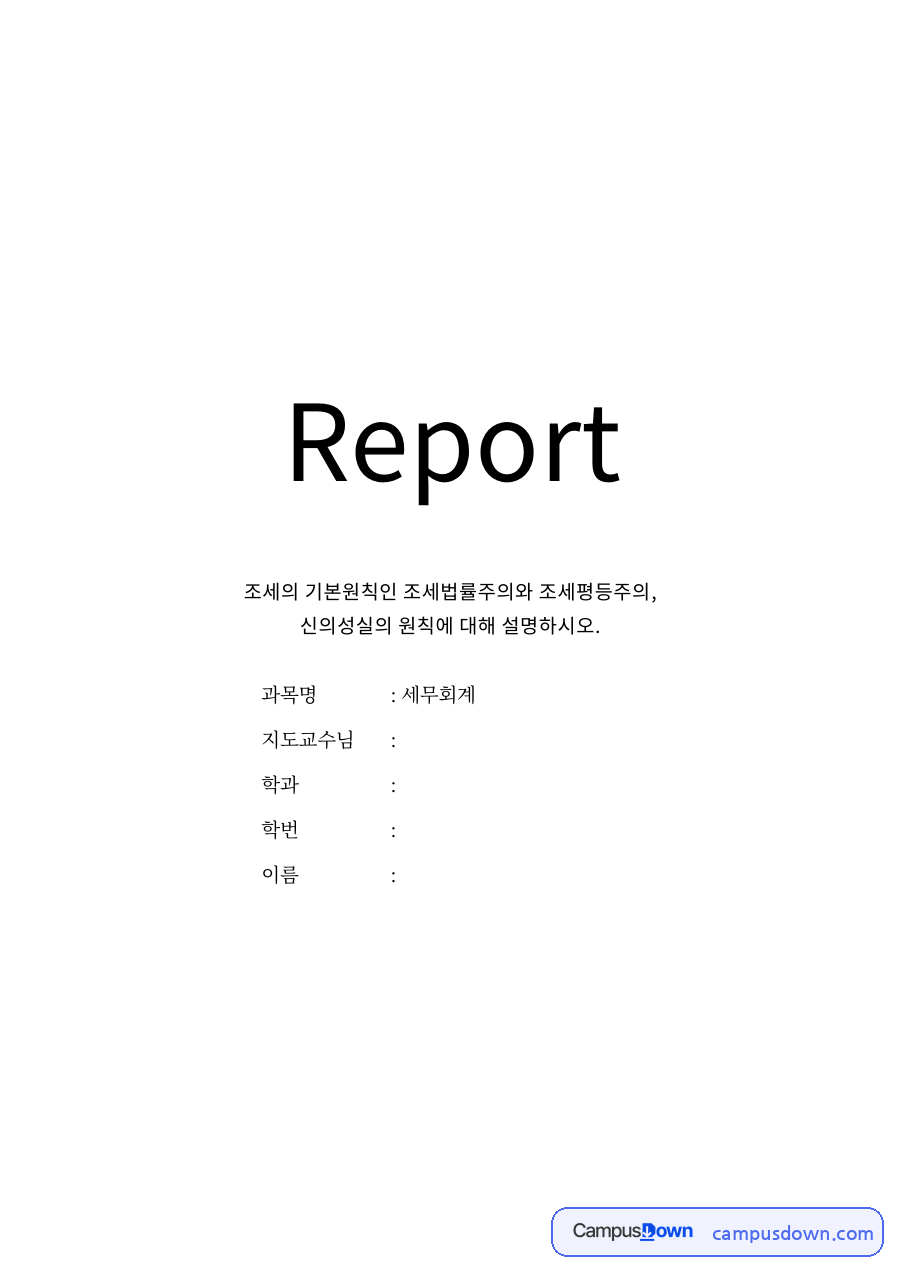
Page 1 is shown as is; from page 2 on, the preview is blurred. Buy it to download the complete original file right away (the file itself is written in Korean).
Packed with real examples and experience. Download it now and save time.
Save your valuable time
Buyer ratings
Fast, accurate and useful.
No ratings yet. Be the first to rate it.


1 / 5
좌우로 밀어서 페이지를 넘겨보세요
과제 개요
| 전체 페이지 수 | 5페이지 |
|---|---|
| 파일 형식 | 한글(HWP) |
| 등록일 | 2025.08.07 |
목차
- 1Ⅰ. 서론
- 2Ⅱ. 본론
- 2.11. 조세법률주의
- 2.22. 조세평등주의
- 2.33. 신의성실의 원칙
- 3Ⅲ. 결론
- 4Ⅳ. 참고문헌
캠퍼스다운 도움말
해당 자료는 No AI 자료입니다. 인싸이트를 얻고 새롭게 가공해 보세요.
자료를 받아서 이용하면 품질이 확 올라갑니다.
- 조세법률주의
- 조세평등주의
- 신의성실의 원칙
- 조세법
- 세법의 기본원칙
- 수평적 공평
- 수직적 공평
- 세무회계
- 국세기본법
- 세무회계 과제
Basic Principles of Korean Tax Law: No Taxation Without Law, Tax Equality, Good Faith, and Horizontal and Vertical Equity
※ You can preview page 1 as is. Buy it to download the complete original file right away. The file itself is written in Korean.
■ Basic Principles of Korean Tax Law: No Taxation Without Law, Tax Equality, Good Faith, and Horizontal and Vertical Equity — Overview
A 4-page Korean tax accounting paper on the three basic principles of tax law. It explains why taxes must rest on statute, how tax equality splits into horizontal and vertical equity, and how the good faith principle applies to both taxpayers and tax authorities.
■ Basic Principles of Korean Tax Law: No Taxation Without Law, Tax Equality, Good Faith, and Horizontal and Vertical Equity — Excerpt from the original document (English translation)
The principle of good faith means that people living together in society must act in good faith and with sincerity so as not to betray the other party's trust. Because this content is highly abstract and ethical, defining it concretely and clearly is difficult. The Customs Act states the principle of good faith by providing that ‘taxpayers shall perform their duties in good faith and with sincerity, and the same applies to customs officials in performing their duties.’
There is some debate over whether the principle of good faith applies only to the tax authorities or must be observed by taxpayers as well as the authorities, but the Customs Act requires it of both. However, considering the various adverse dispositions a taxpayer faces for acting against their own past words or conduct toward the tax authorities, the authorities' superior position, and the fact that the burden of proving that a tax disposition is lawful lies in principle with the tax authorities, the principle of good faith should be applied to taxpayers only in very limited cases and must not be interpreted broadly.
The main body examined the three basic principles of tax law: no taxation without law, tax equality and good faith. In carrying out taxation, these three basic principles need to be realized. The characteristics that tax legislation must observe include public character, administrative primacy, self-sufficiency and equality, technical and written character, and mandatory force.
To add: the constitutional basis of the principle of no taxation without law is Article 38 (duty to pay taxes) and Article 59 (types and rates of taxes are set by law), and tax equality comes from the equality principle in Article 11. The principle of good faith is written not only in Article 6 of the Customs Act but in the same words in Article 15 of the Framework Act on National Taxes, and Article 18 of that act requires tax laws to be interpreted so as not to unduly infringe taxpayers' property rights and bans retroactive taxation. The Supreme Court holds that applying the good faith principle against the tax authorities requires all of the following: an official statement of position, the taxpayer's reliance on it without fault, action taken on that reliance, and a disposition contrary to the stated position that causes the taxpayer harm.
■ Basic Principles of Korean Tax Law: No Taxation Without Law, Tax Equality, Good Faith, and Horizontal and Vertical Equity — Contents and key concepts
What principles limit how a state can tax?
✦ At a glance
- Three basic principles of Korean tax law
- Structure: tax law → statute rule → equality → good faith
- Useful for tax accounting and tax law courses
☰ What the paper covers
- What tax law covers
- No taxation without law
- Tax equality
- Horizontal and vertical equity
- Good faith principle
✎ Tax principles in Korea and the U.S.
Korea's Constitution requires the types and rates of taxes to be set by statute (Article 59), and the Framework Act on National Taxes writes the good faith duty into Article 15.
In the U.S., Article I gives Congress the power to tax, and courts limit the IRS through rules such as estoppel only in narrow cases, much as Korean courts protect taxpayers who relied on an official view.
Note: the paper itself is written in Korean and discusses Korean law. This page is general study information, not legal advice.
■ Basic Principles of Korean Tax Law: No Taxation Without Law, Tax Equality, Good Faith, and Horizontal and Vertical Equity References
- 윤재학, 조세법의 기본원칙과 조세입법의 한계에 관한 연구, 연세대학교, 2000
- 박정우 외, 조세법과 형평법의 조화, 서강대학교, 2011
- 김효신, 조세입법과 조세법률주의에 관한 연구, 숙명여자대학교, 2003
- 조재하, 조세평등주의와 상치되는 세법규정내용 고찰, 월드텍스연구회, 2007
- 류수현, 관세판례해설, 한국관세사회, 2009
- 임승준 외, 조세법, 박영사, 1999, 39p
Keyword Prompt
전문가가 만들었어요과제를 직접 쓰는 데 도움이 되는 영어 프롬프트예요.
Tip! Prompt 에 자신의 생각을 추가해서 하면 훨씬 더 ✨ 좋습니다.
캠퍼스다운에서 레포트 받고 잘 쓰는 법 3가지, AI로 참고자료 제대로 재가공하기 →Prompt 1
I'm writing a university assignment on "조세법의 기본원칙 3가지: 조세법률주의·조세평등주의·신의성실의 원칙의 의미와 수평적·수직적 공평". Help me build an outline (introduction, 2-3 body sections, conclusion) that covers 조세법률주의, 조세평등주의 and 신의성실의 원칙. Don't write the paper for me - give me guiding questions for each section. My own perspective: [자신의 생각 넣는 곳] Please respond in Korean.
Prompt 2
Explain the key concepts "조세법률주의" and "조세평등주의" in simple terms, then show how they connect to the topic "조세법의 기본원칙 3가지: 조세법률주의·조세평등주의·신의성실의 원칙의 의미와 수평적·수직적 공평". Point out common misunderstandings students have about them. My own perspective: [자신의 생각 넣는 곳] Please respond in Korean.
Prompt 3
Suggest 3 real-world cases or examples I could analyze in an assignment on "조세법의 기본원칙 3가지: 조세법률주의·조세평등주의·신의성실의 원칙의 의미와 수평적·수직적 공평", focusing on "신의성실의 원칙". For each, tell me what I should look up and verify in official or academic sources. My own perspective: [자신의 생각 넣는 곳] Please respond in Korean.
Prompt 4
Review my draft paragraph on "조세법의 기본원칙 3가지: 조세법률주의·조세평등주의·신의성실의 원칙의 의미와 수평적·수직적 공평" (key idea: "조세법"). Give feedback on logic, evidence and clarity, and mark where I need a citation. My paragraph: [paste here] My own perspective: [자신의 생각 넣는 곳] Please respond in Korean.
Take a break with a quick personality test?
Ranked by actual participation. Results in about a minute.
Loading…
Most-read content
Loading view counts…

Campusdown is a lifelong-learning community in Korea offering study materials, information on government support, student loans and scholarships, and more. Don't miss our free resources.
Go to the Campusdown home page →Refund policy
- Change of mind / refund requested after partial use / more than 7 days after purchase
◆ Exceptions
- File errors / cannot download or open the file
◆ How to request a refund: send a 1:1 inquiry via Customer Service at the top