
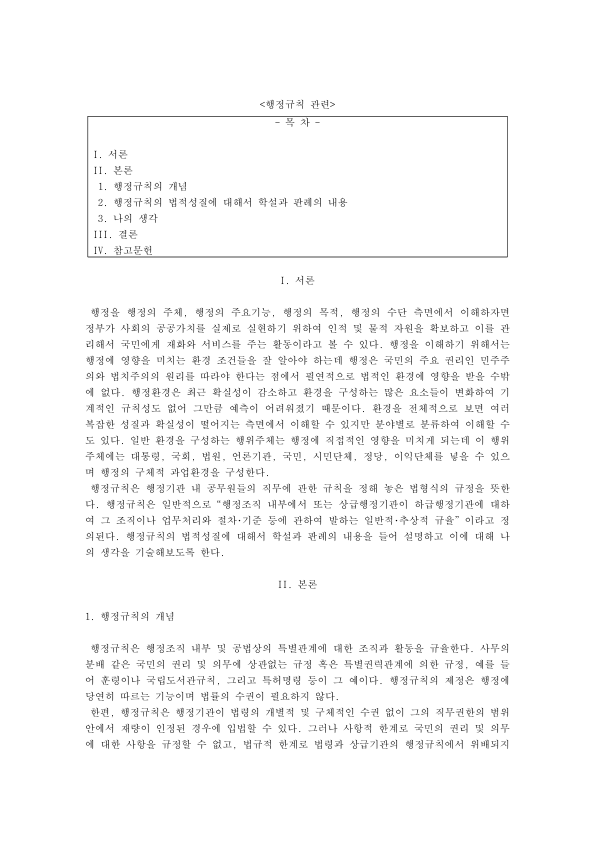
Page 1 is shown as is; from page 2 on, the preview is blurred. Buy it to download the complete original file right away (the file itself is written in Korean).
Packed with real examples and experience. Download it now and save time.
Save your valuable time
Buyer ratings
Fast, accurate and useful.
No ratings yet. Be the first to rate it.

Administrative Rules in Korea and Their Legal Effect: Internal Guidelines, Rules Supplementing Statutes, and Key Supreme Court Cases
※ You can preview page 1 as is. Buy it to download the complete original file right away. The file itself is written in Korean.
■ Administrative Rules in Korea and Their Legal Effect: Internal Guidelines, Rules Supplementing Statutes, and Key Supreme Court Cases — Overview
A 4-page Korean administrative law paper on administrative rules such as directives, notices and guidelines. It defines them, explains their limits, and reviews Supreme Court cases holding that ministerial sanction standards bind only the agency, then compares four theories of their legal nature and shows the exception for notices that supplement a statute, which bind citizens like regulations.
■ Administrative Rules in Korea and Their Legal Effect: Internal Guidelines, Rules Supplementing Statutes, and Key Supreme Court Cases — Excerpt from the original document (English translation)
An instruction (hunryeong) is an administrative order issued within an administrative organization to direct and supervise the exercise of its authority; regardless of the name used, such as training, established rule, notice, directive, public notice, or memorandum, it merely sets standards to be followed within legal relationships under public law and has no binding force externally (Supreme Court, Decision 83Nu54, June 14, 1983).
Although the above processing regulation takes the form of an administrative rule, it functions to supplement the provisions of the Enforcement Decree of the Income Tax Act and, combined with them, has the same effect as a legislative order (external binding force). Therefore, when the tax authority recognizes a transaction as a speculative transaction under item 8 above, it must go through consultation with the Fair Taxation Committee as provided in the processing regulation, and imposing capital gains tax by recognizing a transaction as a speculative transaction under item 8 without going through this procedure must be regarded as unlawful (Supreme Court, Decision 89Nu5676, November 14, 1989).
Looking at theories and case law on the legal nature of administrative rules, the character of administrative rules as legal norms has been entirely denied. Today, at least a quasi-legal character and indirect external effect are recognized for certain types of administrative rules. Unlike legal norms, administrative rules do not govern relations with the general public; they govern the organization and activities within the administrative organization and within special power relationships under public law. In some cases, administrative rules are enacted in the form of statutes and legislative orders. In other words, because administrative rules do not actually have the substance of law, they are regarded as administrative acts, but the prevailing view on their nature is the quasi-legal-norm theory. That is, as long as administrative rules are limited to internal matters of the administrative organization and have no external relevance, their character as legal norms should be recognized.
Today, in a reality where citizens depend heavily on administration and administrative discretion is broadly recognized in administrative action in each field, administrative rules in fact have a great deal of influence on people's lives.
For reference, the "My thoughts" section of the material contains a sentence saying that the legal-norm character of administrative rules should be recognized, but in context it is more natural to read it in line with the quasi-legal-norm theory: in principle administrative rules have no external binding force, and discretionary standards have indirect effect through the principle of equality and self-binding. Also, the Supreme Court treats sanction standards in the form of a ministerial ordinance as administrative rules, but treats sanction standards in the form of a presidential decree as legislative orders, so organize this distinction as well. It is also good to refer to the provisions on administrative legislation in the Framework Act on Administration enacted in 2021.
■ Administrative Rules in Korea and Their Legal Effect: Internal Guidelines, Rules Supplementing Statutes, and Key Supreme Court Cases — Contents and key concepts
Do agency guidelines bind citizens in Korea?
✦ At a glance
- Legal effect of administrative rules
- Structure: concept → cases → theories → exceptions
- Useful for administrative law courses
☰ What the paper covers
- Definition and limits
- Sanction standards as internal rules
- Four theories
- Rules that supplement statutes
- Author's view
✎ Administrative rules in Korea and the U.S.
Korean courts treat most directives and guidelines as internal, but notices that fill in details a statute delegated bind citizens like regulations.
U.S. law draws a similar line between legislative rules issued through notice and comment under 5 U.S.C. 553 and interpretive rules or policy statements, which generally lack the force of law.
Note: the paper itself is written in Korean and discusses Korean law. This page is general study information, not legal advice.
Related wiki: Legislative vs. Interpretive Rules
■ Administrative Rules in Korea and Their Legal Effect: Internal Guidelines, Rules Supplementing Statutes, and Key Supreme Court Cases References
- 전덕진. "법규명령과 행정규칙의 구별에 관한 고찰." 국내석사학위논문 경희대학교 법무대학원, 2018.
- 서울 신유리. "미국 행정법상 입법적 규칙과 비입법적 규칙의 구별에 관한 연구." 국내석사학위논문 서울대학교, 2017. 서울
Take a break with a quick personality test?
Ranked by actual participation. Results in about a minute.
Loading…
Most-read content
Loading view counts…

Campusdown is a lifelong-learning community in Korea offering study materials, information on government support, student loans and scholarships, and more. Don't miss our free resources.
Go to the Campusdown home page →Refund policy
- Change of mind / refund requested after partial use / more than 7 days after purchase
◆ Exceptions
- File errors / cannot download or open the file
◆ How to request a refund: send a 1:1 inquiry via Customer Service at the top