
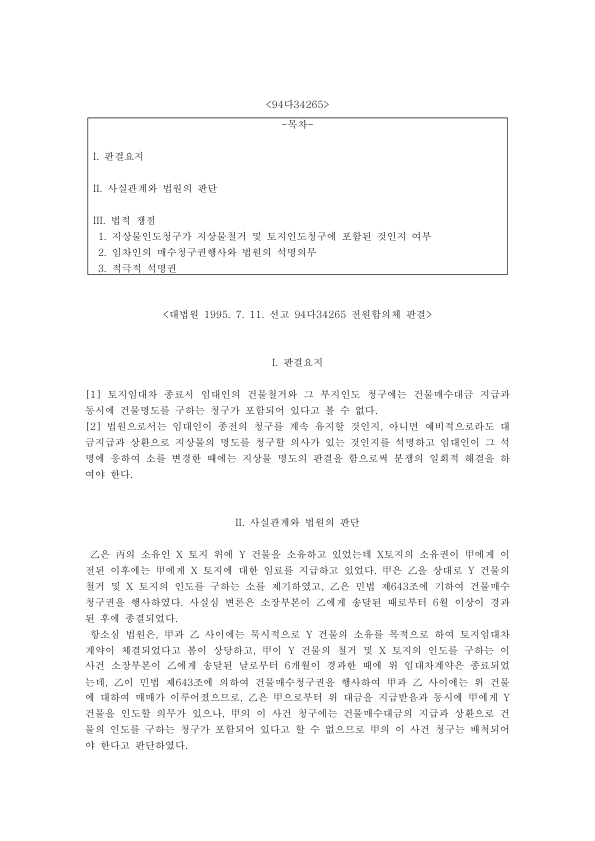
Page 1 is shown as is; from page 2 on, the preview is blurred. Buy it to download the complete original file right away (the file itself is written in Korean).
Packed with real examples and experience. Download it now and save time.
Save your valuable time
Buyer ratings
Fast, accurate and useful.
No ratings yet. Be the first to rate it.


A Ground Tenant's Right to Make the Landlord Buy the Building in Korea: Supreme Court Case 94Da34265 and the Court's Duty to Clarify Claims
※ You can preview page 1 as is. Buy it to download the complete original file right away. The file itself is written in Korean.
■ A Ground Tenant's Right to Make the Landlord Buy the Building in Korea: Supreme Court Case 94Da34265 and the Court's Duty to Clarify Claims — Overview
A 5-page Korean case comment on Supreme Court en banc Decision 94Da34265 (1995). When a landlord sued to have a building demolished after a ground lease ended and the tenant exercised the statutory right to make the landlord buy it, the Court held that the demolition claim didn't include a claim for delivery against payment, but that the trial court had to ask whether the landlord wanted to amend so the dispute could end in one suit.
■ A Ground Tenant's Right to Make the Landlord Buy the Building in Korea: Supreme Court Case 94Da34265 and the Court's Duty to Clarify Claims — Excerpt from the original document (English translation)
The debate over the court's duty to clarify (seokmyeong) centers on whether "active clarification," which is tied to the principle of party presentation, should be recognized. To address the issues of whether active clarification can be included within the scope of the "power to clarify," and whether failing to exercise active clarification can be regarded as a breach of the "duty to clarify," this paper organizes the competing views, and further examines active clarification under mandatory provisions, considering the aspect that the power to clarify is recognized in order to maintain public trust in the judiciary, so that its exercise is a kind of public-interest requirement.
One position holds that the presiding judge must exercise only passive clarification, within the framework of the litigation relationship presented by the parties, in the direction of removing any unclearness, incompleteness, or contradiction in the parties' motions and allegations on factual and legal matters, and may not go beyond that scope to engage in active clarification that encourages the submission of new motions, allegations, or means of attack and defense. By contrast, clarification that, through the exercise of the power to clarify, encourages the submission of new motions, allegations, or means of attack and defense is called active clarification.
If a party keeps maintaining its earlier motions or allegations, there are cases where that party's defeat is certain. If, in such a case, the court on its own initiative engages in active clarification and the outcome is reversed as a result, the opposing party will perceive that it received an unfair trial because of the court's active clarification. This amounts to the court taking the side of one party in an adversarial relationship and helping it win, which is also contrary to the original purpose of the power to clarify, namely maintaining substantive equality between the parties by correcting the carelessness or errors of a party ignorant of the law relative to a party versed in the law, so as to guarantee a fair procedure. Therefore, the court must exercise care and be cautious in engaging in active clarification.
Another position, placing importance on discovering the substantive truth and on the propriety of trials, expands that scope so that the court may not only suggest an amendment of the claim but also prompt the submission of new means of attack and defense such as defenses and replies to defenses, and the additional joinder of a new claim, and, in urging proof, may even go so far as to prompt the submission of specific means of evidence. At the same time, it does not allow unlimited submission of new litigation materials; rather, new materials are submitted under a standard set so as not to lose fairness toward the parties.
With regard to the parties' allegations, if, judging from the litigation materials already submitted, there are circumstances suggesting that a party intended to make a statement, then pointing this out and asking for the party's statement is acceptable, even if the matter is not clearly expressed in the oral argument. Materials from which an intended statement can be inferred include facts revealed in the results of the examination of evidence, auxiliary facts and indirect facts (as opposed to main facts) appearing in the answer and preparatory briefs, and the purpose of proof stated in documentary evidence.
For reference, according to case law, the right to demand purchase of a building is recognized when a land lease for the purpose of owning a building or the like ends upon expiry of its term and the landlord refuses to renew the contract, and it is not recognized when the lease is terminated because of the tenant's non-performance, such as arrears in rent. The right to demand purchase is a formative right, so a sale is concluded the moment it is exercised, and clarification is based on Article 136 of the Civil Procedure Act. When extending active clarification to other cases, also consider whether it infringes the parties' right of disposition and whether it causes unexpected disadvantage to the opposing party.
■ A Ground Tenant's Right to Make the Landlord Buy the Building in Korea: Supreme Court Case 94Da34265 and the Court's Duty to Clarify Claims — Contents and key concepts
What happens when a Korean landlord sues to tear down a tenant's building?
✦ At a glance
- The tenant's building purchase right
- Structure: holding → facts → three legal issues
- Useful for property and civil procedure courses
☰ What the paper covers
- Summary of the holding
- Facts and lower court ruling
- Is delivery included in demolition?
- The court's duty to clarify
- Limits of active clarification
✎ Ground leases in Korea and the U.S.
Korean Civil Act art. 643 lets a tenant who built on leased land demand that the landlord buy the building when the lease expires and renewal is refused.
U.S. ground leases usually settle this by contract, and buildings often revert to the landowner at the end of the term, so Korea's statutory right is unusually protective.
Note: the paper itself is written in Korean and discusses Korean law. This page is general study information, not legal advice.
Take a break with a quick personality test?
Ranked by actual participation. Results in about a minute.
Loading…
Most-read content
Loading view counts…

Campusdown is a lifelong-learning community in Korea offering study materials, information on government support, student loans and scholarships, and more. Don't miss our free resources.
Go to the Campusdown home page →Refund policy
- Change of mind / refund requested after partial use / more than 7 days after purchase
◆ Exceptions
- File errors / cannot download or open the file
◆ How to request a refund: send a 1:1 inquiry via Customer Service at the top