
Why Do People with Lung Cancer Experience Stigma? Smoking Blame and the Role of the Nurse
- Lung cancer is closely linked to smoking in public perception, so patients often feel blamed for their illness.
- Stigma leads to guilt, hiding symptoms and delayed help-seeking.
- Nurses can reduce it through the order and tone of their questions, non-judgemental stop-smoking support and clear screening information.
Contents
Two people can receive the same cancer diagnosis and meet very different reactions. Someone with lung cancer is often asked "Did you smoke?" before anything else, and hears blame in the question rather than sympathy. This guide looks at what lung cancer stigma is, why it matters clinically, and what nurses can do about it.

What does stigma mean?
The sociologist Erving Goffman, in Stigma (1963), described stigma as an attribute that discredits a person's social identity, reducing them "from a whole and usual person to a tainted, discounted one". Labelling theory adds that the labels society attaches can reshape how people see themselves and how they behave.
Student money tip from CampusDown Life UpHow to Find Unclaimed Money in Your Name — How to find unclaimed money in your name for free: official state databases via NAUPA and MissingMoney.com, federal searches like Treasury…
Illness stigma comes less from the disease than from how society interprets it. The more an illness is seen as the patient's own fault, the stronger the stigma tends to be. Researchers often separate three layers: enacted stigma (actual discrimination or hurtful comments), perceived or felt stigma (expecting to be judged) and internalised stigma (blaming yourself).

Why lung cancer in particular?
The link between lung cancer and smoking is so well known that patients are easily seen as having brought it on themselves. Yet people who have never smoked also develop lung cancer. Radon is the second leading cause after smoking according to the WHO, and second-hand smoke, air pollution and occupational exposures such as asbestos all contribute. These facts are far less widely known.
Research on the problem is substantial enough that dedicated measures exist: Cataldo and colleagues published the Lung Cancer Stigma Scale in Oncology Nursing Forum in 2011. Stigma hurts both groups. Former and current smokers may feel guilt and shame, while never-smokers may feel they have to keep announcing that they never smoked, as though the illness would otherwise be deserved.
Skimming the section headings first makes a long guide much easier to map out. Try writing down one question of your own as you read.
How stigma affects patients
Patients who feel stigmatised may hide symptoms or delay seeing a doctor, and some avoid telling friends or relatives, which cuts them off from support. Qualitative studies repeatedly describe patients reading reproach into a single remark from family or clinicians and then withdrawing. These experiences are associated with depression, poorer quality of life and less willingness to talk openly with the care team.
There is also a wider effect. When the public associates a cancer with self-inflicted harm, charity fundraising and public sympathy tend to be lower, and lung cancer has historically attracted less research money than its death toll would suggest. In an essay, linking the individual and societal levels shows a fuller understanding.
How nurses can communicate
Smoking history is clinically necessary, but the order and tone of questions matter. Begin with the patient's current symptoms and worries, then explain that you ask everyone about smoking because it affects treatment planning, and record the answer neutrally. Stop-smoking advice should be framed as a choice that improves treatment from now on, not as a verdict on the past. Setting aside time for the patient to talk about feelings helps a great deal.
Small changes in wording make a difference. Compare "You know smoking caused this" with "Many people with lung cancer have smoked and many haven't; either way, stopping now can help your treatment work better". The facts are the same; only one invites the patient to keep talking.
Early detection: lung screening in the UK
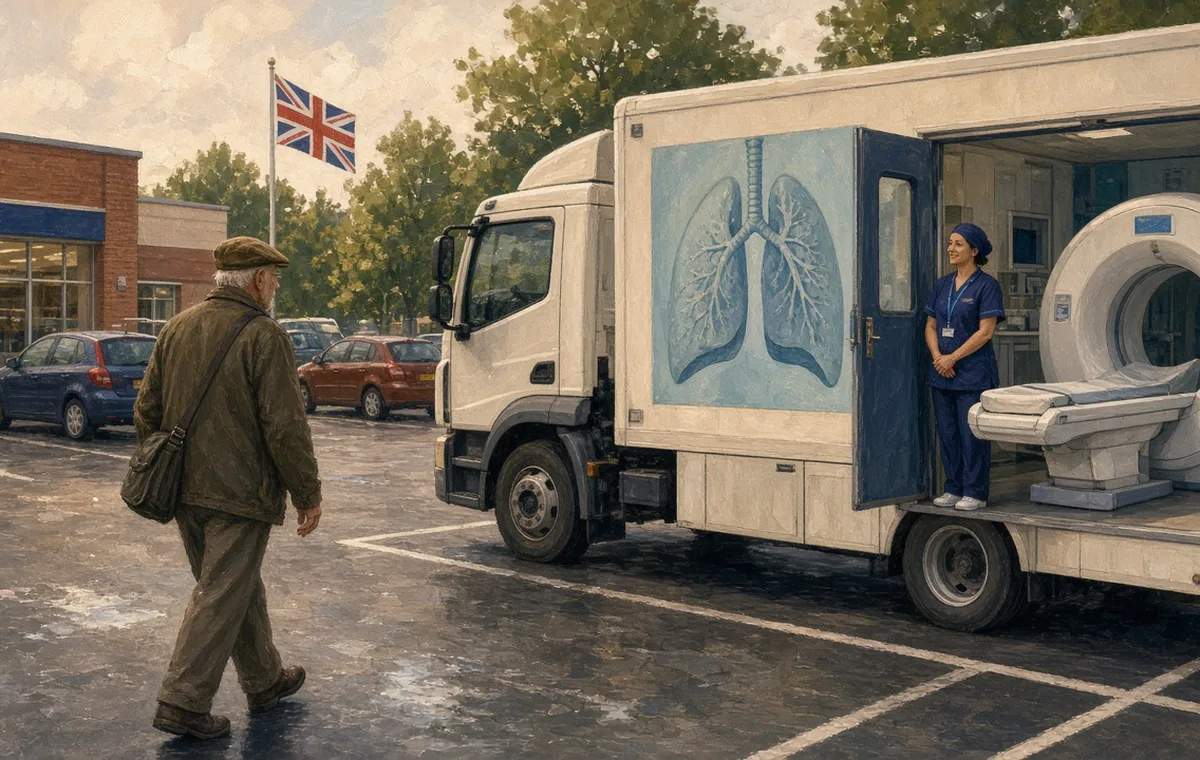
England's Targeted Lung Health Check programme invites people aged 55 to 74 who have ever smoked to a lung health check, often in mobile units parked at supermarkets or community sites. Those assessed as high risk are offered a low-dose CT scan. In 2023 the government announced that this would become a national lung screening programme. Low-dose CT finds small nodules better than a standard chest X-ray while keeping radiation exposure down.
A nodule on the scan does not mean cancer. Most are benign or need only follow-up imaging, depending on size and shape. Explaining before and after the scan how results are interpreted, including the possibility of false positives, eases a great deal of anxiety. People also need to give accurate smoking histories, because hiding them can affect eligibility and interpretation. Helping people not to avoid screening out of fear of being judged is part of nursing.
Talking about stopping smoking
Lecturing and blaming are the things to avoid. "You should have quit years ago" leaves only guilt and weakens the motivation to change. Motivational interviewing, developed by William Miller and Stephen Rollnick, asks what the person thinks about smoking and helps them voice their own reasons for change. In the NHS, Very Brief Advice follows three steps: ask about smoking, advise that the best way to stop is with support, and act by offering a referral to a local stop smoking service.
| Stage | What the patient says | A helpful response |
|---|---|---|
| Precontemplation | "It's too late now anyway" | Share, without pressure, that stopping still helps treatment and wound healing |
| Contemplation | "I know I should, but…" | Explore the pros and cons together |
| Preparation | "I want to try next week" | Agree a quit date and arrange medication or patches |
| Action and maintenance | "It's been ten days" | Praise progress and plan for difficult moments |
Readiness can be judged with the stages of change model: precontemplation, contemplation, preparation, action and maintenance. Pushing someone in precontemplation to set a quit date tends to provoke resistance; a question such as "What, if anything, would make you think about stopping?" fits that stage better.
Breathing and emotional support
Patients often say anxiety rises whenever they are breathless. Breathing and anxiety feed each other, so pulmonary rehabilitation teaches slow pursed-lip and diaphragmatic breathing. Calmer breathing reduces anxiety, which in turn makes breathing easier.

Emotional support is part of treatment. A nurse who makes it clear that being ill is not the patient's fault, whatever the cause, makes it much safer for them to express how they feel. Where needed, refer to peer support groups, specialist lung cancer nurses or psychological services; charities such as the Roy Castle Lung Cancer Foundation run campaigns specifically against lung cancer stigma.
Reducing stigma lets patients ask for help earlier and more honestly. Changing the first question from "Did you smoke?" to "What's been hardest for you lately?" changes the whole atmosphere of the conversation. For revision, the CampusDown nursing notes on communication skills pair well with this topic.
A short case to use in assignments
A man in his sixties was told at a lung health check that his scan showed a nodule, and for three months he did not attend the follow-up appointment. When a nurse phoned to ask why, he said, "I've smoked for forty years. I know exactly what they're going to say." The nurse began by acknowledging how frightening the wait must have been, explained that most nodules turn out not to be cancer, and said that his smoking history mattered only because it helped the team choose the right next step. She added that stopping now would also help with any treatment. He booked the appointment that afternoon.
Student money tip on CampusDown Life Up: How to Find Unclaimed Money in Your Name.
The case works well in a reflective essay because it shows each layer of stigma at once: the felt stigma that made him expect judgement, the internalised blame in his words, and a response that removed the threat without avoiding the facts. Gibbs' reflective cycle or a similar model gives you a structure for analysing what the nurse did and why it worked.
Reviewed by the CampusDown editorial team, November 2026. Sources: Goffman E. (1963), Stigma: Notes on the Management of Spoiled Identity; Cataldo J. K. et al. (2011), Measuring stigma in people with lung cancer, Oncology Nursing Forum 38(1); Miller W. R. & Rollnick S., Motivational Interviewing; NHS England, Targeted Lung Health Check programme; WHO, radon and health.
FAQ
Which book defined the concept of stigma?
Erving Goffman's Stigma: Notes on the Management of Spoiled Identity (1963).
Do only smokers get lung cancer?
No. People who have never smoked can develop it too; radon, second-hand smoke, air pollution and workplace exposures are recognised risk factors.
What test is used for lung screening?
A low-dose CT scan of the chest, which finds small nodules better than a standard chest X-ray.
How should a nurse ask about smoking?
Ask about current symptoms and worries first, then explain that smoking history is needed for treatment planning and ask without judgement.