
Why Does Keynes Return in Every Financial Crisis? His Life, Books and Ideas from the New Deal to 2008, COVID and the UK Gilt Crisis
- Keynes argued that savings and investment do not line up automatically, so demand can stay too low for years.
- His ideas shaped the New Deal era and returned in the 2008 TARP and ARRA package and the 2020 CARES Act and UK furlough scheme.
- The 2022 UK gilt crisis shows the limits: stimulus without spare capacity or credibility can backfire.
Contents
When Lehman Brothers collapsed in September 2008 and governments around the world scrambled to spend, why did commentators from Washington to Westminster suddenly start quoting an economist who had been dead for more than sixty years? John Maynard Keynes was the Cambridge thinker who answered the Great Depression with a new way of doing economics. This guide walks through his life and books, the core idea that split him from the classical school, and why his name returns, sometimes as hero and sometimes as villain, every time a financial crisis hits the US or the UK.
Why does Keynes come back every crisis?
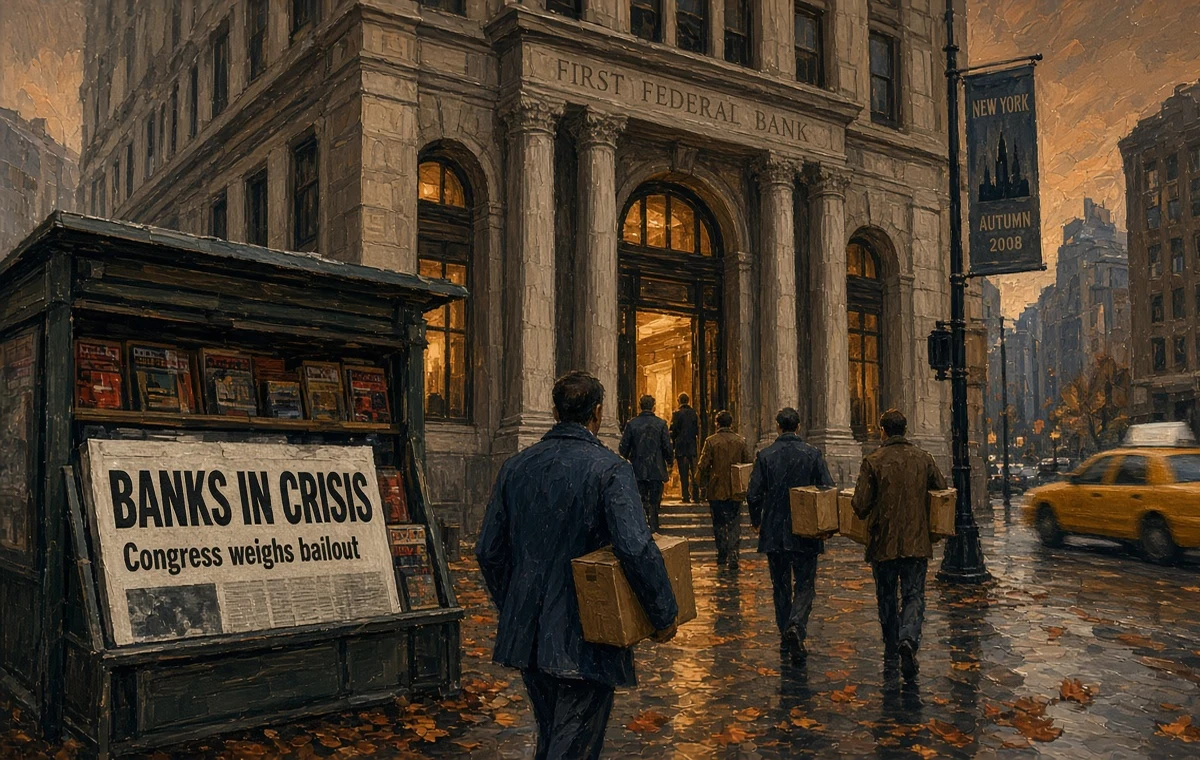
The 2008 crisis started with the unexpected bankruptcy of a single US investment bank and spread through global markets within weeks. In November 2008 President George W. Bush hosted the first G20 leaders' summit in Washington, turning what had been a finance ministers' forum into the world's main crisis committee. Because the downturn was synchronised across countries and far deeper than an ordinary recession, it was compared again and again with the 1930s.
Then came the policy response, and it was openly Keynesian. In the US, the Emergency Economic Stabilization Act created the $700 billion Troubled Asset Relief Program (TARP) in October 2008 to stabilise banks, and in February 2009 Congress passed the American Recovery and Reinvestment Act (ARRA), a stimulus of roughly $787 billion in tax cuts, infrastructure and aid to states. In the UK, Gordon Brown's government recapitalised the banks and temporarily cut VAT from 17.5% to 15% to keep shoppers spending. Twelve years later COVID-19 brought the same playbook on an even larger scale: the US CARES Act of March 2020 (about $2.2 trillion) and Britain's Coronavirus Job Retention Scheme, the "furlough" scheme that paid 80% of wages up to £2,500 a month so that firms would keep workers on the books.
The lesson students often miss is that Keynes is not a magic word. Markets today are tightly integrated, so a policy designed for a single closed national economy in the 1930s cannot simply be copied. Britain learned that the hard way in September 2022, when the "mini-budget" announced around £45 billion of unfunded tax cuts at a time of high inflation. Gilt yields spiked, pension funds using liability-driven investment strategies faced margin calls, and the Bank of England had to launch emergency bond purchases. Within weeks the Chancellor and then the Prime Minister were gone. Keynes argued for spending when demand collapses, not for borrowing regardless of inflation and credibility.
What path did Keynes take, from Cambridge to Bretton Woods?
Keynes was born in Cambridge in 1883, studied mathematics at King's College, and moved in the Bloomsbury Group alongside Virginia Woolf and Lytton Strachey. That mix of rigorous academia, artistic London and high politics shaped a thinker who cared more about solving real problems than about tidy models.
| Year | What happened | Why it matters |
|---|---|---|
| 1913 | First book, Indian Currency and Finance, defending India's gold-exchange standard and the case for a discretionary central bank | Early sign that he saw money as something to be managed |
| 1915 to 1919 | Leaves Cambridge for HM Treasury during the First World War, handling war finance, currency and foreign negotiations | Learns policy from the inside |
| 1919 | Attends the Paris Peace Conference as the Treasury's chief representative, resigns in protest and writes The Economic Consequences of the Peace | Becomes a public celebrity |
| 1931 | Publishes Essays in Persuasion | Revisits his own past arguments |
| 1936 | The General Theory of Employment, Interest and Money | Founds modern macroeconomics |
| 1944 | Leads the British delegation at Bretton Woods, New Hampshire | Helps design the IMF and World Bank |
He began as an academic, but war put him in the room where real policy was designed and negotiated. That experience goes a long way toward explaining why his theory focuses so stubbornly on practical crises. He died in 1946, shortly after negotiating a vital US loan to a nearly bankrupt Britain.
Skimming the section headings first makes a long guide much easier to map out. Try writing down one question of your own as you read.
How did Keynes differ from the classical economists?
Classical economists believed that if people saved more, interest rates would fall and businesses would automatically invest those savings, so the economy would drift back to full employment by itself. Keynes argued that in a money economy there is no mechanism that guarantees savings and investment line up. Firms invest based on expected profits, which depend on fragile expectations, while interest rates are shaped by the demand to hold money. When the two diverge, demand can stay too low for years. This is the heart of effective demand theory.
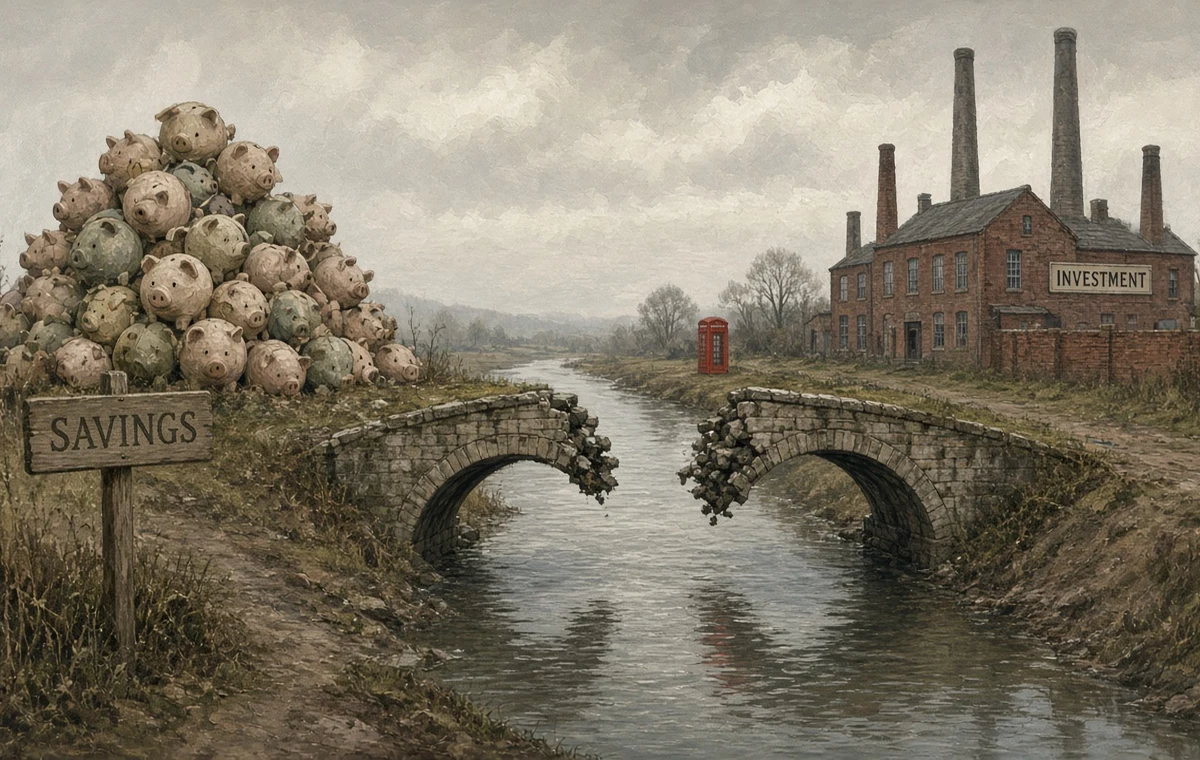
That leads to a famous puzzle, the paradox of thrift. If every household tightens its belt in a recession, total spending falls, incomes fall, and in the end the country may save no more than before. It is why Keynesians argue that government should spend when the private sector will not, and why the 2010 UK austerity programme under David Cameron and George Osborne became such a fierce debate among British economists.
Which ideas did he leave behind?
- Effective demand: output and jobs are driven by total spending, not just by supply
- Liquidity preference: people want to hold cash, especially when uncertain
- Interest rates and the money supply: why cutting rates may not work when everyone hoards cash (the liquidity trap)
- Marginal efficiency of capital: investment depends on expected returns
- The savings-investment gap
- The multiplier: a pound or dollar of public investment can raise national income by more than one
These concepts became the professional core of modern macroeconomics, the toolkit that central bankers at the Federal Reserve and the Bank of England still use, even when they disagree with Keynes's conclusions. Our overview of Keynesian economics shows how those ideas evolved after his death.
The practical takeaway for students is simple: whenever a commentator says "the government should step in" during a downturn, they are borrowing from this toolkit, whether or not they mention Keynes by name, and whenever a critic warns about deficits and inflation, they are usually drawing on the classical and monetarist replies.
What is Essays in Persuasion about?
Essays in Persuasion collects twelve years of Keynes's economic journalism and pamphlets. Writing after the Depression began, he revisited his earlier positions, explained where he had been wrong, and argued for a wiser way out of national crisis. It includes his 1930 essay "Economic Possibilities for our Grandchildren", which predicted a fifteen-hour working week. Keynes is often credited with the line "When the facts change, I change my mind", although historians have never found it in his writings. Even so, the willingness to revise his views is exactly why policymakers keep reaching for his methods.
Beyond the textbook: five ideas that make your essay stand out
The Economic Consequences of the Peace (1919). Keynes warned that crushing reparations on Germany would wreck the whole European economy. The book made him famous and showed his habit of treating economics as inseparable from politics and diplomacy.
The beauty contest. In the General Theory he compared stock-picking to a newspaper competition where you win by choosing not the face you find prettiest, but the one you think others will choose. It is still the go-to metaphor for bubbles, from the dot-com boom to meme stocks such as GameStop in 2021.
Animal spirits. Investment decisions are driven less by careful calculation than by confidence, optimism and fear. The phrase was revived by George Akerlof and Robert Shiller in their 2009 book Animal Spirits, linking Keynes to behavioural economics.
Keynes versus Hayek, and then Friedman. In the 1930s Friedrich Hayek at the London School of Economics argued that government intervention distorts prices and prolongs slumps. From the 1960s, Milton Friedman and the Chicago monetarists argued that money supply, not fiscal stimulus, drives inflation and output. The stagflation of the 1970s and the Thatcher and Reagan years gave their side the upper hand, until 2008 swung the pendulum back.
The IS-LM model. In 1937 John Hicks condensed the General Theory into two curves for the goods and money markets. It became the staple of undergraduate macro, though critics say it flattened Keynes's emphasis on uncertainty.
| Crisis | US response | UK response | Keynesian reading |
|---|---|---|---|
| 1930s Depression | New Deal public works (from 1933) | Leaves the gold standard (1931), cheap money | Demand had collapsed and needed support |
| 2008 financial crisis | TARP and ARRA | Bank recapitalisation, temporary VAT cut | Classic counter-cyclical stimulus |
| 2020 COVID-19 | CARES Act, stimulus cheques | Furlough scheme | Protect incomes to protect demand |
| 2022 inflation shock | Fed raises rates rapidly | Mini-budget triggers gilt crisis | Stimulus without slack or credibility backfires |
To finish an essay on Keynes, split his legacy into the ideas he left and the debates around them. Then you can present him not as an economist who handed us final answers, but as someone whose questions we reopen every time the economy breaks.
Further reading: Skidelsky, R. (2003). John Maynard Keynes 1883 to 1946: Economist, Philosopher, Statesman. Macmillan. Policy figures are rounded and cited for study purposes; check official sources for the latest data.
FAQ
What was Keynes's first book?
Indian Currency and Finance, published in 1913, which defended India's gold-exchange standard and argued for a discretionary central bank.
What role did Keynes play at the Paris Peace Conference?
He attended in 1919 as the chief representative of the British Treasury, resigned over the harsh reparations imposed on Germany, and wrote The Economic Consequences of the Peace.
Were TARP and ARRA Keynesian policies?
ARRA, the 2009 stimulus of roughly $787 billion, was a classic Keynesian fiscal stimulus. TARP was mainly a bank rescue to stabilise the financial system, which Keynesians saw as a precondition for restoring demand.
Does the 2022 UK gilt crisis prove Keynes wrong?
Not really. Keynes argued for stimulus when demand collapses and resources sit idle. The 2022 mini-budget added unfunded tax cuts during high inflation, which markets judged not credible.
How did Keynes differ from Hayek and Friedman?
Keynes argued government should support demand in a slump. Hayek warned intervention distorts prices, and Friedman's monetarism stressed controlling the money supply rather than fiscal stimulus.